


Industry 4.0 increases the pace of technological change and raises the bar for workforce competencies. A Digital Skills Passport (DSP) is a structured, digital record of an employee’s verified skills, certifications and experience. For Mittelstand companies, manufacturers, and automotive suppliers, a DSP makes skills visible, accelerates redeployment, and reduces downtime caused by skill gaps.
What is a Digital Skills Passport?
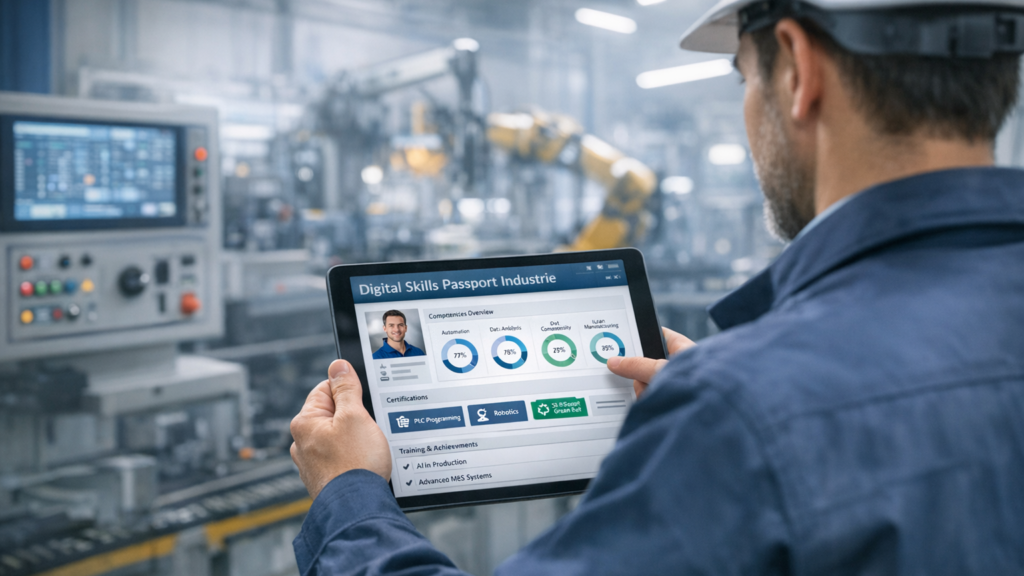
A Digital Skills Passport is a centralized, machine-readable profile that documents an individual’s hard and soft skills, certifications, training history and assessment results. Core components include:
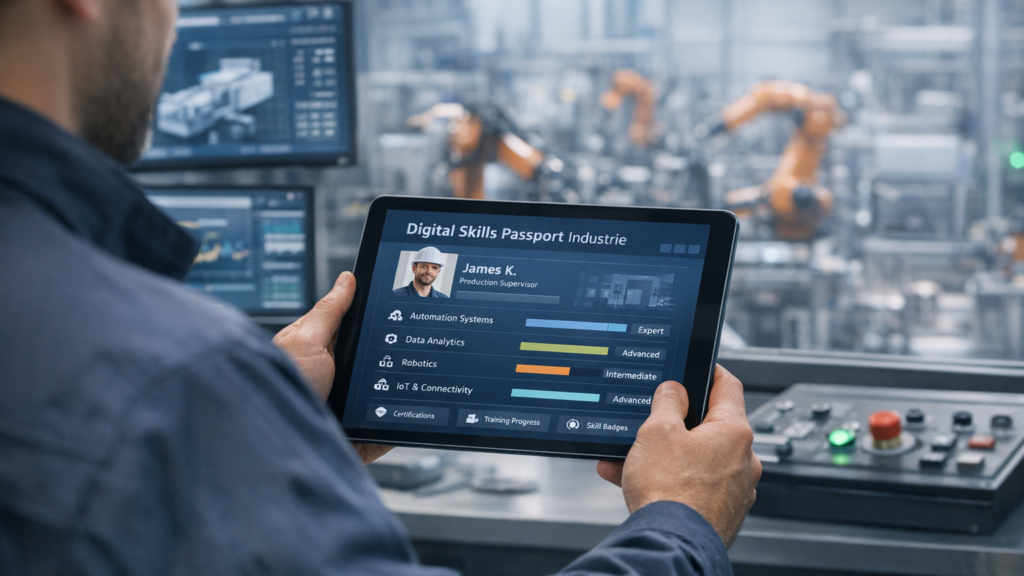
- Skills taxonomy aligned to company roles and Industry 4.0 technologies (e.g., PLC programming, robotics maintenance, digital twin operation).
- Proof elements: certificates, assessment scores, time-stamped endorsements and training records.
- Interoperability layer: APIs or export formats to share profiles with HR systems, LMS, ERP and shop-floor scheduling tools.
- Governance model: rules for verification, data ownership and update frequency.
Benefits for Mittelstand and Industrial Companies
- Faster deployment: Match qualified staff to tasks or shifts without manual skills checks.
- Reduced downtime: Identify and fill critical skill gaps proactively.
- Targeted reskilling: Use aggregated skills data to design training programs that matter.
- Compliance and traceability: Keep auditable certification records for regulated processes.
- Workforce resilience: Enable multi-skilling and internal mobility, especially important for supply chain shocks.
How to Implement a Digital Skills Passport — Practical Steps
- Define the skills taxonomy: Start with core roles and Industry 4.0 capabilities; keep it extensible.
- Map existing data sources: HR profiles, LMS completions, certification bodies, shop-floor assessments.
- Choose verification rules: Who approves a skill? Which proofs are acceptable? How often to revalidate?
- Integrate systems: Connect the DSP to HRIS, LMS and operational systems so data flows automatically.
- Pilot with one plant or department: Validate processes, data quality and user experience before scaling.
- Govern and iterate: Assign owners, review KPIs and refine taxonomy and verification over time.
Technical and Operational Requirements
Key technical and operational considerations include:
- Data model: Support structured skill records, evidence attachments and timestamping.
- Security & privacy: Role-based access, encryption at rest and in transit, and consent mechanisms for personal data.
- APIs and export formats: Ensure compatibility with HR and MES/ERP systems.
- User experience: Simple mobile-first interface for shop-floor staff to update and present credentials.
- Governance: Clear ownership, update cycles and dispute resolution for contested records.
Integrations: Where the DSP Adds Most Value
Integrate the Digital Skills Passport with these systems to unlock operational impact:
- HRIS for promotion, succession and payroll alignment.
- LMS for targeted training based on identified gaps.
- MES/Maintenance systems to assign certified technicians to critical tasks.
- Recruiting platforms to compare external candidate skills with internal profiles.
Measurement: KPIs and Continuous Improvement
Track measurable outcomes to prove ROI:
- Time-to-deploy qualified personnel per task
- Reduction in unplanned downtime linked to skill shortages
- Training completion rates and time-to-competency
- Internal mobility rate for critical roles
- Percentage of verified skills vs. self-declared skills
Common Challenges and How to Mitigate Them
- Data fragmentation: Mitigate by prioritizing integrations and a canonical data model.
- User adoption: Involve shop-floor supervisors early, keep updates simple and incentivize participation.
- Verification trust: Use multi-source evidence and manager or third-party endorsements.
- Scale governance: Start with a tight pilot governance model and expand roles as you scale.
Next Steps: Pilot Checklist
Run a focused pilot to de-risk rollout:
- Select one plant or line and define 6–10 critical skills to track.
- Map data sources and import an initial cohort of profiles.
- Define verification rules and appoint verifiers.
- Measure baseline KPIs and set improvement targets.
- Collect user feedback and iterate before scaling to other sites.
For Mittelstand and larger industrial companies, a Digital Skills Passport is a practical instrument to make workforce capabilities visible and actionable. When combined with targeted training and systems integration, it turns workforce data into competitive advantage for Industry 4.0.
FAQ
What is the difference between a Digital Skills Passport and a traditional HR record?
A Digital Skills Passport focuses on verified, granular skills and evidence (assessments, certifications) and is designed for interoperability with operational systems. Traditional HR records often list job titles and tenure but lack machine-readable skill detail and evidence.
How long does it take to deploy a pilot DSP?
A focused pilot can be deployed in 3–6 months depending on data readiness and integration scope. Keep scope small: limited skills set, one plant and a defined verification process.
Can a DSP help with compliance in regulated industries?
Yes. By storing time-stamped certifications and verifications, a DSP provides auditable records that support regulatory and safety compliance.
How do you ensure data privacy and employee consent?
Implement role-based access controls, data minimization, encryption and clear consent workflows. Define who can view, edit and share records and document retention policies.