


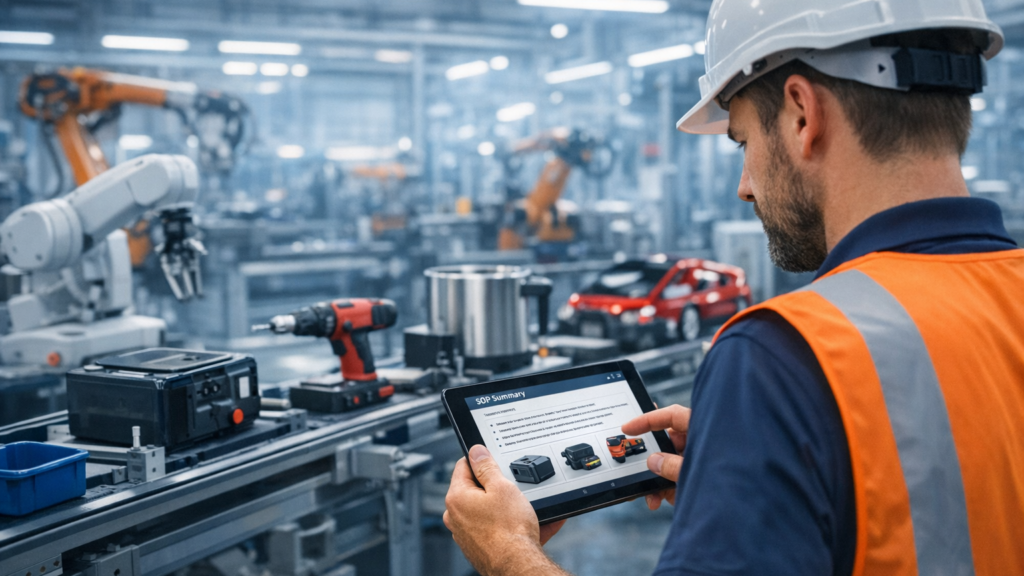

Manufacturing, automotive and other industrial organisations depend on clear Standard Operating Procedures (SOPs) and correct handling of product variants. Yet SOPs grow long, variants multiply, and human onboarding stays slow. Generative AI can bridge that gap by producing concise SOP summaries, extracting critical steps and decision points, and generating variant-aware instructions tailored to role and context.
Key capabilities of generative AI in this context include:
- Summarizing long SOPs into short, role-specific checklists and step-overviews.
- Identifying variant-dependent steps and producing variant-specific instructions or decision rules.
- Mapping SOP content to shop-floor systems (MES, PLM) and learning systems (LMS) for consistent training and execution.
- Highlighting compliance-relevant items and change-history that affect operations.
For the mid-market and large-scale manufacturers, these capabilities translate into measurable operational benefits:

- Faster onboarding: New operators receive concise, task-focused instructions instead of reading entire manuals. That reduces training time and initial performance variability.
- Fewer errors: Variant-aware instructions prevent common mistakes caused by wrong component or process choices.
- Consistent execution: Auto-generated checklists and prompts make processes repeatable across shifts and sites.
- Improved compliance: Summaries flag mandatory steps and record which SOP version was used, supporting audits.
Implementation differs by organisation size and complexity. Small and mid-sized manufacturers benefit most from quick win pilots that focus on high-impact SOPs (assembly, safety checks, quality gates). Enterprises and automotive OEMs usually require tighter integration with PLM/PDM and variant management systems to ensure instructions reflect engineering changes and option configurations.
Best practices for adoption:
- Start with prioritized SOPs: Choose processes that are frequent, error-prone, or costly when executed incorrectly.
- Use human-in-the-loop workflows: Subject-matter experts validate generated summaries and variant logic before deployment.
- Keep the source of truth: Maintain canonical SOP documents and version control; AI outputs should be traceable to their source.
- Integrate with existing systems: Feed AI outputs to MES, LMS, or digital work instruction platforms so operators see context-aware steps where they work.
- Define clear governance: Establish roles for approval, retraining, and revalidation after engineering changes.
Measure impact with practical KPIs: time-to-competence for new hires, first-pass yield improvements, reduction in process deviations, and audit findings related to SOP compliance. Pilot projects that track these metrics produce clear ROI signals for broader rollout.
For manufacturing and automotive teams that need a tested approach, learn how generative AI can standardize work instructions and SOPs in production environments by exploring our service details and use cases:
Generative AI for standardized work instructions and SOPs
Carefully designed pilots, validated by operators and integrated with engineering systems, unlock the real value of generative AI: faster onboarding, fewer errors, and consistent, auditable operations. The path is iterative—start small, prove impact, then scale.
Weiterfuehrende Inhalte
FAQ
Which SOPs should we prioritize for an AI summarization pilot?
Start with SOPs that are high-frequency, error-prone, or safety-critical—assembly sequences, changeover procedures, quality inspections, and machine-start/stop checklists. These deliver measurable returns on reduced errors and faster onboarding.
How do we ensure AI-generated instructions remain compliant?
Keep canonical SOPs in a versioned repository and require human sign-off before publishing AI-generated summaries. Log the source document version and reviewer approvals to maintain auditability.
Can generative AI handle complex product variants?
Yes—when integrated with variant and engineering data (PLM/PLM configurations), AI can produce variant-aware steps or decision rules. Accuracy improves when the model has access to structured variant parameters and subject-matter review.
What are common risks and how do we mitigate them?
Risks include hallucinated steps, stale information after engineering changes, and overreliance on AI without validation. Mitigate by using human-in-the-loop review, source-traceability, change-triggered revalidation, and incremental rollouts.
Ready to reduce onboarding time and avoid variant-related errors? Learn how our generative AI solutions standardize work instructions and SOPs for manufacturing and automotive operations.