

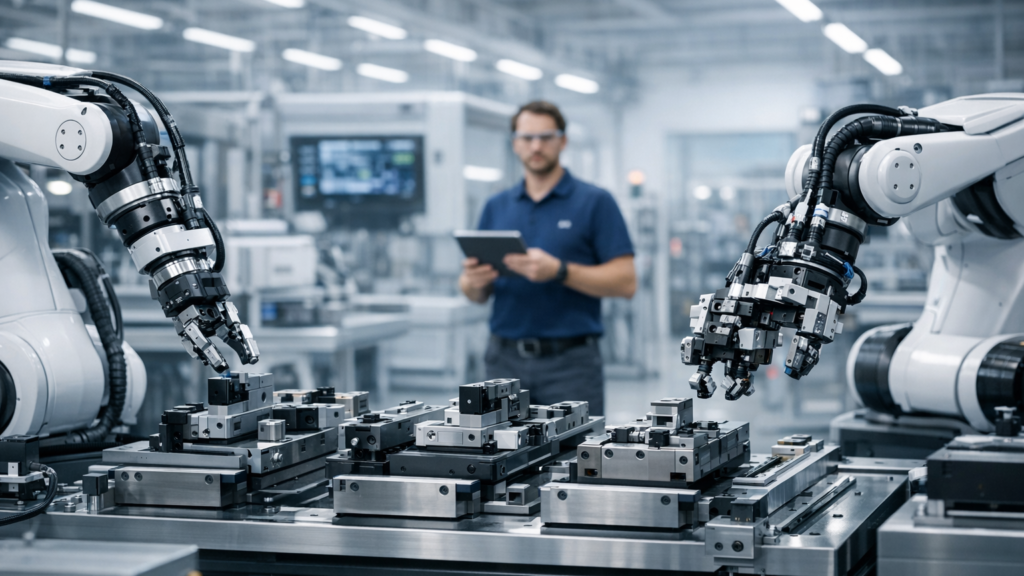

Zero‑Touch Changeover refers to changeover processes that require no human intervention at the machine during the critical setup phase. It is the logical extension of SMED (Single Minute Exchange of Die) into an autonomous, digitized form that automates mechanical adjustments, tooling swaps, parameter loading, and verification. For manufacturers—from mid‑market to enterprise and automotive suppliers—Zero‑Touch Changeover reduces downtime, stabilizes quality, and raises overall equipment effectiveness (OEE).
What is Zero‑Touch Changeover and Autonomous SMED?
Traditional SMED focuses on separating internal and external setup tasks and streamlining manual steps to achieve quick changeovers. Zero‑Touch Changeover builds on that by leveraging automation, controls integration, sensors, and software orchestration so that key setup actions happen without an operator at the machine. The result: repeatable, fast, and safe changeovers that are less dependent on skilled labor.
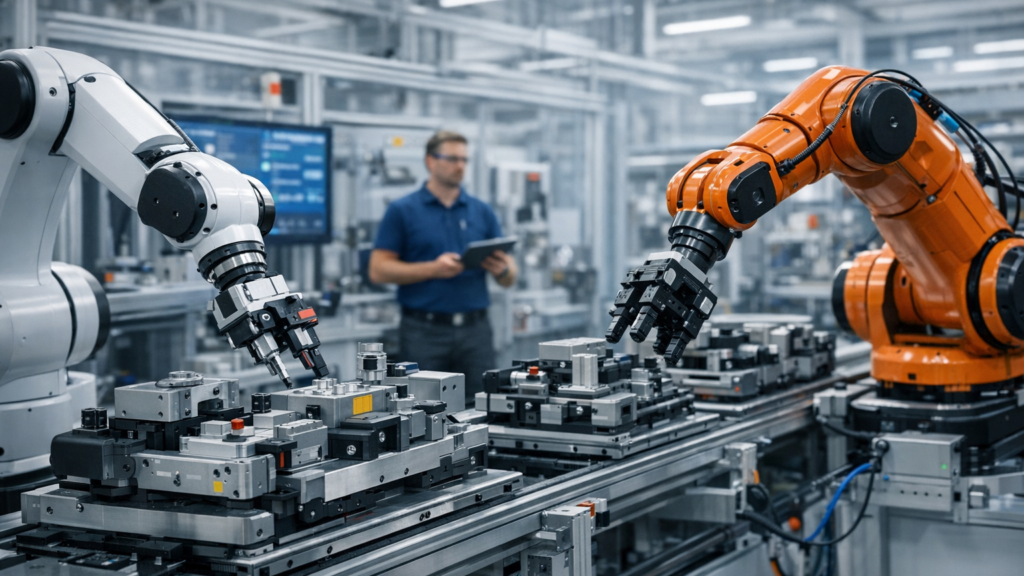
Why Zero‑Touch Changeover matters for industry and automotive
- Higher machine availability: Faster, repeatable changeovers increase productive run time and reduce lost cycles.
- Quality consistency: Automated parameter loading and verification reduce setup variation and scrap after changeover.
- Labour efficiency: Operators shift from manual setup to supervision, exception handling, and higher‑value tasks.
- Flexibility for mixed production: Supports shorter runs and faster SKU transitions typical in automotive tiers and discrete manufacturing.
Key components and technologies
- Standardized modular tooling: Tooling designed for quick mechanical coupling and automated recognition.
- Actuation and servo systems: Motorized clamps, guided actuators, and automated positioning replace manual adjustments.
- Integrated controls and PLCs: Centralized logic sequences that orchestrate instruments, robotics, and I/O during changeover.
- Digital twins and recipe management: Software stores validated setup recipes and deploys them automatically to the machine.
- Sensors and verification: Vision systems, proximity sensors, and torque sensors confirm proper setup before production starts.
- Connectivity and MES/SCADA integration: Changeover events, status, and KPIs feed higher‑level systems for planning and analytics.
A practical implementation roadmap
- Baseline and process mapping: Document current changeover steps, durations, variability, and root causes of delays.
- Apply SMED principles: Separate external/internal tasks, eliminate waste, and standardize procedures as the foundation.
- Identify automation candidates: Target repeatable, time‑consuming, and safety‑sensitive tasks for mechanization first.
- Develop modular tooling and recipes: Design quick‑couple fixtures and digital recipes for parameterization.
- Integrate controls and verification: Implement PLC sequences, sensors, and safety interlocks to ensure reliable, autonomous sequences.
- Pilot and measure: Run pilots on critical lines, capture changeover times, first‑pass yield, and touch time to validate ROI.
- Scale and continuous improvement: Roll out to other lines using lessons learned and maintain recipe/version control.
Metrics to measure success
- Changeover time (minutes): Average time from last good part to first good part after changeover.
- Touch time: Operator minutes required per changeover (aim for zero or near zero).
- OEE improvement: Availability gains attributable to reduced setup time.
- First‑pass yield post‑changeover: Quality stability immediately after setup.
- Mean time between changeovers: Frequency and scheduling efficiency for production runs.
Common challenges and mitigation
- Legacy equipment: Retrofit with modular adapters and external automation cells where full integration is impractical.
- Recipe complexity: Simplify and standardize parameter sets; keep a validated baseline and controlled revisions.
- Workforce transition: Invest in training—operators become supervisors and exception managers rather than manual adjusters.
- Safety and compliance: Ensure interlocks, guarded zones, and validation steps are part of the autonomous sequence.
- Upfront cost and ROI clarity: Prioritize lines with highest downtime cost and calculate payback from incremental OEE gains.
Services and support model
A practical services model for Zero‑Touch Changeover includes:
- Process assessment and baseline SMED consulting
- Mechanical design for modular tooling and retrofit kits
- Controls engineering, sequencing, and PLC integration
- Recipe management, digital twin validation, and software commissioning
- Operator training, maintenance handover, and continuous improvement coaching
Deliverables should include clear acceptance criteria: validated changeover time, zero‑touch target met, safety validations, and documented ROI assumptions.
Short case example
A mid‑market automotive supplier reduced average changeover from 45 to 6 minutes by standardizing tooling, automating clamp actuation, and deploying recipe‑based parameter loading. Touch time per changeover dropped to under one minute (visual checks only). The result: a measurable 8 percentage‑point lift in availability on the pilot line and faster ability to accept shorter production runs.
Next steps
Start with a focused line pilot: map current changeovers, target the highest‑impact tasks for automation, and define clear KPIs. Use a staged approach—SMED first, then incremental automation and controls integration—to manage cost and risk while delivering measurable uptime gains.
FAQ
Is Zero‑Touch Changeover suitable for small and medium manufacturers?
Yes. By prioritizing high‑downtime lines and using modular retrofits, SMEs can achieve significant uptime improvements with manageable investment. Begin with SMED and small automation steps.
How long does a typical Zero‑Touch pilot take?
A focused pilot—from assessment through commissioning—typically takes 8–16 weeks depending on complexity and integration needs.
What safety considerations are required?
Safety requires validated interlocks, guarded zones, controlled access during automated sequences, and formal safety assessments integrated into the design and commissioning process.
Can legacy machines be part of a Zero‑Touch strategy?
Yes. Retrofit kits, external automation stations, and recipe managers can enable many legacy assets to participate without full replacement.
Ready to reduce setup time and increase equipment availability? Contact our services team to scope a Zero‑Touch Changeover pilot, define KPIs, and estimate ROI. We provide assessment, tooling design, controls integration, and operator training to get you to autonomous setups.