


Introduction: Why Lean Management matters for the Mittelstand

Mittelstand companies—small and medium-sized enterprises that are the backbone of many economies—need efficient, resilient operations to stay competitive. Lean Management provides a practical, proven approach to reduce waste, improve quality, shorten lead times, and increase customer focus without heavy upfront investment. This article explains Lean in plain terms, shows concrete advantages for mid-sized businesses, and gives an actionable roadmap to get started.
What is Lean Management? Core principles explained
Lean Management is a systematic method for creating more value with fewer resources by identifying and eliminating waste across processes. Originating from the Toyota Production System, Lean applies to manufacturing, services, and administrative processes. The core principles are:
- Value: Define value from the customer’s perspective.
- Value stream: Map end-to-end processes to see how value flows and where waste occurs.
- Flow: Design processes so work moves smoothly without delays or bottlenecks.
- Pull: Produce only what the customer needs, when they need it.
- Perfection: Pursue continuous improvement (Kaizen) to reduce defects and variation.
How Lean differs from other operational approaches
Unlike one-off cost-cutting or technology-only initiatives, Lean is people-centered and focused on process behavior. It emphasizes small, frequent improvements driven by teams who do the work. This makes Lean especially effective in Mittelstand firms where employee knowledge and flexibility are strategic assets.
Concrete benefits for mid-sized companies (Mittelstand)
Here are measurable advantages Mittelstand organizations typically achieve with Lean:
- Cost reduction: Less inventory, fewer defects, and more efficient use of resources reduce direct and hidden costs. For practical cost-reduction methods, see our article on cost reduction techniques: Cost Reduction.
- Shorter lead times and faster delivery: Streamlined flow and pull systems reduce cycle time, improving on-time delivery and customer satisfaction.
- Higher quality and fewer defects: Built-in quality methods (e.g., poka-yoke, standardized work) reduce rework and warranty costs.
- Better capacity utilization: Standardized processes and demand-driven production increase throughput without always requiring new hires or capital expenses.
- Improved employee engagement: Empowering teams to solve problems increases motivation and reduces turnover—critical for specialized Mittelstand labor pools.
- Scalable operational excellence: Lean creates a repeatable improvement culture that scales across sites and functions. For manufacturing examples and case studies, see our Lean Manufacturing series: Lean Manufacturing.
- Operational resilience: Lean reduces complexity and increases visibility, which helps companies respond faster to disruptions.
Practical first steps for implementing Lean
- Start with a focused pilot: Choose a process with clear customer impact and measurable baseline metrics (e.g., order-to-delivery lead time).
- Map the value stream: Document current-state flow, identify waste (transportation, waiting, overproduction, defects, etc.), and calculate lead time vs. value-added time.
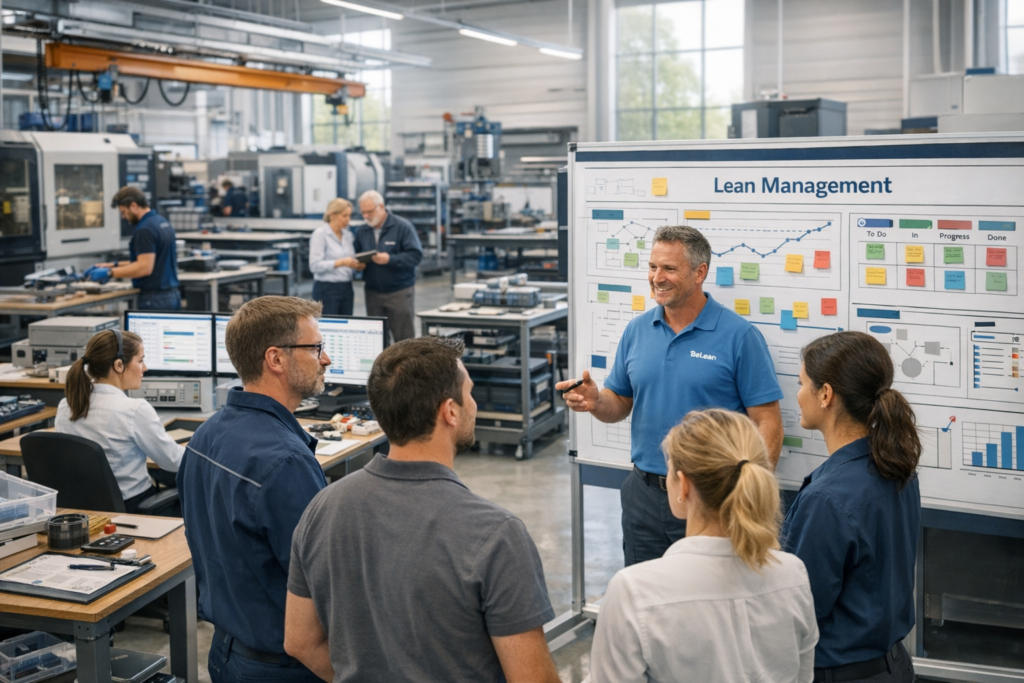
- Engage teams and train key tools: Teach basic Lean tools—5S, visual management, standardized work, Kaizen events—and involve frontline employees in problem-solving.
- Implement simple pull and leveling mechanisms: Use kanban or order-based pull to align production with real demand.
- Measure and iterate: Use a small set of KPIs (lead time, first-pass yield, inventory turns, on-time delivery) and run rapid improvement cycles.
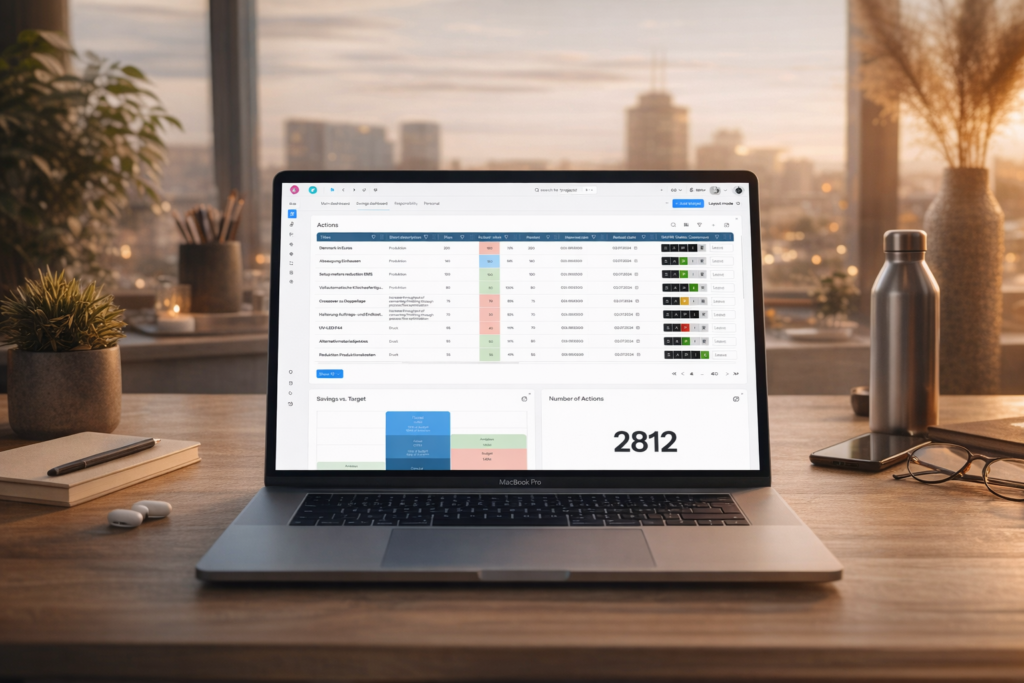
Digital tools can accelerate adoption—mobile apps and dashboards make data visible and enable faster Kaizen. Learn more about OPEX (operational excellence) tools and apps that help teams adopt and sustain Lean: OPEX App.
Common challenges and how to overcome them
- Change resistance: Overcome it by involving employees early, celebrating quick wins, and linking improvements to daily work.
- Short-term focus: Avoid one-off cuts by tracking both financial and operational KPIs and by committing to ongoing Kaizen.
- Insufficient training: Provide hands-on coaching and simple playbooks rather than long theoretical courses.
- Fragmented data: Use visual management and simple digital dashboards to create a single source of truth for process performance.
Measuring success: KPIs and continuous improvement
Track a few leading and lagging indicators tailored to your pilot area. Typical KPIs include:
- Lead time / cycle time
- First-pass yield / defect rate
- On-time delivery
- Inventory turns
- Improvement rate (e.g., number of Kaizen events and resulting time/cost savings)
Define targets, review performance weekly, and maintain a visual board for accountability. Continuous improvement is a journey—small consistent gains compound into significant competitive advantage for Mittelstand companies.
Resources and next steps
To go deeper, download our practical whitepaper that walks through implementation steps and a road map tailored to mid-sized firms: Download the Whitepaper. Explore related insights on Lean manufacturing, OPEX tools, and cost reduction in the links above.
If you want help designing a pilot or selecting the right tools, our services combine Lean expertise with practical digital solutions to accelerate results. Learn more and request a consultation on our services page.
FAQ
Is Lean Management only for manufacturing companies?
No. While Lean originated in manufacturing, its principles—reducing waste, improving flow, and focusing on customer value—apply to services, administration, supply chain, and product development as well.
How long does it take to see results from Lean?
You can typically see measurable improvements (reduced lead time, fewer defects) within weeks of a focused pilot. Cultural change and broad rollout take longer—several months to years—depending on scope and commitment.
What is the best first project for a Mittelstand company?
Choose a process with clear customer impact and measurable metrics, such as order-to-delivery, high-rework production lines, or a high-cost administrative process (e.g., procurement). Small, visible wins build momentum.
Do we need expensive software to do Lean?
No. Many Lean improvements start with simple, low-cost interventions (5S, visual boards, kanban). Software and apps can accelerate scaling and data visibility but are not mandatory for initial success.
Ready to start a Lean pilot?
Download our practical whitepaper with step-by-step guidance for Mittelstand companies: Get the whitepaper.
Want hands-on support? Explore our services and request a consultation to design a pilot that delivers measurable cost reduction and faster delivery: Lean Manufacturing Insights • OPEX App • Cost Reduction.