

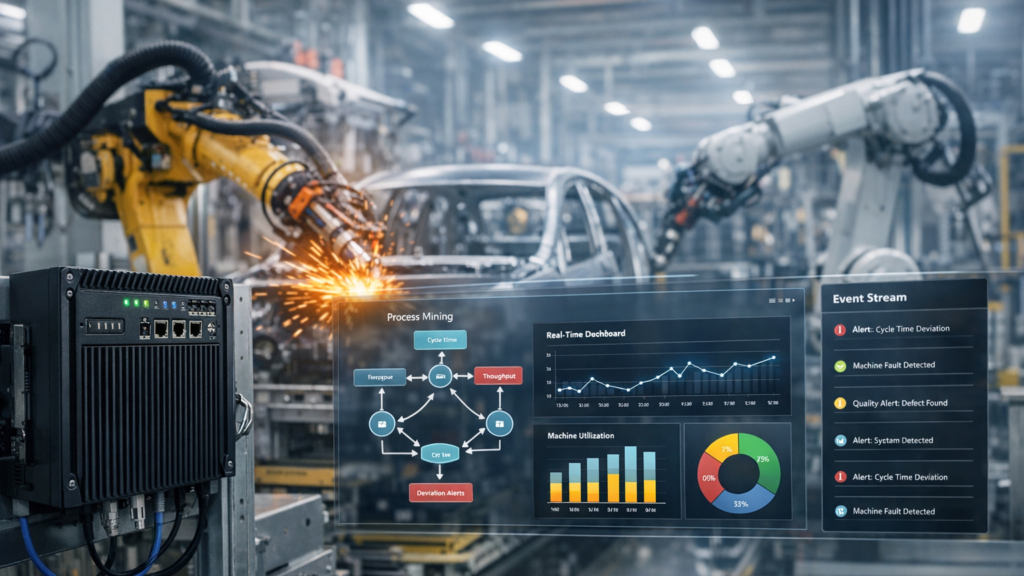

Edge-native process mining brings process discovery and conformance analysis to the place where value is created: the manufacturing cell. Instead of routing raw machine and event data to a central cloud for delayed analysis, edge-native approaches perform core processing locally at or near the shop floor. The result is lower latency, reduced bandwidth use, improved privacy, and the ability to act on insights in seconds rather than hours.
What is edge-native process mining?
Edge-native process mining runs the data ingestion, event correlation, and initial analytics on edge devices—PLC gateways, industrial PCs, or local edge servers—close to machines and robots. Only aggregated results, exceptions, or selectively filtered datasets are forwarded to higher-level systems. This preserves the core capabilities of process mining (process discovery, variant analysis, conformance checking, root-cause correlation) but optimized for the constraints and priorities of industrial environments.
Why it matters for mid-market manufacturers and enterprises
- Real-time detection: Identify deviations and bottlenecks while a batch or cycle is still in production.
- Reduced operational risk: Keep sensitive production data local to meet security and IP protection needs.
- Resilience: Maintain analytics during network outages or limited connectivity.
- Cost efficiency: Lower cloud ingress costs by transmitting only distilled insights.
Key benefits
Edge-native process mining typically delivers:
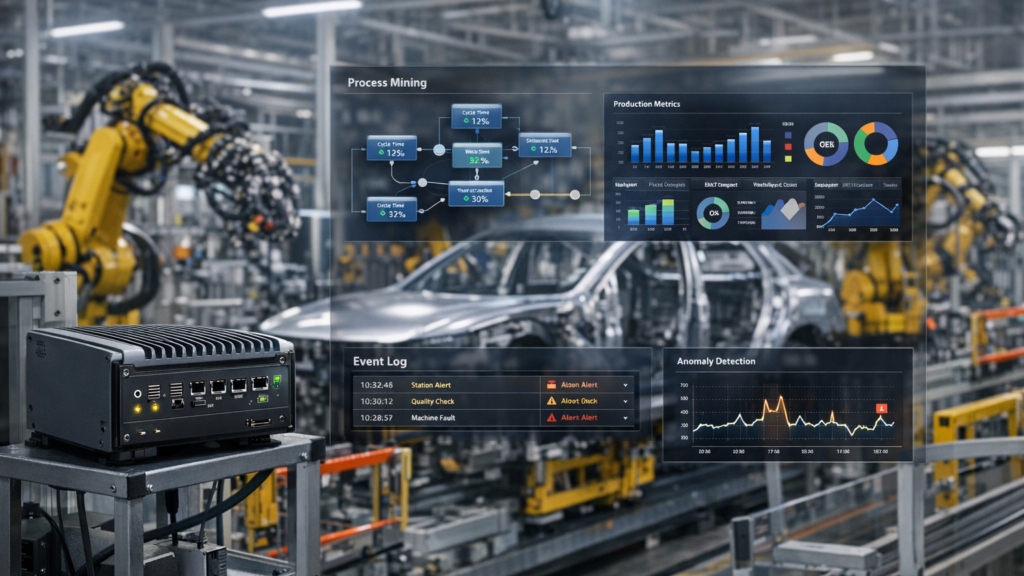
- Sub-second to second-level latency for alerts and decision support.
- Faster root-cause analysis by combining event sequences with contextual sensor data at the edge.
- Bandwidth savings through local aggregation, sampling, and event filtering.
- Improved data governance because raw data can remain on-premise.
How edge-native differs from cloud-first approaches
Cloud-first process mining centralizes heavy analytics in remote data centers. That works well for historical, enterprise-wide trend analysis but can be too slow or costly for cell-level interventions. Edge-native complements cloud analytics by handling time-sensitive tasks locally while still supporting aggregated, strategic reporting in central systems.
Typical architecture and components
A practical edge-native solution includes:
- Data adapters at PLCs, OPC-UA servers, or IIoT gateways to capture events and timestamps.
- Lightweight local processors that normalize, correlate, and enrich events into process-aware traces.
- On-edge analytics modules for variant detection, conformance checks, and anomaly scoring.
- Secure transport for selected summaries, alerts, and KPIs to MES, ERP, or cloud analytics.
Implementation checklist for factories
- Map critical processes and cell-level events you need to monitor.
- Assess existing edge hardware or plan modest upgrades (industrial PCs, gateways).
- Define data retention, aggregation, and transmission policies for compliance and cost control.
- Deploy on-edge collectors, validate event fidelity, and run parallel tests with historical data.
- Integrate alerting and local control loops to enable automatic corrective actions where appropriate.
Data privacy, latency, and reliability
Manufacturers often prioritize keeping proprietary cycle data on-premise. Edge-native process mining supports this by enabling local storage and processing. From a reliability perspective, decentralized analytics reduces single points of failure—if connectivity drops, the edge continues to detect anomalies and buffer summaries for later sync.
KPIs and business cases
Common KPIs to track with edge-native process mining include:
- Cycle time variability and trend by machine or cell
- First-pass yield and defect location frequency
- Mean time to detect (MTTD) process deviations
- Reduction in unplanned downtime and scrap percentage
Practical use cases: automated quality gate detection, immediate deviation alerts during critical cycle phases, on-cell predictive maintenance triggers, and rapid feedback loops for line balancing.
Common challenges and mitigations
- Data quality: Start with a small set of well-defined event sources and iteratively expand.
- Edge resource limits: Offload heavy historical analytics to central systems; keep edge tasks lightweight and deterministic.
- Integration complexity: Use standard industrial protocols (OPC-UA, MQTT) and clear data schemas.
- Operational change management: Train operators on actionable alerts and tie analytics to existing workflows.
Next steps
Begin with a pilot focused on a high-impact cell or bottleneck. Validate event capture, on-edge processing, and the value of the real-time alerts. Use pilot results to scale across lines and integrate with MES/ERP for enterprise-level insights.
Edge-native process mining is not a replacement for centralized process intelligence—it is a strategic extension that brings speed, privacy, and resilience to where production actually happens.
FAQ
Which manufacturing systems are suitable for edge-native process mining?
Any environment with digitized event streams—PLCs, machines with timestamped logs, IIoT sensors, or OPC-UA-capable devices—can adopt edge-native process mining. Start where events are already reliable and add adapters for missing sources.
Will edge-native analytics replace cloud process mining?
No. Edge-native and cloud analytics are complementary. Edge handles time-critical, low-latency tasks and privacy-sensitive data; cloud systems handle large-scale historical analytics, cross-site correlation, and long-term trend modeling.
How quickly can I see ROI from an edge-native pilot?
Many organizations realize measurable improvements in hours-to-weeks for cycle-time detection and minutes-to-months for quality or downtime reduction, depending on scope and maturity of data capture.
Ready to evaluate edge-native process mining on your production line? Contact our team to discuss a targeted pilot and technical requirements.