

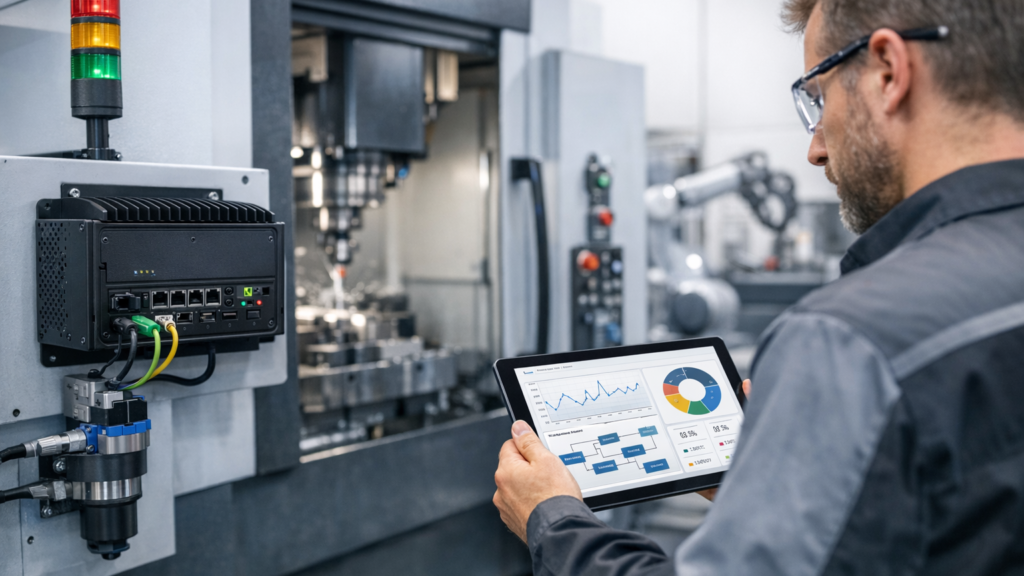

Edge-native process mining moves analysis from centralized servers to the shop floor: algorithms run near or on machines to produce actionable, low-latency insights where operations actually happen. For mid-market manufacturers, industrial firms, automotive suppliers and large enterprises, this approach shortens the time between signal and corrective action — from minutes or hours to seconds.
What makes a solution “edge-native”?
An edge-native implementation places data capture, preprocessing and core analytics at or near the production cell. Typical characteristics:
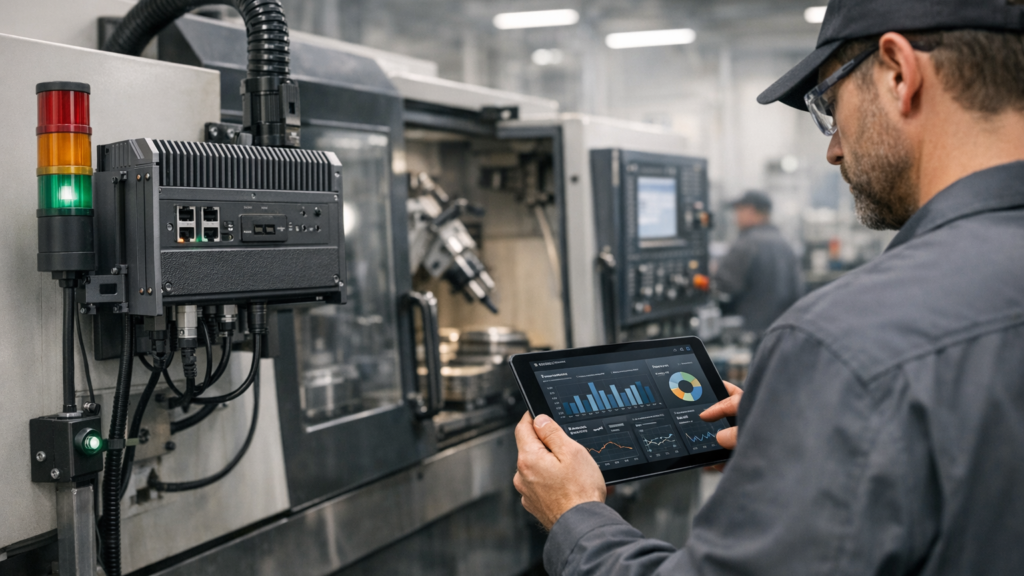
- Local event collection from PLCs, sensors and machine controllers.
- On-device preprocessing to filter, normalize and aggregate events.
- Lightweight process mining engines or inference models running on edge gateways or industrial PCs.
- Selective cloud synchronization for historical analysis, model updates and enterprise reporting.
Why manufacturers need real-time, on-edge insights
Manufacturing environments demand low latency and high availability. Network outages, bandwidth limits and strict data residency requirements make centralized-only analytics impractical. Edge-native process mining addresses these constraints by:
- Delivering near-instant detection of deviations and anomalies at the cell level.
- Reducing unnecessary data transfer by filtering and aggregating locally.
- Maintaining operations even when connectivity to cloud or on-prem servers is interrupted.
Key benefits for mid-market, industrial and automotive companies
- Faster root-cause identification: trace process deviations to the specific machine or step in seconds.
- Reduced downtime: trigger local corrective actions or operator alerts immediately.
- Improved OEE and cycle time: identify bottlenecks and waste within the actual process flow.
- Data minimization and compliance: keep raw, high-volume sensor data local and share only aggregated events.
- Scalable deployment: roll out analytics across multiple cells without saturating network resources.
How edge-native process mining works on the shop floor
At a high level, a typical edge-native process mining architecture includes:
- Event sourcing: capture discrete events from PLCs, MES, sensors and machine vision systems.
- Edge preprocessing: normalize timestamps, map signals to process steps, and filter noise.
- Local mining and monitoring: run process discovery, conformance checks and anomaly detection locally.
- Action layer: trigger OPC-UA commands, operator HMI alerts or local scripts when conditions are met.
- Federated reporting: send summarized metrics and selected traces to central systems for trend analysis and auditing.
Implementation steps for manufacturing organizations
Deployments succeed when they integrate clearly with operations and prioritize measurable outcomes:
- Start with a pilot: pick a single line or cell with clear KPIs (scrap rate, cycle time, downtime).
- Map events to process steps: work with operators and engineers to define meaningful events and state transitions.
- Deploy edge nodes: install gateways or industrial PCs close to equipment and configure secure data flows.
- Define local actions: decide which automated responses or operator prompts are allowed at the edge.
- Establish synchronization policies: determine what, when and how aggregated data is sent to central systems.
- Measure and iterate: monitor KPIs, refine event mappings and adjust alerts to reduce false positives.
Data, privacy and integration considerations
Edge-native approaches change the balance between local and central control. Practical considerations:
- Security: secure edge devices with hardened OS, device authentication and encrypted transport.
- Data governance: document what data stays local versus what is shared for analytics and compliance.
- Interoperability: use standard industrial protocols (OPC-UA, MQTT) and map to MES/ERP event models where possible.
Operational KPIs and measurable outcomes
Use specific metrics to evaluate value:
- Mean time to detect anomalies (MTTD) and mean time to repair (MTTR).
- Reduction in unplanned downtime (minutes or hours per week).
- Improvement in cycle time consistency and first-pass yield.
- Network bandwidth savings through local preprocessing and aggregation.
Common challenges and how to mitigate them
- False positives: tune detection thresholds and involve operators in validation.
- Edge resource limits: choose lightweight algorithms and offload heavy training to central systems.
- Change management: train maintenance and production teams on new alerts and workflows.
Next steps: adopting edge-native process mining
Begin with a clearly scoped pilot, focus on measurable KPIs, and plan for secure, scalable edge deployments. Edge-native process mining is not a replacement for enterprise analytics; it complements central systems by providing the real-time, operational decision layer that manufacturing needs.
FAQ
Which manufacturing sites benefit most from edge-native process mining?
Sites with frequent network constraints, strict latency requirements, or high volumes of sensor data—such as assembly lines, machining cells and test benches—gain the most immediate value.
Does edge-native process mining require replacing existing MES or PLC systems?
No. The usual approach integrates with existing PLCs and MES via standard interfaces, collecting events without replacing core control systems.
How do I measure success after deployment?
Define baseline KPIs before the pilot (downtime, cycle time, yield). Measure changes in MTTD/MTTR, reductions in downtime, and improvements in cycle consistency after the system is live.
Ready to evaluate edge-native process mining for your production floor? Contact our team to discuss a pilot scoped to your KPIs and operational constraints.