

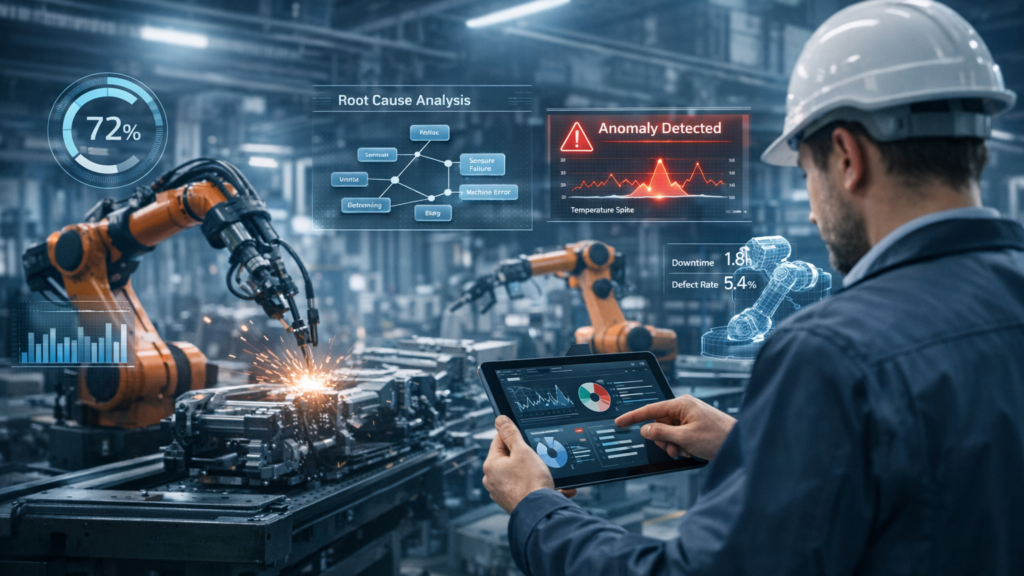

Persistent quality issues, unexpected downtime and recurring defects drain margin and trust. Root cause analysis (RCA) aims to find the underlying source of problems, but manual RCA is slow and often incomplete. AI-driven RCA combines machine learning, process data and structured investigation to accelerate discovery and reduce rework. This article explains how AI-powered tools such as BeLean support faster, more reliable RCA for Mittelstand companies, industrial manufacturers, and automotive enterprises.
Why faster root cause analysis matters in manufacturing
Time-to-resolution affects cost, delivery and safety. A delayed fix can multiply scrap, extend downtime and ripple through supply chains. Faster, more accurate RCA produces three immediate benefits:
- Lower cost from less scrap, less rework and shorter downtime
- Improved throughput and on-time delivery
- Better compliance and product reliability
What AI-driven RCA is and how it differs from traditional approaches
Traditional RCA relies on human investigation, fishbone diagrams, 5 Whys workshops and expert intuition. AI-driven RCA augments that work with data-driven insights:
- Pattern detection across production logs, sensor streams and quality records
- Anomaly detection to flag atypical behavior earlier
- Probabilistic prioritization of likely causes instead of single-point guesses
AI doesn’t replace engineers; it amplifies their ability to focus investigation where it matters.
How BeLean applies AI to accelerate RCA
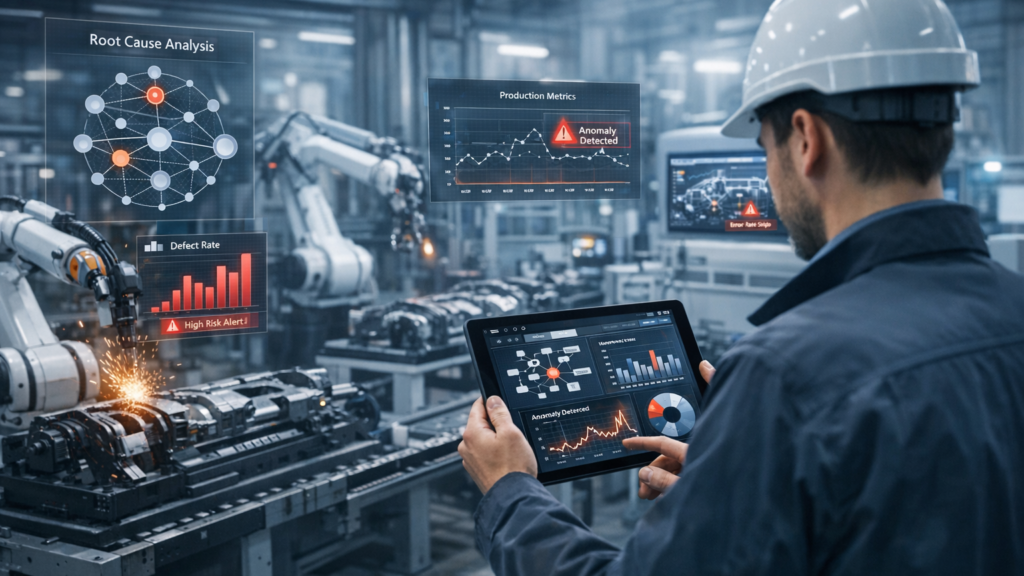
BeLean integrates data sources common in manufacturing—PLC/SCADA logs, MES records, quality inspections and maintenance histories—and applies analytics to surface root-cause candidates. Key capabilities that accelerate RCA include:
- Automated anomaly detection: Early identification of deviations in sensor or process data that often precede visible defects.
- Correlation analysis: Rapidly identifying variables that correlate with failures across many runs or batches.
- Event sequencing: Reconstructing the sequence of machine, operator and process events to highlight causal chains.
- Guided investigation workflows: Structured workflows and checklists that capture findings, hypotheses and verification steps—reducing knowledge loss.
- Root-cause prioritization: Ranking candidate causes by likelihood and impact so teams focus on the highest-return investigations first.
These capabilities reduce the time spent on data gathering and hypothesis generation, letting engineers validate fixes faster.
Use cases by sector
BeLean’s approach adapts to different manufacturing contexts:
- Mittelstand / SMB manufacturers: Fast ROI from fewer line stoppages and reduced scrap. Lightweight integration and guided workflows help small teams scale quality practices without hiring many specialists.
- Industrial and producing companies: Cross-line correlation and trend analysis reveal systemic issues such as material variation or design-for-manufacturing gaps.
- Enterprise: Centralized RCA knowledgebase and standardized workflows support multi-site rollouts and regulatory audits.
- Automotive: High traceability requirements benefit from event sequencing, batch-level correlation and documentation-ready RCA outputs for compliance and recalls.
Implementation: data, people, process
Successful AI-driven RCA requires three aligned elements:
- Data: Collect relevant logs, quality records and maintenance data. Data quality matters more than sheer volume—timestamps, identifiers and consistent units are crucial.
- People: Involve process engineers, maintenance and quality staff early. AI insights are hypothesis drivers; teams validate and act on them.
- Process: Define how alerts feed into escalation, investigation and corrective action. Use guided RCA templates to capture lessons learned and prevent repeat issues.
Metrics to measure RCA success
Track these KPIs to evaluate impact:
- Mean time to detect (MTTD) and mean time to repair (MTTR)
- Reduction in scrap and rework rates
- Number of repeat incidents per month
- Time from detection to root-cause hypothesis validation
Common pitfalls and how to avoid them
- Pitfall: Poor data quality—garbage in, garbage out. Fix: Prioritize data hygiene and establish minimal required fields and timestamps.
- Pitfall: Treating AI as a black box. Fix: Use explainable outputs and maintain human-in-the-loop validation.
- Pitfall: Over-automation of corrective actions. Fix: Automate detection and recommendation, but keep final decisions with qualified staff.
Next steps and practical recommendations
To adopt AI-driven RCA with minimal disruption:
- Start with a high-impact pilot: choose a line or product with frequent failures and available data.
- Map data sources and fix data collection gaps before modeling.
- Run AI alongside existing RCA to validate findings and build trust.
- Document workflows and incorporate successful fixes into standard work to prevent recurrence.
BeLean can support these steps by connecting to common manufacturing systems, applying AI models to surface likely causes and providing structured workflows for investigation and documentation. The goal is pragmatic: reduce the time spent chasing symptoms and increase time spent implementing durable fixes.
Faster RCA improves margin, reliability and supplier relationships. For manufacturers from Mittelstand to enterprise-level operations—especially in automotive where traceability and uptime are critical—AI-driven RCA is a practical way to turn data into faster, more dependable problem resolution.
FAQ
What is the difference between traditional RCA and AI-driven RCA?
Traditional RCA relies heavily on human-led workshops and manual data review. AI-driven RCA uses analytics to detect anomalies, correlate variables and prioritize likely causes, speeding hypothesis generation while keeping humans in control of verification and corrective actions.
Can AI-driven RCA work with limited data history?
Yes, AI can be effective with limited data if that data is relevant and clean. Start with a pilot on a well-instrumented line, improve data collection, and expand models as more validated incidents accumulate.
Will AI replace process engineers or quality staff?
No. AI is a decision-support tool that surfaces likely causes and patterns. Engineers and quality staff validate findings, design fixes and make final decisions.
What KPIs should we use to measure the impact of AI-driven RCA?
Track metrics such as mean time to detect (MTTD), mean time to repair (MTTR), scrap and rework rates, and the frequency of repeat incidents to quantify improvement.
Ready to shorten your time-to-fix? Contact our team to discuss a pilot and see how BeLean applies AI to your production data.