

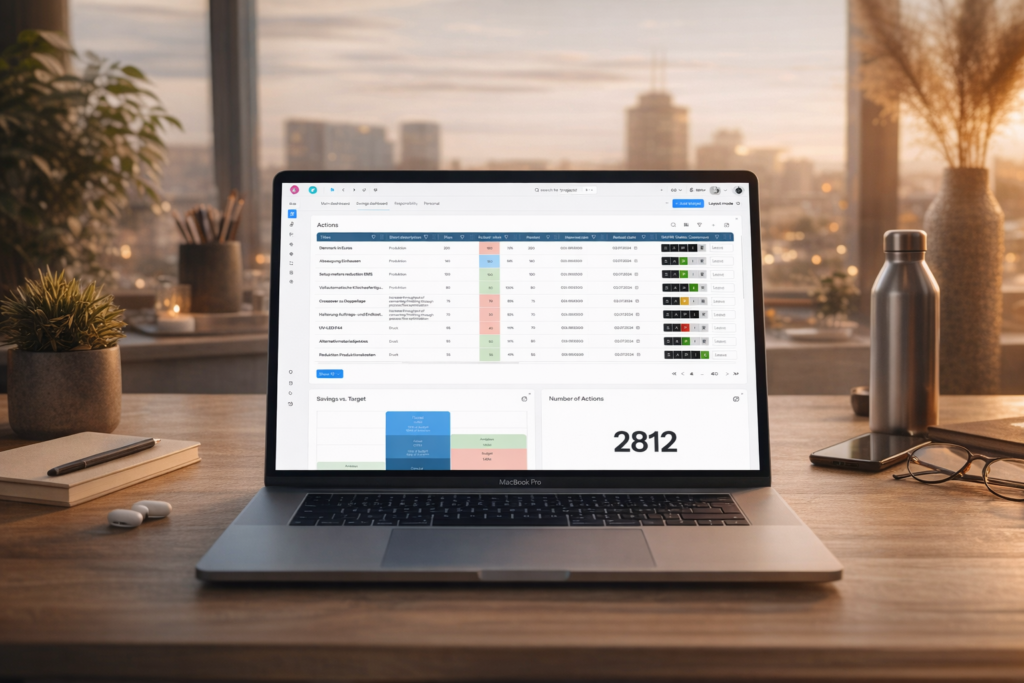
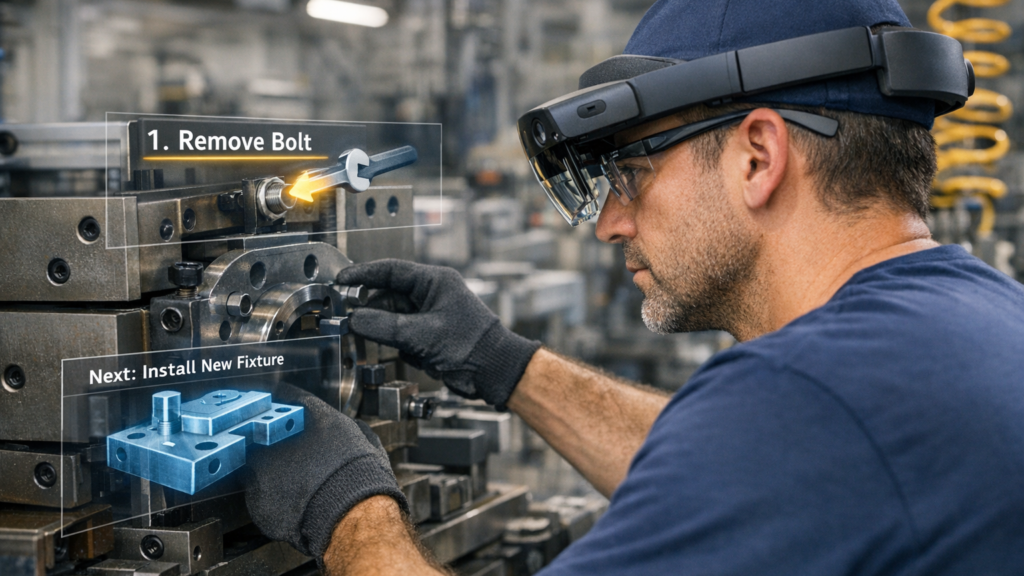

Short setup times are a competitive advantage in modern manufacturing. SMED (Single Minute Exchange of Die) remains the standard method to reduce changeover time. Augmented Reality (AR) augments SMED by delivering step‑by‑step digital guidance at the point of work, improving consistency, lowering errors and making training repeatable across sites.
What is AR‑assisted SMED?
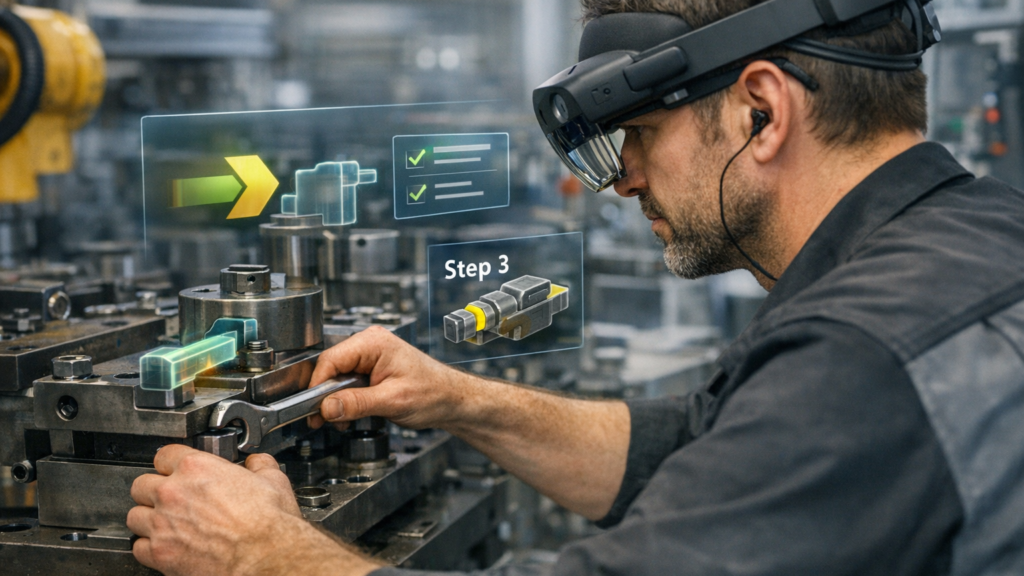
AR‑assisted SMED overlays digital content — instructions, annotations, sequences or part identification — directly on machines or components using wearable displays, tablets or projection. Instead of paper checklists and oral instructions, operators follow contextual visual guidance that adapts to the current step and machine state.
How AR supports each SMED step
- Separate internal vs. external tasks: AR visualizations show which tasks can be done while the machine is running and which require stoppage, reducing unnecessary downtime.
- Convert internal to external: AR can present pre‑assembled tools, checklists and exact placement locations so operators prepare external tasks off‑line and minimize machine stoppage.
- Streamline remaining internal tasks: Live guidance and zoomable overlays speed up complex adjustments and alignments.
- Standardize and document: AR captures steps, timings and operator inputs automatically, locking in best practices and enabling continuous improvement.
Practical benefits for Mittelstand, industry and automotive
- Faster onboarding: Less experienced operators can perform changeovers with confidence using guided steps.
- Reduced errors and rework: Visual cues and confirmations prevent missed steps and incorrect adjustments.
- Knowledge retention: AR converts tacit knowledge into reproducible digital procedures.
- Scalability: Identical AR sequences distribute standardized procedures across plants and shifts.
Implementation checklist: tools, people, data
- Define scope: Start with high‑frequency or high‑impact changeovers.
- Select hardware: Choose head‑worn displays or rugged tablets that suit the shop floor environment.
- Create content: Capture existing expert steps, then convert them into visual, stepwise AR scripts with images, annotations and verification points.
- Integrate data: Link AR workflows to familiar work orders, parts lists and tooling data so information is current and reduces manual searching.
- Train and iterate: Run pilot shifts, collect operator feedback and refine both content and process before scaling.
Common challenges and how to avoid them
- Overcomplex content: Keep AR steps concise; avoid dense instructions that defeat the purpose of quick, visual guidance.
- Poor hardware choice: Test devices under real conditions — dust, gloves, noise and lighting affect usability.
- Data misalignment: Ensure engineering and production data (BOMs, tooling lists) are synchronized to avoid discrepancies in AR instructions.
- Resistance to change: Involve operators early, measure time savings and highlight reduced cognitive load, not just technology for its own sake.
Measuring success: KPIs for AR‑supported changeovers
- Average setup time per changeover (before / after)
- Variation in setup times between operators (consistency)
- Error or rework rate attributable to changeover faults
- Time to competence for new operators
- Number of documented best practices implemented
Case considerations for automotive and high‑mix production
Automotive and other high‑mix environments benefit from AR where changeovers are frequent and complex. Focus on reliable part recognition, secure access control for procedure updates, and tight integration with production planning systems to ensure the right tooling and parts arrive at the right time.
Next steps and recommended actions
- Map current changeover processes and pick two pilot lines with measurable changeover cost.
- Create lightweight AR guides for the pilot lines; measure baseline KPIs first.
- Run pilots for several weeks, collect operator feedback, and refine procedures.
- Scale to additional lines once repeatable time savings and reduced errors are demonstrated.
AR is a tool to operationalize SMED: when implemented pragmatically it accelerates setup, preserves operator knowledge and reduces variability. For manufacturing leaders, the priority is not the tech itself but clear scope, clean data and operator adoption.
FAQ
Can AR replace traditional SMED methods?
AR complements SMED by making procedures visual and repeatable. It does not replace the SMED methodology; instead it accelerates identification of external tasks, standardizes internal tasks and documents best practices.
What hardware is best for shop‑floor AR?
There is no one‑size‑fits‑all. Rugged tablets work well for occasional use and quarantine environments; head‑worn displays free both hands for complex tasks. Choose devices after on‑site testing for dust, noise, gloves and lighting.
How quickly will we see ROI?
ROI timing depends on changeover frequency, pilot selection and measurement discipline. Many teams see measurable time and error reductions within a few pilot cycles when they start with high‑impact changeovers and accurate baseline data.
Ready to pilot AR‑assisted changeovers? Start with two high‑impact lines, document baseline times and run a short pilot to validate gains. Contact your internal change‑management or digitalization team to begin.