


Overview
AR‑assisted SMED (Single Minute Exchange of Die) applies Augmented Reality to the classic goal of reducing machine changeover times. For manufacturing organisations — from Mittelstand to large enterprise and automotive suppliers — AR can reduce errors, standardize procedures, and make tacit operator knowledge explicit and repeatable.
What is AR‑assisted SMED?
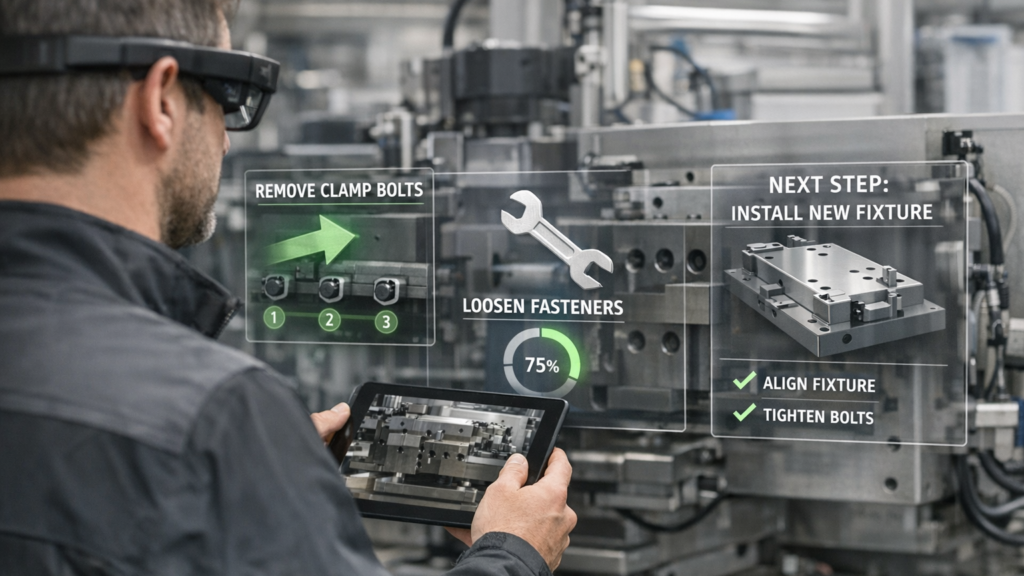
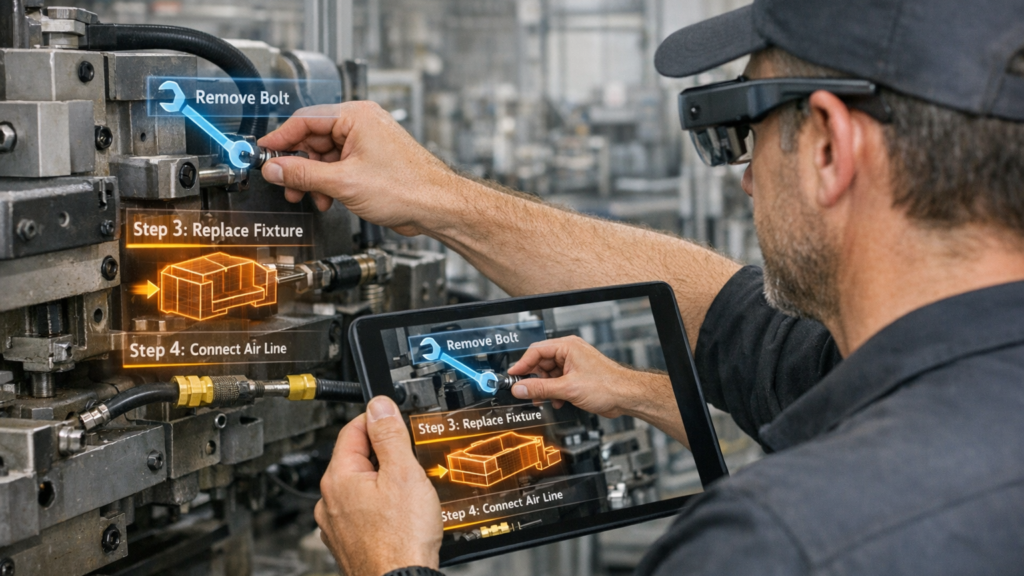
SMED is a set of lean methods focused on minimizing downtime during tool or product changeovers. AR‑assisted SMED overlays contextual digital information onto the physical workspace: step‑by‑step instructions, part identification, torque values, and safety warnings, visible through tablets, smart glasses, or fixed displays.
Why AR helps reduce changeover times
- Faster guidance: Operators see only the next step, reducing search time and hesitation.
- Reduced errors: Visual alignment cues and live validation (QR tags, object recognition) prevent incorrect assembly or adjustments.
- Knowledge transfer: AR captures best practices from skilled operators and makes them accessible to less experienced staff.
- Parallel work: AR can coordinate multiple operators, showing task assignments and timing to enable safe parallelization of activities.
Key AR features for effective SMED
- Step sequencing: Split changeovers into discrete, timed steps with visual prompts.
- 3D overlays: Show exactly where to place, remove, or tighten parts.
- Interactive checklists: Require confirmation or capture evidence (photo, sensor readback) before progressing.
- Live support: Remote expert video and annotation to assist complex tasks in real time.
- Integration: Connect AR with MES/ERP to pull job-specific data and to push completion events.
Practical implementation steps
- Map the current changeover: Time each step, note variations and pain points. Use video capture where possible.
- Identify quick wins: Target steps with high variance, frequent errors, or long duration.
- Design AR workflows: Create concise step sequences, visuals, and acceptance criteria. Start with one product/machine.
- Pilot with operators: Run short cycles, collect feedback, iterate. Prioritize ergonomics and clarity.
- Integrate data sources: Link AR to job orders, tooling lists, and sensor inputs to ensure the AR content is context‑aware.
- Scale and standardize: Expand across lines, document standards, and include AR content in operator training.
Measurement and KPIs
Track simple, manufacturing‑centric KPIs:
- Average changeover time (pre/post)
- Variation in changeover time (standard deviation)
- First‑time‑right rate after changeover
- Number of remote expert interventions
- Operator training time to certified competence
Common challenges and mitigation
- Resistance to change: Involve operators early and use pilots that visibly reduce pain points.
- Content upkeep: Assign clear ownership for AR content and tie updates to engineering change processes.
- Hardware fit: Choose devices that match the environment (noise, PPE, lighting) and workflow ergonomics.
- Integration complexity: Start with lightweight data connections; expand to full MES/ERP integration once ROI is proven.
Use cases by sector
Mittelstand & contract manufacturers: Rapid upskilling for variable product mixes and short runs. AR reduces experiential dependency.
Automotive & suppliers: Complex tooling changes and safety‑critical steps gain from AR validation and traceable evidence.
Enterprise production lines: Standardization across sites: same AR workflow enforces consistent changeover across plants.
Next steps for industrial adopters
Start with a focused pilot: pick a high‑impact machine, set clear baseline KPIs, and run 5–10 trial changeovers with AR guidance. Measure time, errors, and operator feedback. Use those results to build a business case for broader rollout and for tighter integration with manufacturing systems.
Bottom line: AR‑assisted SMED makes changeovers faster, safer, and more consistent by turning tacit skills into repeatable, visual workflows. For manufacturers aiming to reduce downtime and improve throughput, AR is a pragmatic tool that complements lean methods.
FAQ
What hardware do I need for AR‑assisted SMED?
Common choices are tablets, ruggedized handhelds, or industrial smart glasses. Select devices based on ergonomics, PPE compatibility, and environmental conditions. Start with tablets if you want lower complexity.
How quickly will AR reduce our changeover times?
Results depend on the process and baseline. Typical pilots show measurable reductions within weeks for targeted setups. Use a short pilot to establish realistic expectations for your site.
Does AR replace training?
No. AR complements training by providing on‑the‑job guidance and reducing dependency on memory. It shortens ramp‑up time but should be part of a wider training and competence program.
How do we keep AR content up to date?
Assign ownership to engineering or process teams and integrate content updates into the change control workflow. Version control and scheduled reviews reduce drift between AR instructions and actual practice.
Ready to pilot AR‑assisted SMED on your shop floor? Contact your internal automation or digitalisation team to define a targeted pilot and baseline KPIs.
Please coordinate with your operations and IT leads to assess device suitability and data integration requirements.