

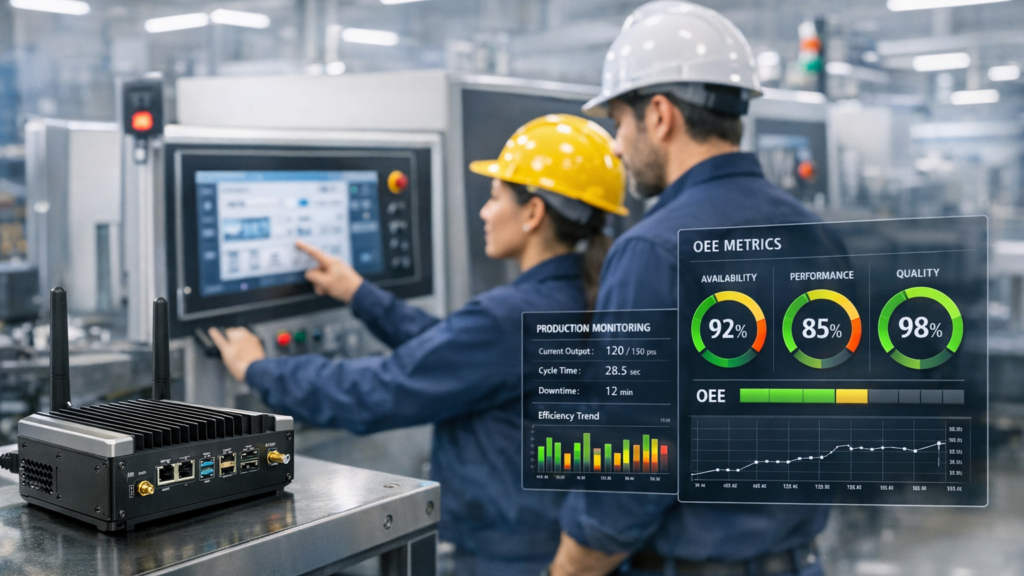

Overall Equipment Effectiveness (OEE) is only useful when measurements are timely and trustworthy. Edge analytics moves data processing from centralized servers to devices near the machines, enabling sub‑second insights, immediate corrective actions and reduced data transport costs. For midsize manufacturers, industrial plants and automotive suppliers, this shift turns raw signals into actionable, real‑time intelligence at the shopfloor level.
Why real‑time OEE needs edge analytics
Traditional OEE systems often rely on batch uploads to a central historian or cloud. That introduces latency, network dependency and gaps in traceability. Edge analytics addresses three common pain points:
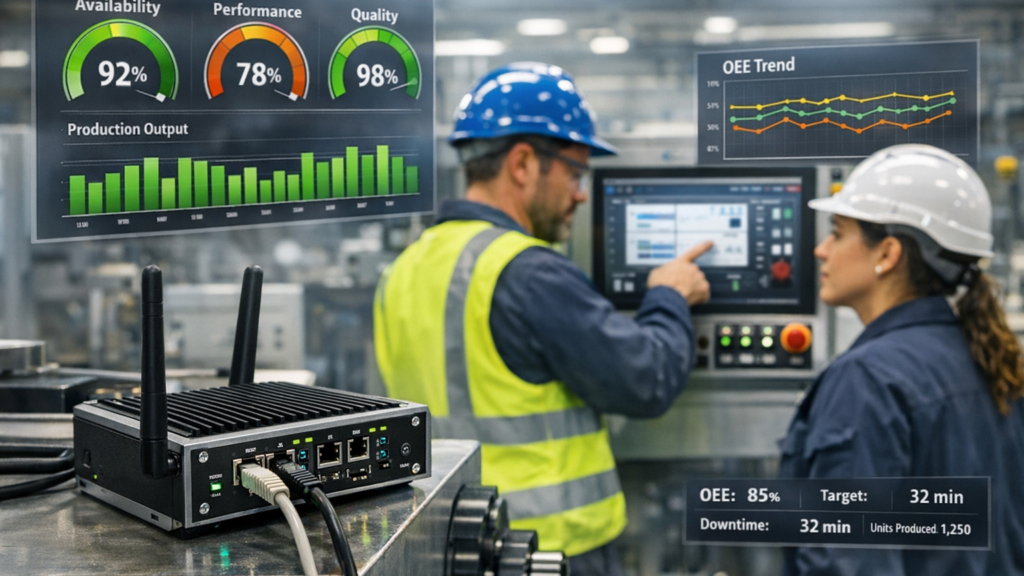
- Latency: decisions such as stopping a line or adjusting a parameter require near real‑time detection of stops, slow cycles and quality losses.
- Data volume and bandwidth: high‑frequency sensor streams can overwhelm networks and cloud storage budgets if every sample is transmitted raw.
- Resilience: edge processing keeps monitoring and local responses running even during network outages.
What edge analytics does on the shopfloor
At its core, edge analytics ingests signals from PLCs, sensors and MES, applies filtering, aggregation and event detection, and outputs condensed metrics and alerts. Typical functions relevant to OEE:
- Real‑time state detection (running, idle, downtime) and automatic cause categorization.
- Adaptive cycle time calculation and detection of slow‑downs.
- Quality anomaly detection from inline measurements or reject rates.
- Local dashboards and operator prompts for immediate corrective actions.
Key components of an edge analytics solution
- Edge hardware: industrial gateways or edge servers with deterministic I/O and sufficient CPU for analytics workloads.
- Data ingestion layer: drivers for OPC UA, MODBUS, MQTT and APIs to MES/SCADA.
- Stream processing: real‑time filters, windowed aggregations (e.g., per cycle), and event detection logic.
- Local storage and buffering: short‑term retention for context and to survive network interruptions.
- Integration layer: lightweight data packages sent to cloud or plant historian: OEE KPIs, events, summaries, not raw streams.
- Operator UX: on‑machine HMI or mobile alerts that tie detected events to corrective actions and root cause steps.
Practical implementation steps for mid‑sized manufacturers and enterprises
- Start with a focused pilot: choose 1–3 high‑impact lines where OEE improvement is clear and measurable. Define baseline OEE and expected uplift.
- Map available signals: identify PLC tags, sensors and MES events needed to detect availability, performance and quality losses.
- Implement lightweight edge processing: deploy edge nodes that perform state detection and compute cycle‑level metrics. Send only KPI summaries and events upstream.
- Embed operator workflows: ensure alerts include next steps or links to standard work so operators can act immediately.
- Measure and iterate: compare real‑time OEE to historical reports, validate event classification and refine detection thresholds.
Data governance, security and integration best practices
Edge projects must respect plant security and IT requirements. Keep these rules in mind:
- Use network segmentation and secure tunnels for any outbound connections. Favor push-only telemetry from edge to cloud to minimize attack surface.
- Aggregate and anonymize data where necessary: send KPIs and events rather than raw high‑frequency traces unless required for troubleshooting.
- Maintain clear ownership of models and thresholds: keep a change log for any detection logic tuned on edge nodes.
- Ensure compatibility with existing MES/ERP: map OEE dimensions to shopfloor context and order/shift metadata.
Measuring impact and scaling from pilot to plant network
Quantify outcomes with concrete KPIs: OEE percentage uplift, minutes of unplanned downtime avoided, reduced cycle variability, and mean time to detect (MTTD) events. Use the pilot to define governance for rolling out standardized edge configurations and templates across other lines and plants. Centralize exception reporting while keeping local control for immediate corrections.
Next steps and prescriptive actions
Moving from descriptive monitoring to prescriptive action requires linking detected events to recommended countermeasures. Combining edge analytics with process mining and prescriptive logic enables automatic assignment of corrective steps and prioritization of issues that deliver the highest OEE gain. Learn more about prescriptive approaches and process mining to drive automated recommendations and action plans in production:
Edge analytics is not a silver bullet, but it is a high‑leverage enabler for real‑time OEE optimization: lower latency, local resilience, and immediate operator feedback make measurable improvements possible within weeks rather than months.
Weiterfuehrende Inhalte
- Prescriptive Process Mining Platforms: From Insights to Direct Improvements with BeLean
- Prescriptive Process Mining Platforms: From Insights to Direct Improvements with BeLean
FAQ
What is the main benefit of running analytics at the edge for OEE?
The main benefit is reduced latency: edge analytics detects and classifies events near the machine, enabling immediate corrective actions and reducing unplanned downtime. It also lowers bandwidth use by sending only condensed KPIs and events upstream.
Can edge analytics run without cloud connectivity?
Yes. Edge nodes can compute OEE metrics, generate alerts and run operator workflows locally. Cloud connectivity is useful for historical analysis, cross‑plant comparisons and model updates but is not required for real‑time operation.
How should I choose which lines to pilot first?
Select lines with clear OEE issues and measurable opportunity (e.g., frequent downtime or quality rejects). Prefer setups where required signals are accessible from PLCs or existing sensors to reduce integration effort.
Will edge analytics replace MES or historians?
No. Edge analytics complements MES and historians by providing real‑time processing and condensed insights. It reduces load on central systems and improves responsiveness while feeding summarized data for longer‑term analysis.
Ready to connect edge analytics with prescriptive actions? Explore how prescriptive process mining can turn real‑time OEE insights into prioritized corrective measures: Prescriptive Process Mining (Belean) and the follow‑up: Prescriptive Process Mining (Belean) — follow‑up.