


Manufacturing organizations—from mid-market suppliers to automotive OEMs—maintain thousands of SOPs and variant-specific instructions. Keeping those documents concise, consistent and accessible speeds onboarding and reduces execution errors. Generative AI now automates SOP summarization and helps manage variants, delivering measurable gains in time-to-competency and quality control.
Why SOP summarization and variant handling matter
New operators and engineers waste time parsing long, inconsistent documents. Variant complexity—options, part substitutions, process branches—adds cognitive load and increases mistake risk. Summaries and clear variant-aware instructions reduce decision friction on the shop floor and in maintenance, inspection, and assembly tasks.
What generative AI brings to SOP workflows
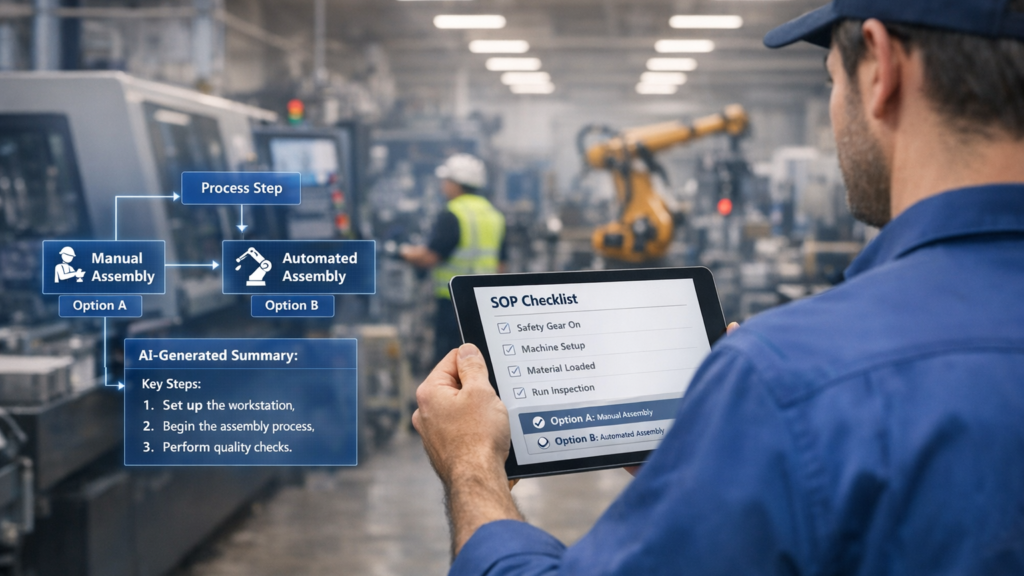
- Concise, role-tailored summaries: Auto-generate short, actionable SOP briefs for operators, technicians, and supervisors.
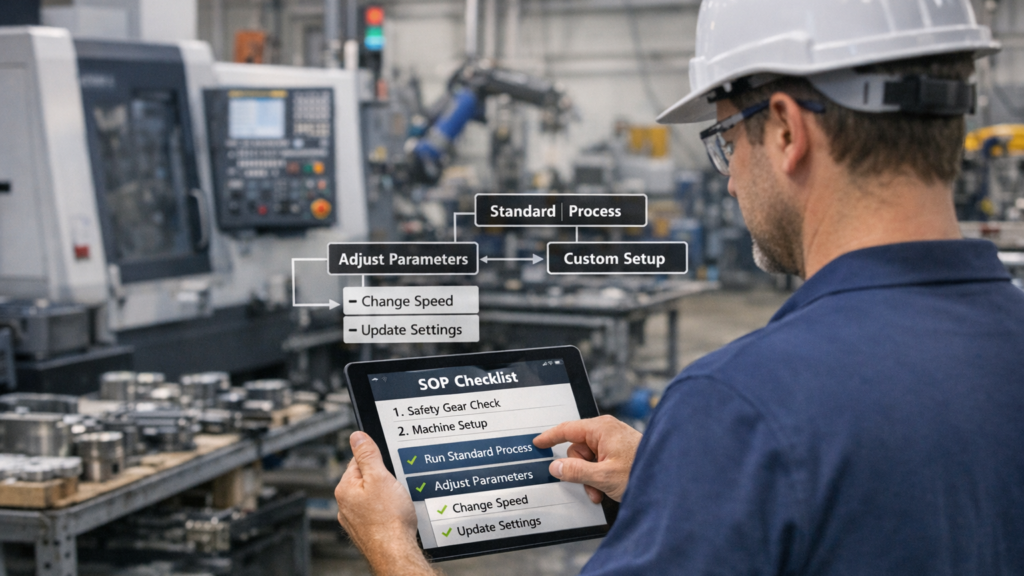
- Variant-aware instructions: Produce step lists that adapt automatically to product/configuration variants to prevent incorrect steps or parts.
- Standardization and quality control: Detect inconsistent language, missing safety steps, or conflicting parameters across SOPs.
- Faster onboarding: Reduce ramp-up time by providing layered documentation: one-line task descriptions, short checklists, and full SOPs on demand.
- Continuous improvement: Use feedback loops to refine summaries and variant rules as processes evolve.
Typical implementation workflow
- Inventory and classify: Catalog SOPs, tag by process, machine, role, and variant impact.
- Prepare canonical inputs: Clean source SOPs, extract key sections (safety, pre-conditions, steps, accept/reject criteria).
- Define templates and prompts: Create standardized output templates (e.g., 3-sentence summary, 5-step operator checklist, variant decision table).
- Model selection and fine-tuning: Choose a suitable generative model and fine-tune or use retrieval-augmented generation to ground outputs in your SOP corpus.
- Human-in-the-loop validation: Route AI outputs to SMEs for rapid verification before deployment. Capture corrections for model retraining.
- Integrate to systems: Push summaries and variant rules into LMS, MES, PLM or operator tablets for contextual delivery.
Data & model governance: ensure safety and traceability
Regulated industries require traceable decisions. Build governance around:
- Source authenticity: link every summary back to the canonical SOP version.
- Change logs: record who approved AI-generated content and when.
- Fallback rules: if model confidence is low, show the full SOP and alert an SME.
- Access control and IP protection: limit model access and monitor usage.
Integration points: MES, PLM, LMS and the shop floor
Best results come from embedding outputs where people work. Examples:
- MES: Present step-by-step variant-specific checklists at workstations.
- PLM: Keep variant decision tables and engineering notes synchronized with BOM changes.
- LMS: Auto-create microlearning modules from SOP summaries for new hires.
- Operator devices: Provide quick-access summaries and a one-touch link to the full SOP.
Measuring impact: KPIs and quick wins
Track metrics to prove ROI and prioritize expansion:
- Onboarding time: reduce time-to-productivity for new hires (hours/days saved).
- Error rate: fewer process deviations and nonconformances tied to SOP steps.
- Time on task: less time spent searching documents.
- SME review time: reduced validation effort through higher-quality initial drafts.
Quick wins often include generating operator checklists for the highest-variance, highest-risk processes and embedding them in the MES or tablet interface.
Common pitfalls and how to avoid them
- Pitfall: Blind trust in AI outputs. Mitigation: mandatory SME signoff and versioned approvals.
- Pitfall: Poor source data quality. Mitigation: canonicalize SOPs before generation and maintain a single source of truth.
- Pitfall: Over-customization per variant causing proliferation. Mitigation: manage variants with rule-based templates and limit unique procedures to necessary differences.
- Pitfall: Regulatory non-compliance. Mitigation: keep traceability and audit logs, and retain human accountability for published SOPs.
Next steps for manufacturing and automotive teams
Start small, demonstrate value, and scale:
- Identify 2–3 high-impact SOPs with frequent errors or long onboarding times.
- Run a pilot that produces operator checklists and variant decision tables, with SME validation.
- Measure onboarding time and error rate before and after deployment.
- Iterate: integrate validated outputs into LMS/MES and expand by priority.
For a practical example of generative AI applied to standardized work instructions and SOPs in manufacturing, see our overview and use cases here: Generative AI for Standardized Work Instructions & SOPs in Manufacturing.
Weiterfuehrende Inhalte
FAQ
Can generative AI replace subject-matter experts for SOP creation?
No. Generative AI accelerates drafting and standardization but should operate with SME validation. Human oversight ensures safety, regulatory compliance, and contextual accuracy.
How do you ensure AI-generated summaries match the correct variant?
Use structured variant metadata (BOM, configuration flags) plus retrieval-augmented generation or rule-based gating so outputs are generated against the specific variant context; add confidence thresholds and SME review for low-confidence cases.
What immediate benefits can mid-market manufacturers expect from a pilot?
Typical benefits include faster onboarding (hours to days saved per hire), reduced process deviations for targeted SOPs, and lower SME review time for document updates. These gains make pilots cost-effective within months.
What governance controls are essential?
Maintain source traceability, versioned approvals, access controls, audit logs, and an established fallback to full SOPs when confidence is low. These controls preserve accountability and regulatory compliance.
Ready to pilot SOP summarization and variant-aware instructions? Learn how our approach applies to manufacturing and automotive processes: Explore our solution.