


Hyperlocal inventory coordination on the production line means managing material supply at the smallest practical location — the line, cell or workstation — instead of at a siloed warehouse or plant-level pool. This shift matters for mid-market manufacturers, industrial producers, the automotive sector and enterprise operations because it reduces delays, minimizes excess work-in-progress (WIP), and improves overall equipment effectiveness (OEE).
Why hyperlocal coordination matters
Traditional inventory models centralize stock and push replenishment on fixed schedules. That can hide variability and cause overstock or line stoppages when a specific workstation needs parts. Line-level coordination aligns replenishment cadence with actual consumption, enabling faster response to variation and reducing both safety stock and obsolescence.

Key benefits at line level
- Lower line stoppage risk: parts arrive where and when they are needed.
- Reduced WIP and safety stock: smaller buffers placed closer to consumption points.
- Improved flow and takt time adherence: replenishment follows production rhythm.
- Higher transparency: team-level visibility on shortages and consumption patterns.
- Better supplier collaboration: shorter, more predictable replenishment loops.
Core principles for material readiness
- Localize visibility: ensure each line has real-time information on on-hand, on-order and reserved quantities.
- Align to takt: match replenishment frequency and batch size to production takt time and variation.
- Standardize pick locations and kanban triggers: simple, visual signals reduce errors and speed response.
- Prioritize critical parts: classify SKUs by impact on line stoppage and assign stricter controls.
- Minimize handoffs: reduce touch points between warehouse and line to lower lead time and errors.
Practical steps to implement hyperlocal coordination
- Map consumption at line level: capture unit consumption, variability and lead time for top SKUs.
- Segment SKUs: identify fast movers, critical parts and slow movers to apply different replenishment rules.
- Design replenishment loops: define who (warehouse, supermarket, supplier), when (kanban, min/max, pull), and how (totes, carts) material reaches the line.
- Pilot on a single line or product family: validate triggers, frequencies and physical layouts before scaling.
- Train line teams and warehouse staff: focus on new behaviors, visual controls and escalation when signals aren’t met.
- Iterate using daily shopfloor metrics: adjust quantities and cadence based on observed variation and shortages.
Technology and systems to support line-level supply
Effective hyperlocal coordination requires systems that provide timely, accurate data at the point of use. Typical capabilities include:
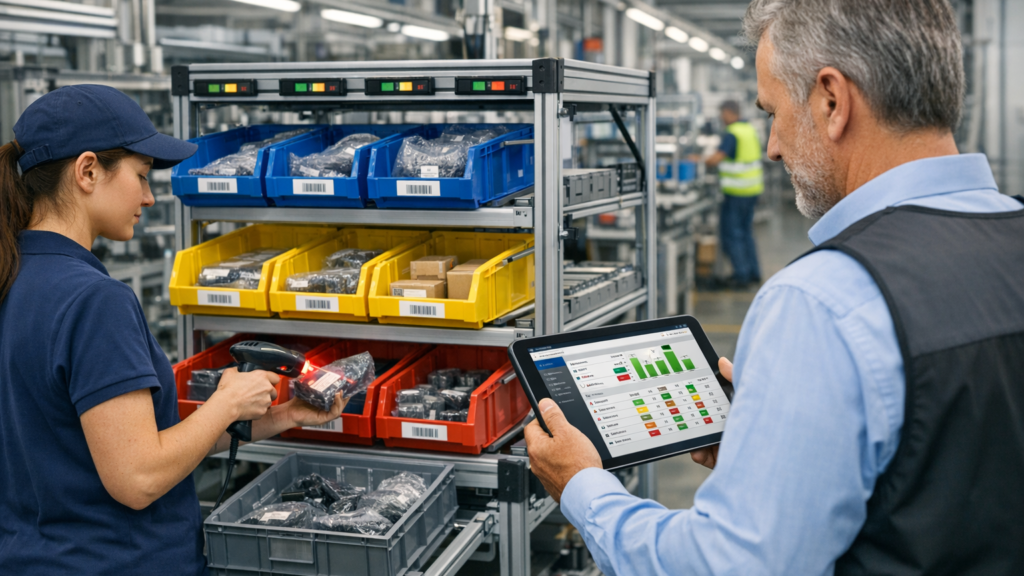
- Real-time inventory visibility at bin/tote level.
- Simple replenishment triggers (electronic or visual kanban).
- Integration between MES/ERP and local replenishment tools to avoid double handling and data lag.
- Analytics to size buffers using consumption variability and lead time distribution.
Operational rules and governance (CTA rules)
Clear operational rules — what to do when a kanban is missing, how to escalate an impending stockout, or when to adjust buffer quantities — are essential. Example CTA-style rules to include in standard work:
- Call-to-action on visual trigger: if a kanban card is removed, the line operator notifies the supermarket within X minutes.
- Escalation path: if replenishment is not completed within Y minutes, escalate to the shift supervisor and trigger a temporary swap of compatible parts if available.
- Continuous improvement loop: weekly review of shortages, root causes and corrective actions with supply chain and production leads.
Common challenges and how to overcome them
- Data accuracy: reduce manual counts by using barcode/RFID at point of use and reconcile discrepancies daily.
- Supplier lead-time variability: move critical parts to vendor-managed inventory or shorten supplier response windows.
- Space constraints at the line: use vertical racking, modular trolleys or micro-supermarkets to keep footprints small.
- Cultural resistance: pilot small, show measurable benefits (reduced stoppages, lower inventory), then scale with visible wins.
Measuring success and KPIs
- Line stoppage frequency and duration (before vs. after).
- Inventory turns for line-stocked SKUs.
- WIP levels and finished goods lead time.
- On-time material arrival at the point of use.
- First-pass yield and OEE improvements attributable to material readiness.
Typical implementation approach (example)
Start with a focused pilot: select one line with frequent supply issues, map its top 30 SKUs by consumption, implement visual kanban and a simple electronic inventory record, train teams and run the pilot for 8–12 weeks. Use collected data to size buffers and set replenishment frequency, then expand to adjacent lines in waves.
Conclusion and next steps
Hyperlocal, line-level inventory coordination reduces risk, lowers working capital and supports stable production rhythm. For manufacturers and automotive producers, the path is pragmatic: map consumption, pilot a local system, solidify rules and scale based on measured results. Start small, measure often, and standardize what works.
FAQ
What is hyperlocal inventory coordination at line level?
It is the practice of managing material supply directly at the production line, cell or workstation so replenishment follows actual consumption rather than centralized schedules.
Which SKUs should be managed at line level?
Prioritize critical parts and high-consumption SKUs that cause line stops or long recovery times; low-use or bulk items can stay at higher-level stores.
What minimal technology is needed to start a pilot?
A basic electronic inventory record (barcode scanning or simple mobile app), visual kanban or tote system, and a way to capture consumption data daily are sufficient to begin.
How long before we see benefits?
With a focused pilot, measurable reductions in stoppages and inventory for the targeted line often appear within 8–12 weeks as processes stabilize and buffers are tuned.
How do we control supplier variability?
Use classification to move critical SKUs to vendor-managed inventory, shorten reorder windows, or hold small safety buffers at the line while working with suppliers to improve lead-time reliability.
Ready to optimize material readiness at the line? Start with a one-line pilot: map consumption, implement visual triggers and measure stoppages for 8–12 weeks. Contact your internal supply chain or continuous improvement team to get started.