

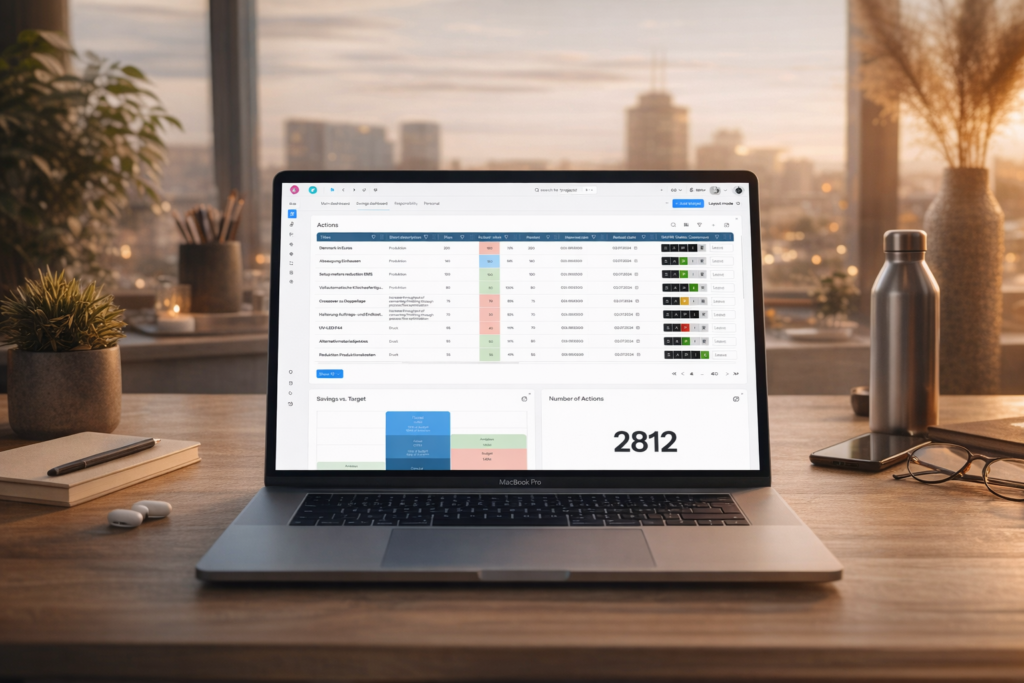
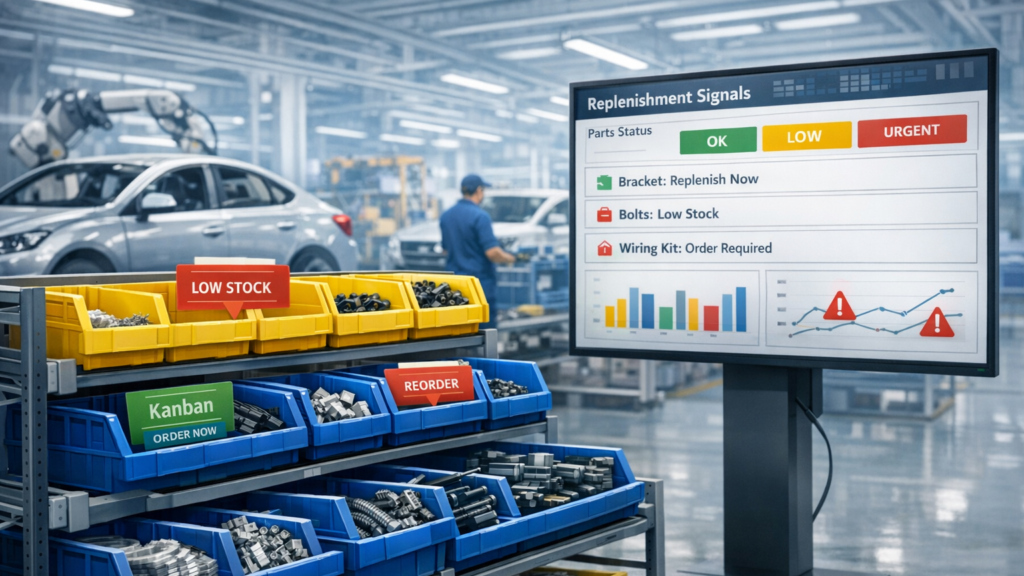

Hyperlocal line-level inventory coordination means managing materials right at the production line — not at a distant warehouse — so the right parts arrive at the right time and place. For medium-sized companies, industrial manufacturers, and automotive suppliers, this reduces interruptions, shortens reaction time to demand variance and improves line efficiency without large-scale inventory increases.
Why focus on line level? Managing stock at the line (point-of-use) targets the last link before value is added. That reduces transport waste, prevents overstocking upstream, and makes replenishment cycles shorter and more responsive. It also supports takt-time adherence and reduces work-in-progress (WIP).
Benefits by segment
- Mittelstand (SME): Faster problem detection, simpler visual controls, lower capital tied up in buffer stock.
- Industry & Produzierendes Gewerbe: Improved throughput, steadier flow, fewer emergency runs and less production downtime.
- Enterprise: Scalable standards, better cross-plant synchronisation and clearer escalation paths for supply issues.
- Automotive: Critical for JIT/JIS processes — reduces lineup risk and supports supplier quality and delivery metrics.
Core principles to apply
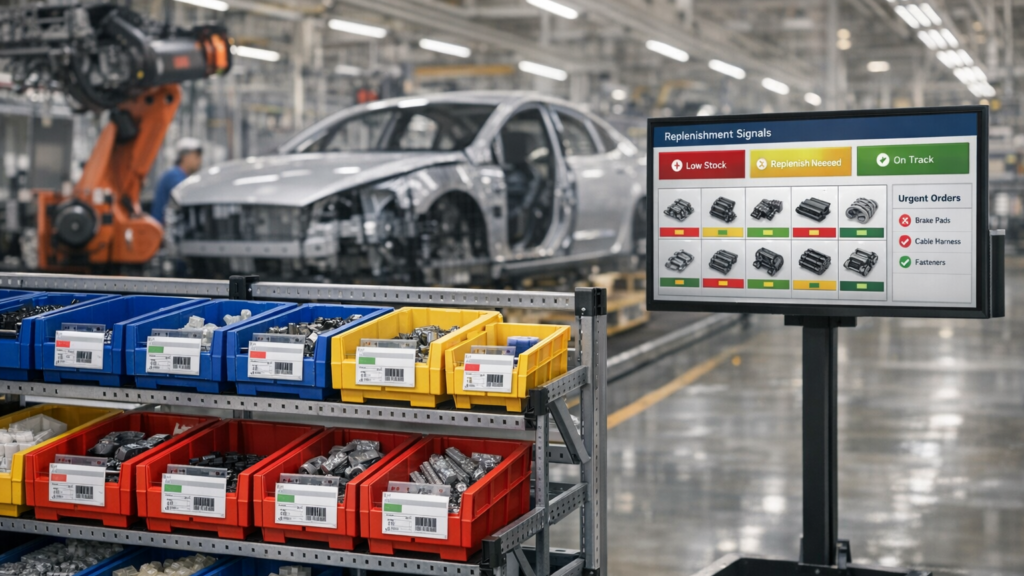
- Point-of-use placement: Store parts as close to the operation as possible with defined min/max levels.
- Visual management: Kanban cards, signal lights or simple bin color-coding to trigger replenishment.
- Takt alignment: Size replenishment to match takt and prevent pacing variability.
- FIFO & traceability: Prevent ageing and maintain lot traceability, particularly for regulated industries.
- Short feedback loops: Rapid detection and escalation of shortages via local ownership and simple escalation paths.
Practical implementation steps
- Map the value stream for the target line: identify critical parts, lead times and failure modes.
- Define service levels per part family: what uptime is required and what buffer is acceptable.
- Choose a replenishment method: Kanban, min/max, supermarket pull or mixed approach based on variability.
- Install point-of-use storage and visual signals; standardize part presentation and labeling.
- Set clear ownership: line operator, material handler, and a supply coordinator with defined tasks.
- Integrate lightweight IT where beneficial: mobile scanning, simple dashboards or MES hooks for visibility.
- Run a pilot on 1–2 lines, measure outcomes, and scale using lessons learned.
Hardware and software considerations
Not every plant needs a full ERP extension at the line. Start with low-friction tools: barcode/RFID for traceability, mobile devices for scanning, and small dashboards for local KPIs. For enterprises, integrate line-level signals into higher-level planning systems to avoid double work and ensure supplier visibility.
Operational roles & governance
- Define RACI for replenishment tasks: who checks levels, who triggers replenishment, who resolves shortages.
- Daily short meetings at the line or a digital brief to review exceptions and adjust stock settings.
- Cross-functional escalation path involving purchasing, logistics and engineering for recurring part issues.
Common pitfalls
- Overcomplex replenishment rules — keep rules simple for operators to follow reliably.
- Ignoring variability — safety stock must reflect real demand and supplier variability.
- Implementing tools before process design — technology should support a proven process, not replace it.
Measuring success
- Line availability / uptime
- On-time parts provision at point-of-use
- Reduction in emergency replenishments and material-related downtime
- Inventory turns at line vs. plant level
- Lead time from pull signal to replenishment complete
Quick implementation checklist
- Map parts and demand pattern for the line
- Decide replenishment method and min/max rules
- Set up point-of-use storage and visual signals
- Assign roles and communication routines
- Pilot, measure, adjust, then scale
Hyperlocal coordination at line level is a high-impact, low-footprint improvement for organizations that need reliable material flow without large inventory increases. Start small, standardize, then scale. The result: steadier lines, fewer fire-fighting episodes, and clearer supply-to-production alignment.
FAQ
What is the difference between hyperlocal line-level coordination and traditional warehouse inventory management?
Hyperlocal line-level coordination stores and manages materials at or immediately next to the production line, focusing on short replenishment cycles and point-of-use visibility. Traditional warehouse management centralizes stock, which increases transit time and delays detection of line-level shortages.
Which replenishment method is best for automotive lines?
Automotive environments often benefit from Kanban or supermarket pull systems because they support JIT/JIS processes and provide clear visual signals. The best choice depends on demand variability, supplier reliability and takt requirements.
How do you avoid increasing total inventory when adding point-of-use stock?
Design min/max and safety stock based on measured variability and lead time; consolidate slow movers; eliminate redundant upstream buffers. Piloting and measuring inventory turns before scaling prevents unnecessary inventory growth.
Do I need to integrate line-level systems with ERP?
Integration helps with supplier visibility and aggregated reporting but is not always necessary at start. Lightweight digital tools (mobile scanning, local dashboards) often suffice for pilots; integrate with ERP/MES once processes are stable.
Ready to reduce line downtime and improve material flow? Contact our operations specialists to evaluate a pilot for your production lines. Request a short assessment to define quick wins and a scaled rollout plan.