


Interoperability is no longer optional for original-equipment (OE) platforms. Open APIs and standardized data models let manufacturers, suppliers and enterprise teams exchange information reliably, automate workflows and build ecosystems that create measurable business value. For Mittelstand companies, producers in the industrial and automotive sectors, and large enterprise organizations, interoperability can be a decisive competitive factor.
Why interoperability matters for OE platforms
OE platforms connect product data, engineering systems, service records, telematics and downstream applications. When those systems use closed interfaces or bespoke data formats, integration costs and time-to-market rise, collaboration stalls and supplier lock-in reduces flexibility. Interoperability reduces integration friction, accelerates innovation and enables multi-vendor ecosystems where value is shared and reinvested.
Open APIs and standardized data models: definitions and benefits
Open APIs provide well-documented, stable endpoints that allow external systems to interact with platform capabilities. Standardized data models define a common language and schema for representing parts, assemblies, firmware, sensor telemetry, maintenance events and more. Together they deliver:
- Predictable integrations: fewer custom adapters and faster onboarding for partners.
- Reusability: common models reduce duplicated mapping efforts across projects.
- Scalability: ecosystems grow without exponential integration costs.
- Innovation: third parties can build complementary services on top of platform capabilities.
Business impacts by sector
Mittelstand / SMEs: Lower integration costs and faster supplier onboarding mean Mittelstand companies can participate in larger supply chains and offer digital services without major IT overhauls.
Manufacturing / Produzierendes Gewerbe: Standardized telemetry and maintenance data enable predictive maintenance, reduced downtime and better spare-parts logistics.
Enterprise: Interoperability supports enterprise integration patterns, master data management and compliance across global operations.
Automotive: Shared vehicle models, telematics and over-the-air (OTA) update schemas allow OEMs, tier suppliers and service providers to coordinate features, recalls and software deployments securely.
Technical components of interoperable OE platforms
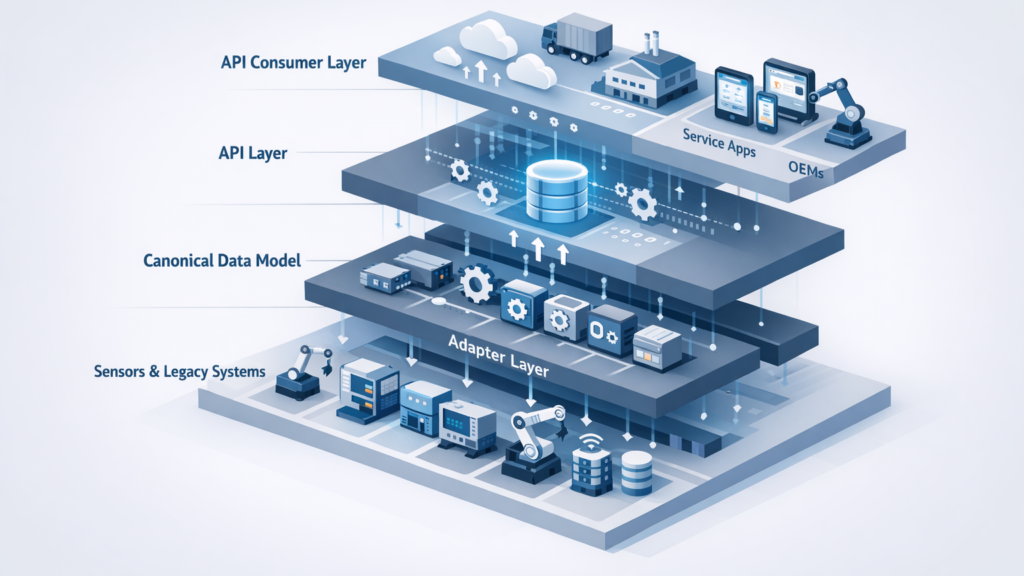
- API-first architecture: Design platform capabilities as versioned REST/GraphQL APIs with clear contracts and change policies.
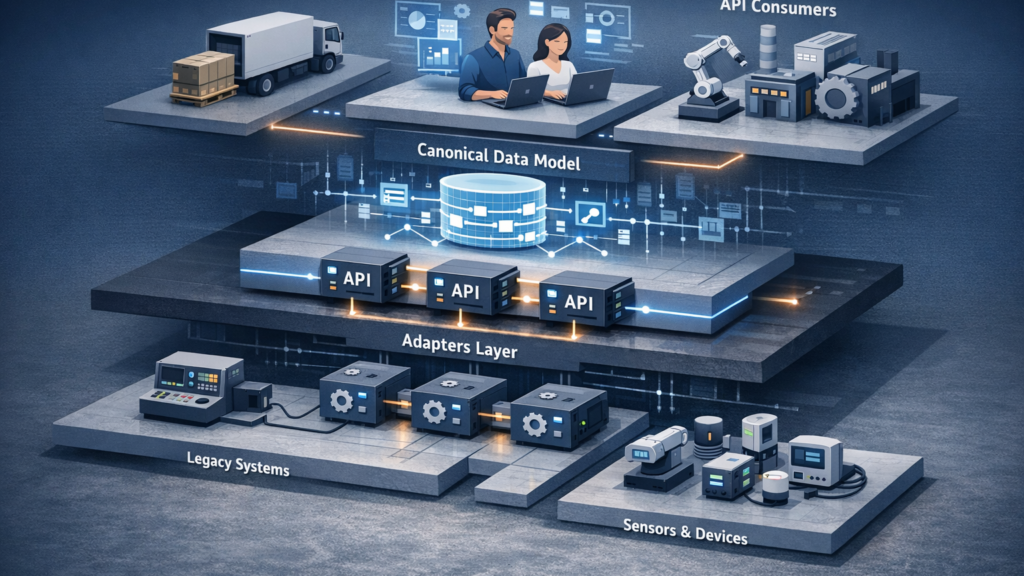
- Canonical data model: Establish a core schema for parts, products, assets and events; map internal models to the canonical layer.
- Adapters and gateways: Implement adapters for legacy protocols (e.g., OPC UA, MQTT, CAN) to translate to the canonical model.
- Security and governance: OAuth/OpenID Connect for auth, fine-grained authorization, encryption in transit and at rest, and an audit trail for data changes.
- Developer experience: SDKs, sandbox environments, clear docs and sample data to reduce partner onboarding time.
Implementation roadmap
Follow a pragmatic sequence to deliver value fast and reduce risk:
- Assess: Inventory systems, data sources, stakeholders and integration pain points.
- Define: Select or design a canonical data model aligned to industry standards where possible.
- Prototype: Build a small API-first proof of concept connecting critical systems and one external partner.
- Secure & govern: Implement authentication, authorization and data governance policies before scaling.
- Scale: Publish SDKs, onboard additional partners and automate onboarding with self-service tooling.
Commercial and organizational considerations
Technical work must align with commercial models. Decide whether APIs are:
- Open and public, to foster marketplaces and third-party innovation.
- Partner-only, to preserve competitive advantages while enabling key suppliers.
- Internal-only, to standardize across global operations before wider exposure.
Governance and a product-led API strategy help balance openness with control. Ensure SLAs, pricing (if applicable), and support models are established before opening endpoints broadly.
Measuring success
Track metrics that reflect both technical health and business impact:
- Time-to-onboard partners
- Number of integrations implemented vs. custom adapters avoided
- Increase in automated workflows and reduction in manual handoffs
- Downtime reduction and maintenance cost savings
- Number of third-party applications built on the platform
Common pitfalls and how to avoid them
- Avoid building APIs as an afterthought. Adopt an API-first mindset.
- Don’t ignore security—design governance and auth early.
- Resist the urge to over-standardize from day one; iterate the canonical model with real integrations.
- Plan for versioning and backward compatibility to maintain partner trust.
Next steps
Start with a targeted use case that delivers visible ROI—predictive maintenance, spare parts ordering or OTA updates are typical high-impact candidates. Combine a small pilot with clear KPIs and governance rules, then scale the platform capabilities and partner program as you validate value.
FAQ
What is the difference between an open API and a standardized data model?
An open API defines how systems communicate (endpoints, methods, authentication), while a standardized data model defines the structure and meaning of the data exchanged. Together they ensure predictable integration and shared understanding.
Which industry standards are relevant for manufacturing and automotive?
Common standards include OPC UA for industrial telemetry, MQTT for lightweight messaging, ISO APIs for automotive telematics, and emerging domain models such as VDA or industry consortium schemas. Choose standards that match your use case and ecosystem.
How do we start if our landscape includes legacy systems?
Use adapters or gateways to translate legacy protocols into your canonical model. Start with a limited-scope pilot that proves the adapter approach and allows gradual refactoring.
Ready to make your OE platform interoperable? Identify a pilot use case, define a canonical model and secure a small cross-functional team to deliver results quickly. Contact your internal integration lead to begin a 90-day pilot.