

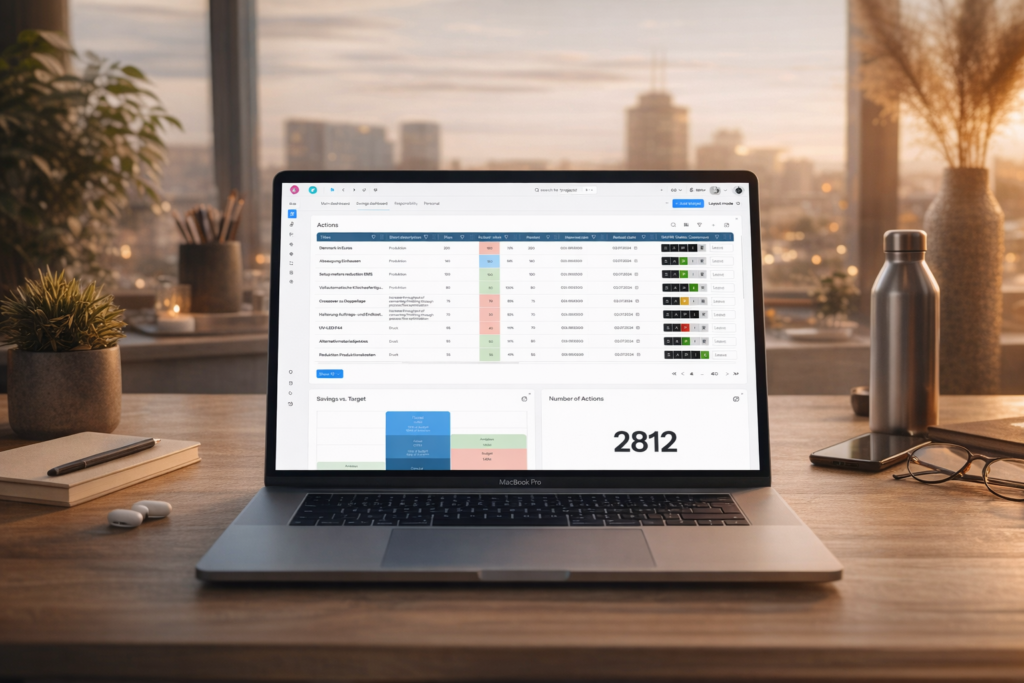


Lifecycle traceability for modular vehicle assembly means recording and maintaining the identity, status, and history of every component from supplier to final assembly line. For automotive manufacturers and suppliers across Mittelstand and enterprise, that capability reduces recalls, accelerates root-cause analysis, and supports quality and compliance.
Why lifecycle traceability matters in modular assembly
Modular assembly breaks vehicles into interchangeable building blocks. Without precise traceability, a single faulty module can be difficult to locate across batches and lines. Traceability to the line enables:
- Faster recall and containment by isolating affected vehicles and assembly steps
- Clear supplier accountability through immutable component histories
- Improved quality analytics by linking failures to specific modules, stations or lot numbers
- Operational transparency for multi-site or multi-tier supply chains
Key components of a traceability system
Build traceability around three pillars:

- Unique identifiers: serial numbers, batch IDs, or RFID tags that persist through the lifecycle.
- Reliable data capture: automated scans at receipt, inventory, kit, and line operations to avoid manual errors.
- Persistent storage and linking: a system of record (cloud or on-prem) that links component IDs to process events, line IDs and timestamps.
Integrating traceability with assembly lines and MES
Traceability must integrate into the Manufacturing Execution System (MES) and line controls so that every pick, fit, test and handover is logged. Practical steps:
- Map touchpoints where components change state (reception, kitting, line pick, joining, testing).
- Standardize scan events and data payloads (ID, timestamp, location, operator, process step).
- Ensure low-latency data flows from edge devices to the MES and traceability store to support real-time decisions.
Role of digital twins and interoperability
Digital twins provide a synchronized representation of assets and processes, which helps detect deviations and analyze failure modes. For traceability, link physical component histories to their digital counterparts to:
- Visualize component lineage across assembly stages
- Run simulations and root-cause analysis using historical data
- Detect drift in models that predict quality or process behavior
Use interoperable standards and open collaboration principles to avoid vendor lock-in and enable cross-system analytics. See how lifecycle governance and interoperable digital twin standards support these goals:
- Lifecycle governance for digital twins — detect model drift & retraining
- Interoperable digital twin standards and open collaboration
- Lifecycle governance — model monitoring and retraining
- Lifecycle governance — operationalizing digital twins
Implementation roadmap (practical for Mittelstand and enterprise)
- Define scope: choose pilot vehicle line, module family, or supplier lane.
- Inventory identifiers: decide on barcode, 2D code, RFID or a hybrid approach and standardize formats.
- Instrument capture points: equip receiving, kitting, and line stations with scanners and edge logging.
- Integrate with MES and ERP: ensure component events update production orders and vehicle build records.
- Link to analytics and digital twins: feed component histories into models and dashboards for visibility.
- Validate and iterate: run controlled tests, measure data quality, then scale across lines and sites.
Data governance, security and model maintenance
Maintain a clear data ownership model and retention policy. Protect traceability data with role-based access, encryption in transit and at rest, and secure APIs. For analytical models tied to traceability, monitor performance and retrain when drift is detected — lifecycle governance practices are essential; see the lifecycle governance resources above.
Common challenges and mitigations
- Poor identifier hygiene: enforce standards and quality checks at receipt.
- Manual interventions: automate scans and reconcile exceptions with workflows.
- Data silos: use open interfaces and agreed schemas to integrate MES, PLM and supplier systems.
- Scale and performance: design storage and indexing for high event rates and fast queries.
Key metrics and expected ROI
Measure success with:
- Mean time to resolution for quality incidents
- Reduction in recall scope and affected units
- Rate of successful first-pass assemblies tied to module trace histories
- Time saved in supplier fault attribution
Next steps
Start with a focused pilot that connects a single module family from receipt through one assembly line. Use that pilot to validate identifiers, data flows, and digital twin linkage, then expand. For guidance on governance and model lifecycle as you scale, review the lifecycle governance and digital twin resources linked above.
Weiterfuehrende Inhalte
- Lifecycle Governance for Digital Twins: Detect Model Drift and Manage Retraining
- Interoperable Digital-Twin-Standards for OE: From Silos to Open Collaboration
- Lifecycle Governance for Digital Twins: Detect Model Drift and Manage Retraining
- Lifecycle Governance for Digital Twins: Detect Model Drift and Manage Retraining
FAQ
What level of granularity is necessary for effective traceability?
Track at the smallest meaningful unit that allows you to isolate faults—often the serial or lot level for modules. Balance granularity with cost and data volume; start with critical modules and expand.
Can traceability work with existing MES and ERP systems?
Yes. Effective implementations integrate scan events and component histories into MES and ERP through APIs or middleware, preventing separate data silos and enabling real-time visibility.
How do digital twins improve traceability outcomes?
Digital twins link physical component histories to virtual models, enabling visual lineage, faster root-cause analysis, and simulation-driven diagnostics. They also help detect model drift and guide retraining for predictive use cases.
Ready to pilot lifecycle traceability on your modular assembly line? Contact our team to design a scoped proof-of-concept that integrates identifiers, MES events and digital twins. Review lifecycle governance best practices and interoperability guidance in our resources linked above.