


What is a Manufacturing Data Fabric?
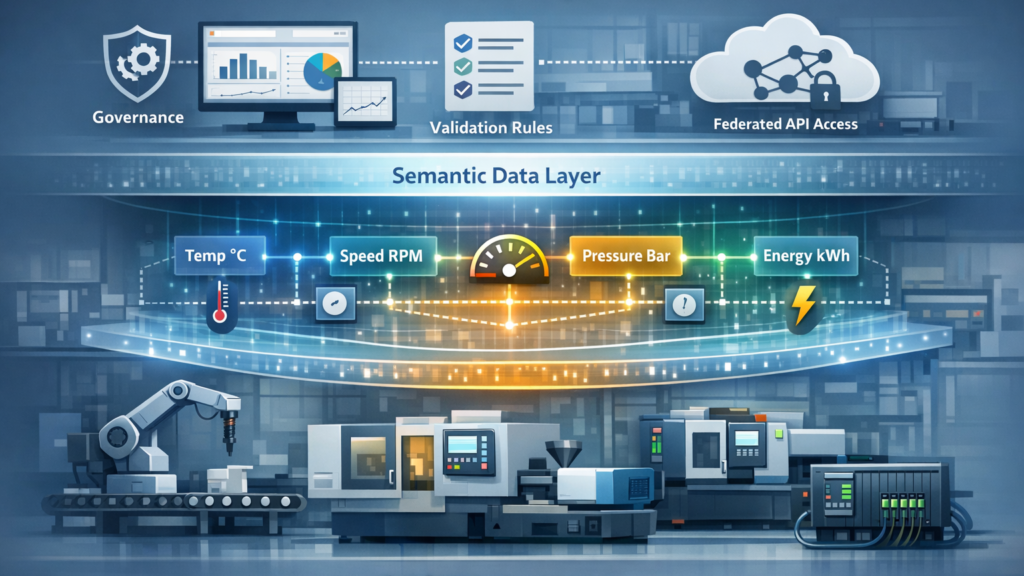
A Manufacturing Data Fabric is an architecture and set of services that unify data access, context and governance across heterogeneous shopfloor systems. It exposes a semantic layer that represents machines, lines, work orders and parameters in a consistent way so consuming systems—MES, analytics, digital twins, PLM and BI—get reliable, business-ready data without custom point-to-point integration work.
Why shopfloor data is unreliable today
Manufacturing environments typically contain a mix of PLCs, CNC controls, OPC-UA servers, historians, local SCADA, edge gateways and legacy databases. Differences in naming, units, update cadence, missing timestamps and intermittent device connectivity create noise and gaps. Integrations often hard-code mappings for a single use case, producing brittle pipelines that break when equipment changes or new use cases appear.
The role of the semantic layer

The semantic layer sits above raw telemetry and normalizes entities, attributes and relationships using domain-aware models. It maps raw signals to canonical concepts (for example: “motor_speed_rpm” → “SpindleSpeed” with units and validity rules), applies provenance metadata, and exposes a consistent API and schema for downstream consumers. This decouples consumers from device-level heterogeneity and provides one source of truth for definitions and quality rules.
Key capabilities of a Manufacturing Data Fabric
- Canonical data model: A shared ontology for equipment, assets, work orders, quality metrics and events.
- Signal mapping and normalization: Unit conversion, timestamp alignment and semantic tagging of raw signals.
- Validation and quality rules: Thresholds, range checks, completeness rules and anomaly flags with lineage.
- Contextualization: Enrich telemetry with production context—shift, lot, operator, recipe and routing.
- Federated access: A unified API and query layer that connects on-prem and cloud systems securely.
- Governance and provenance: Versioned schemas, access controls and data lineage to satisfy audits.
How it fits different company sizes and industries
– Mid-market manufacturers: Reduce recurring integration costs and speed up analytics projects by reusing mappings and validation logic across plants.
– Large industrial and enterprise environments: Scale semantic models across multiple sites, enforce governance, and deploy federated queries to avoid mass data movement.
– Automotive and highly regulated sectors: Ensure traceability from material lot to finished vehicle, with quality rules and provenance to support recalls and compliance.
Implementation considerations
Start with a clear scope: identify high-value assets, KPIs and consumers. Build a minimal canonical model for those use cases and iterate. Key practices:
- Profile existing signals to discover synonyms, units and gaps.
- Define validation rules with operations and quality teams to avoid false positives.
- Adopt a hybrid architecture: edge preprocessing for latency-sensitive checks, and a central semantic layer for cross-site consistency.
- Automate mapping capture where possible and store mappings as managed artifacts.
- Plan for governance: schema versioning, change management and access policies.
Business benefits and measurable outcomes
When the semantic layer and data fabric are implemented correctly, organizations typically see:
- Faster time-to-insight for analytics and OEE projects.
- Lower integration and maintenance costs through reuse of mappings and models.
- Improved data trust: fewer anomalies, higher completeness and clear provenance.
- Better interoperability between digital twins, MES and enterprise systems.
Quick checklist to evaluate solutions
- Does the platform provide a reusable canonical model for manufacturing domains?
- Can it normalize units, timestamps and signal names automatically or with minimal effort?
- Are validation rules configurable and versioned with lineage?
- Does it offer federated query and APIs to avoid unnecessary data replication?
- Are governance features—access control, schema versioning, and audit logs—built in?
- Does it integrate with your existing MES, historian and edge stack without heavy customization?
For more on interoperability and standards that support consistent semantic models for digital twins and manufacturing systems, see our resource on open collaboration and digital twin standards: Interoperable Digital Twin Standards — Open Collaboration.
Weiterfuehrende Inhalte
FAQ
What is the difference between a data lake and a Manufacturing Data Fabric?
A data lake stores raw data but does not provide semantic normalization, validation or domain models. A Manufacturing Data Fabric adds a semantic layer, consistent models and governance so downstream apps receive curated, trustworthy shopfloor data.
Can a Manufacturing Data Fabric work with legacy PLCs and historians?
Yes. A core purpose of the fabric is to connect heterogeneous sources—PLCs, historians, OPC-UA servers and edge gateways—apply mappings and validation, and expose normalized data to consumers.
How quickly can organizations start seeing value?
Value can appear within weeks for focused use cases (OEE, downtime analysis, quality checks) when you prioritize key assets and reuse canonical models. Broad enterprise rollouts take longer and benefit from iterative delivery and governance.
Ready to make shopfloor data reliable and interoperable? Learn how semantic models and open standards enable sustainable integration in manufacturing: Interoperable Digital Twin Standards — Open Collaboration