

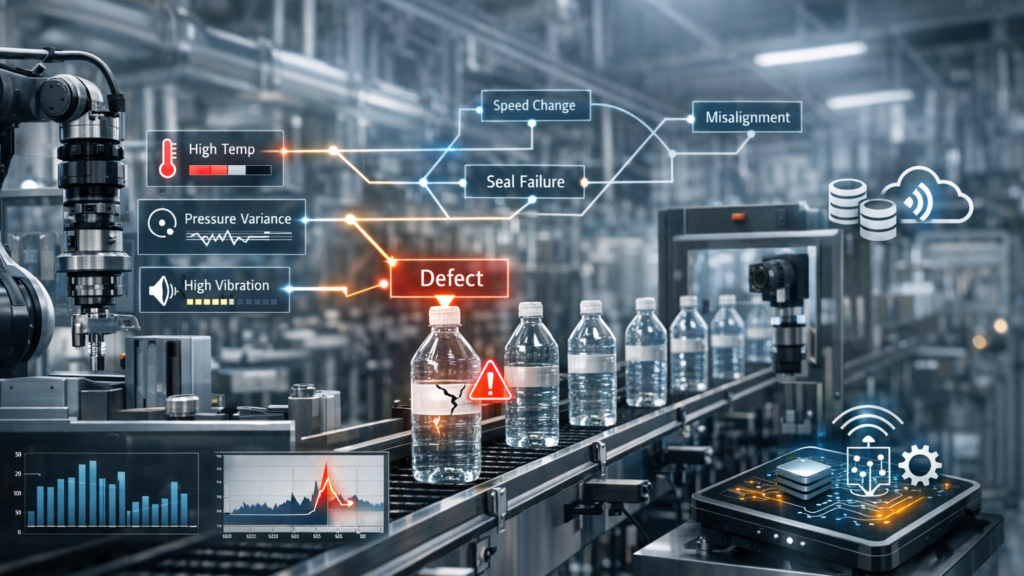

Manufacturers and automotive producers are drowning in sensor streams, MES logs, quality reports and ERP records. Traditional analytics highlights correlations—pressures rise when defects occur, temperatures drift before a fault—but correlations alone can mislead operations teams. Real-time causal analytics identifies which variables actually drive defects and enables automated or guided interventions that reduce scrap, rework and warranty costs.
Correlation vs. causation in production environments
Correlation answers “what moves together.” Causation answers “what moves when I change something.” In a production line, correlated signals can result from common drivers (ambient conditions), downstream effects, or feedback loops. Acting on correlation can waste time and create process instability. Causal analytics determines actionable levers—setpoints, sequence changes, maintenance actions—that reliably change defect rates.
Key components of real-time causal analytics
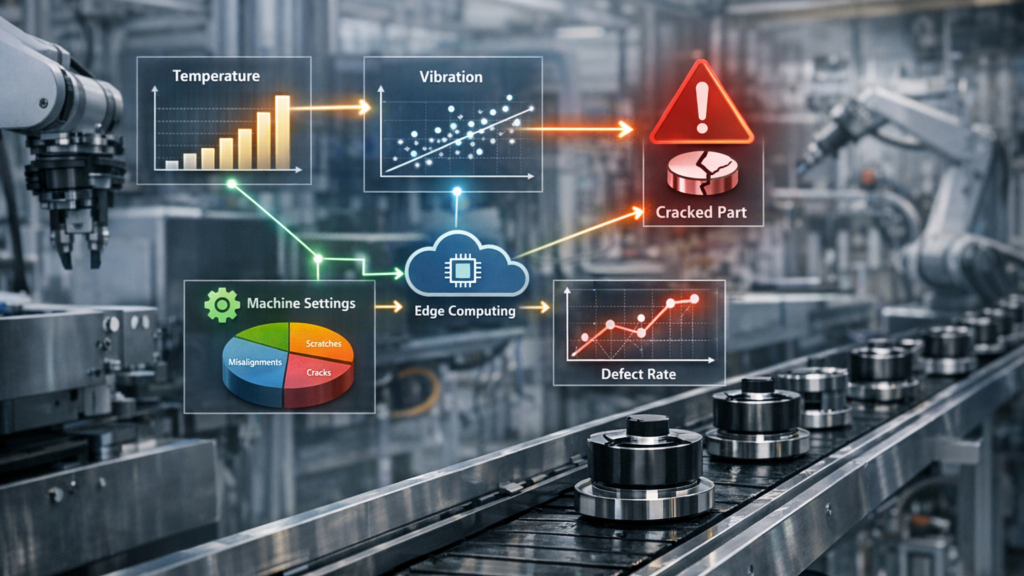
- High-fidelity time-series ingestion near the source (edge) to avoid latency and data loss.
- Data alignment and contextual enrichment (work order, SKU, operator, batch ID).
- Causal discovery algorithms that respect temporal order and domain constraints.
- Real-time intervention testing (A/B, do-operator simulations, synthetic controls).
- Operational integration to turn insights into alerts, control changes or operator guidance.
Data requirements and integration at the edge
Effective causal inference needs synchronized timestamps, stable identifiers (lot, serial number), and metadata (machine, tool, recipe). Edge-native collection preserves sub-second resolution and enables preprocessing (feature extraction, drift detection) before sending aggregated insights to central systems. This reduces bandwidth and improves reaction times on the line.
Analytical methods suited for real-time causal insights
- Causal discovery (constraint-based, score-based) tuned for time-series.
- Granger-causality with enhancements to avoid confounding bias.
- Interventional evaluation: controlled experiments, run-to-run comparisons, and synthetic control approaches when randomized tests are infeasible.
- Bayesian causal models for uncertainty quantification and robust decision-making.
Operationalizing insights: from detection to closed-loop control
Finding a causal relationship is only valuable if you can act on it. Operationalizing means:
- Translating causal findings into clear actions (adjust setpoint, change sequence, schedule maintenance).
- Implementing guardrails and validation steps to avoid unintended consequences.
- Automating interventions where safe, or routing recommendations to operators with contextual guidance.
Technology and services: edge-native process mining and realtime insights
Edge-native process mining and real-time insights platforms combine local data capture, process context and causal analytics to deliver rapid, explainable recommendations. These services support low-latency detection and enable experiments on live production lines without compromising throughput. See an example of edge-native process mining for manufacturing realtime insights in this resource: Edge-native process mining — realtime insights.
Implementation checklist for manufacturers and automotive firms
- Map critical defect modes and their production contexts.
- Inventory sensors, logs, and business data sources with timestamps and identifiers.
- Deploy edge collection where latency or data volume is critical.
- Run causal discovery on historical data, then validate with short controlled interventions.
- Integrate decisioning with MES/SCADA or operator screens and define rollback conditions.
- Monitor model performance and recalibrate as processes or recipes change.
Common pitfalls and how to avoid them
- Confounding variables: include contextual features (batch, operator, environment) to reduce bias.
- Pseudo-random experiments: when randomization is impossible, use synthetic controls and careful temporal controls.
- Overfitting to noise: prioritize causal stability across shifts, lines and batches.
- Ignoring human factors: pair automated actions with clear operator instructions and training.
Measuring ROI and continuous improvement
Quantify defect reduction, yield improvement, cycle-time impact and savings in rework or warranty. Use holdout periods and sequential A/B testing to measure persistent gains. Track adoption metrics—how often operators accept recommended interventions and the time to resolution—to keep analytics aligned with shop-floor realities.
Conclusion and next steps
Real-time causal analytics moves manufacturing teams from observation to intervention. For medium-sized manufacturers through enterprise and automotive OEMs, the combination of edge-native data capture, rigorous causal methods and operational integration reduces defects and preserves throughput. To learn practical steps and see applications, explore detailed examples and guidance here: GetBelean — detailed guidance.
Weiterfuehrende Inhalte
FAQ
What is the main advantage of causal analytics over traditional correlation-based analytics?
Causal analytics identifies which variables will change defect rates when you act on them, enabling reliable interventions; correlation only shows associations that may not be actionable.
Can causal analytics run in real time on the shop floor?
Yes—when combined with edge-native data ingestion and preprocessing, causal methods can deliver low-latency insights and support automated or operator-guided interventions.
What data do I need to get started?
Synchronized timestamps, stable identifiers (lot, serial), machine and recipe metadata, and quality outcomes. The more context (operator, shift, environmental data) you include, the better you can control confounding.
Is it safe to automate interventions based on causal findings?
Automated interventions can be safe if you implement guardrails, validation experiments, rollback conditions and operator oversight. Start with advisory actions and progress to automation after successful trials.
Ready to reduce defects with edge-native causal analytics? Learn how our edge-native process mining and realtime insights services help manufacturing and automotive teams move from correlation to action: Edge-native process mining — realtime insights. For implementation guidance and case examples, read more here: GetBelean detailed guidance.