


Introduction: Why digital twins matter for continuous improvement
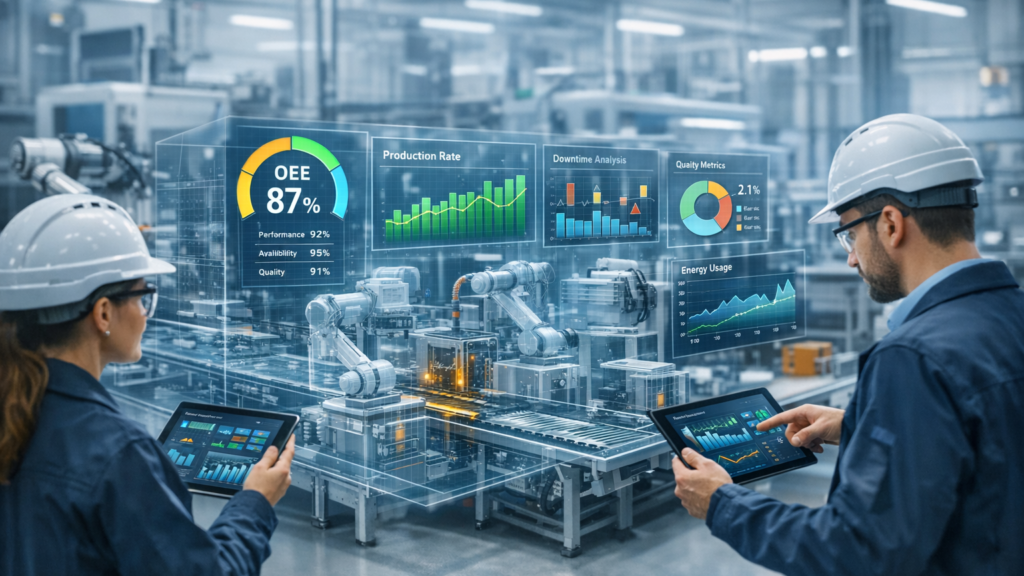
Manufacturers increasingly rely on real-time insights to improve uptime, quality and performance. Digital twins—live, data-driven models of assets, lines and processes—enable continuous improvement by turning operational data into actionable simulations and predictions. For small and mid-size enterprises (SMEs) as well as large industrial and automotive companies, the result is measurable OEE uplift: fewer unplanned stoppages, higher throughput and improved yield.
What is a digital twin and a live model?
A digital twin is a virtual representation of a physical asset, process or system that mirrors current state and behavior using sensor data, control logic and historical records. A live model extends that concept with continuous data ingestion and real-time analytics, allowing the twin to update instantly and run what-if scenarios, root-cause analyses and predictive maintenance forecasts.
How live models drive continuous improvement and raise OEE
- Faster root-cause analysis: Live correlation of process variables shortens the time to identify causes of downtime or quality loss.
- Predictive maintenance: Models forecast component degradation, allowing repairs during planned windows rather than causing unplanned stops.
- Process optimization: What-if simulations reveal parameter sets that increase throughput and reduce scrap.
- Standardized best practices: Digital twins capture optimal operating procedures and propagate them across lines and sites.
- Continuous feedback loop: Closed-loop adjustments from model outputs to control systems sustain incremental improvements over time.
Key use cases by segment
SMEs and mid-market manufacturers
Cost-effective, targeted twins for critical machines or a single production line can deliver quick OEE wins. Focus on easy-to-measure KPI improvements: availability, performance and quality. Start with a pilot on the bottleneck asset.
Large industrial and enterprise environments
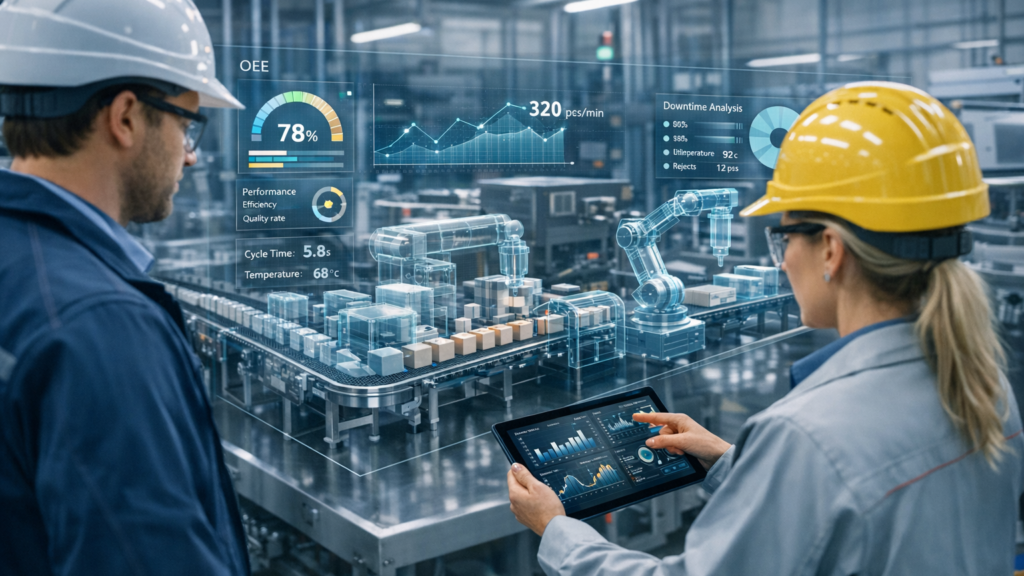
Scale twins across plants to harmonize operations, compare performance and roll out optimizations enterprise-wide. Integrate with MES, historians and PLCs to enable enterprise dashboards and site-to-site benchmarking.
Automotive
Use digital twins for assembly lines, powertrain test benches and paint shops. Live models help reduce changeover time, detect subtle quality drifts and coordinate maintenance across highly synchronized production sequences.
Implementation steps: From pilot to scaled adoption
- Define the objective: Choose a clear OEE-related goal (e.g., reduce unplanned downtime by 20%).
- Scope the pilot: Select a high-impact machine, cell or process with accessible data.
- Instrument and connect: Ensure reliable data collection—sensors, PLC tags and historian feeds.
- Model and validate: Build the live model, validate against observed behavior and refine parameters.
- Operationalize: Integrate outputs into operator interfaces, maintenance workflows and control loops.
- Scale: Use lessons from the pilot to template twins for other assets and sites.
Data, integration and governance best practices
Reliable live models depend on clean data, robust integrations and clear governance:
- Establish a single source of truth for time-series data and production events.
- Use deterministic mappings between PLC signals and model variables to avoid ambiguity.
- Implement access controls and data retention policies to protect IP and comply with regulations.
- Maintain model versioning and validation logs so changes are auditable and reversible.
KPIs and measurement: How to quantify OEE gains
Track OEE components before and after deploying the twin: availability (uptime), performance (cycle rate) and quality (good parts). Complement OEE with reduction in mean time to repair (MTTR), number of unplanned stops and improvement in throughput. Run A/B tests or phased rollouts to attribute gains to the live model and rule out external factors.
Common challenges and how to overcome them
- Data quality issues: Start with a limited number of high-value signals and add complexity iteratively.
- Integration complexity: Use industrial data brokers or IIoT gateways to unify heterogeneous protocols.
- Change management: Involve operators and maintenance early; demonstrate quick wins to build trust.
- Scalability: Build reusable model templates and standardize deployment patterns.
Next steps and recommended actions
Begin with a focused pilot targeting a bottleneck asset. Define clear success criteria tied to OEE, instrument the asset, validate a live model and operationalize outputs into daily workflows. Use measured results to secure broader investment and scale across lines and sites.
If you need a practical roadmap or help scoping a pilot, prepare a one-page summary: objectives, targeted asset, expected OEE uplift and required data sources. That document accelerates decision-making and vendor selection.
FAQ
What improvement in OEE can I expect from a digital twin pilot?
Expected OEE improvement varies by context. Typical pilots deliver 5–15% OEE gains from reduced downtime and scrap; larger, well-integrated programs can exceed that. Baseline measurement and phased rollouts provide reliable attribution.
How long does it take to build and validate a live model for a production asset?
A minimal pilot focused on a single machine or cell often takes 6–12 weeks to instrument, model and validate. Complexity, data availability and integration requirements can extend timelines for larger systems.
Ready to explore a pilot for boosting OEE with a digital twin? Prepare a one-page scope (objective, asset, data sources) and contact your internal automation or digitalization team to start the assessment.