


Manufacturing environments demand tight latency, high reliability and clear data control. An edge‑first machine learning (ML) strategy places inference and often parts of the ML lifecycle close to machines and sensors. That design reduces network dependence, improves responsiveness and preserves privacy — all essential for factories, production lines and automotive validation.
Why choose an edge‑first approach in manufacturing
Edge‑first ML means running inference at or near the data source (on controllers, gateways or local servers) and using the cloud primarily for training, aggregated analytics and orchestration. That approach matches common shop‑floor constraints:
- Low and deterministic latency: real‑time control and closed‑loop automation require millisecond responses that cloud round trips can’t guarantee.
- Network resiliency: factories often run on segmented or intermittent networks; local inference keeps systems operational even if connectivity drops.
- Data privacy and compliance: sensitive product or process data can stay on premises, simplifying regulatory and IP protections.
- Bandwidth and cost: sending only aggregated features, alerts or model deltas reduces cloud fees and on‑premise WAN costs.
Core benefits in practice
For manufacturers of all sizes — from Mittelstand to large enterprise and automotive OEMs — edge‑first ML delivers measurable benefits:
- Improved uptime: local anomaly detection and failover keep lines running during network outages.
- Faster decisioning: immediate inference enables closed‑loop adjustments such as robotic corrections or adaptive process controls.
- Reduced data movement: only relevant events or model summaries traverse networks, lowering costs and exposure.
- Scalability: distributed inference scales horizontally across devices without proportionally increasing cloud compute.
Recommended architecture
An effective edge‑first architecture separates responsibilities across layers while keeping operations manageable:
- Edge devices: sensors, vision modules, PLCs or embedded AI accelerators that run inference. Choose devices based on latency and accuracy requirements.
- Local gateways/edge servers: aggregate data, host heavier models or ensembles, handle buffering and coordinate OTA updates.
- Network and security layer: secure tunnels, device identity, TLS and local firewalls protect communications without exposing endpoints.
- Cloud control plane: model training, lifecycle management, aggregated analytics and long‑term storage. The cloud orchestrates rollouts and collects labeled feedback.
- Management layer: centralized monitoring, logging, metrics and CI/CD for models and code. Instrumentation must cover both edge and cloud.
Model lifecycle for edge deployments
Edge ML projects succeed when the model lifecycle is operationalized end‑to‑end:
- Training: use cloud or on‑prem GPU pools with representative data. Consider transfer learning to accelerate results.
- Optimization: quantization, pruning or conversion to runtime formats (e.g., ONNX, TensorRT) reduce resource needs while preserving accuracy.
- Deployment: staggered canary rollouts to gateways and devices, with automatic rollback on regressions.
- Monitoring: track inference drift, latency, resource usage and model accuracy using labeled feedback and synthetic tests.
- Updates: securely push model deltas, and when needed trigger on‑site retraining or federated learning for privacy‑sensitive data.
Deployment patterns by organization size
- Mittelstand / SMEs: start with targeted pilots (one line or cell). Use compact edge devices and cloud for training to keep costs predictable.
- Industrial / Produzierendes Gewerbe: deploy edge clusters at plant level, integrate with MES/SCADA, and automate inference monitoring across sites.
- Enterprise & Automotive: adopt hybrid architectures with validated CI pipelines, strong security controls and regulatory traceability for safety‑critical applications.
Concrete use cases
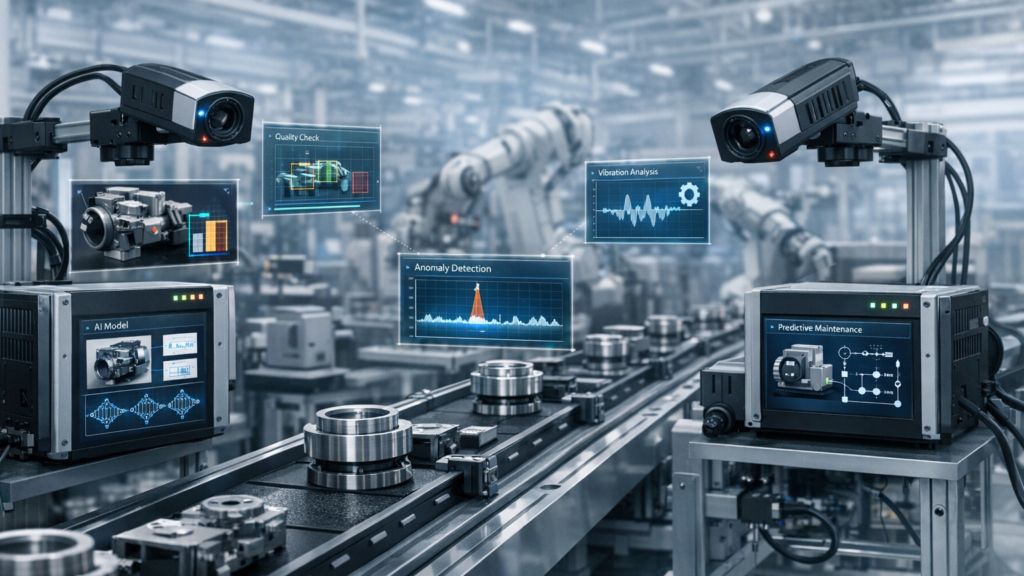
- Predictive maintenance: local anomaly detection on vibration or current signals to trigger immediate protective actions and reduce downtime.
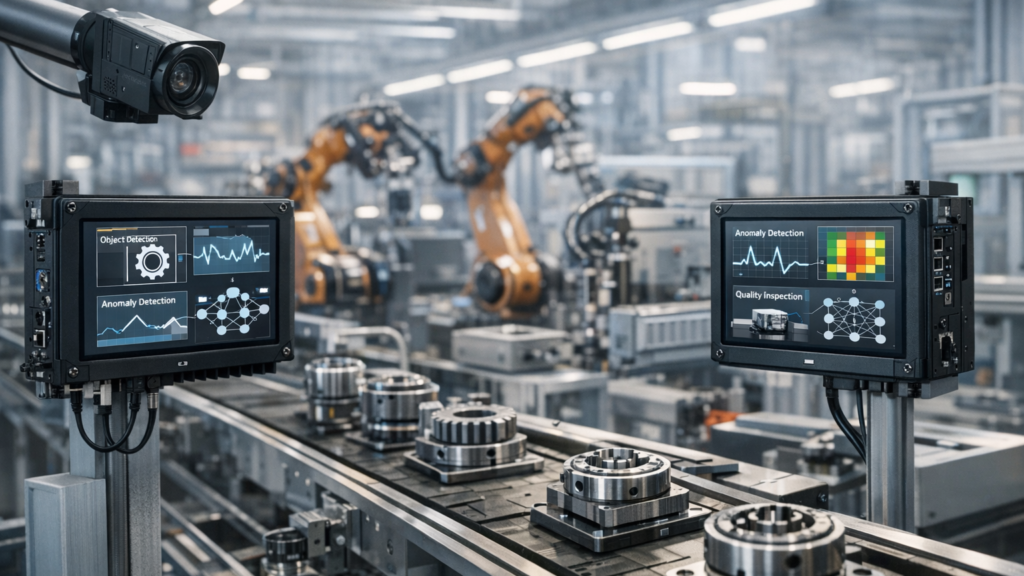
- Quality inspection: on‑camera vision models that reject defects at line speed without sending full video streams offsite.
- Robotics & motion control: real‑time pose estimation and collision avoidance for collaborative robots.
- Energy optimization: local control loops that adapt HVAC or drive systems based on edge ML forecasts.
- Automotive validation: edge devices capture and label sensor anomalies during test runs; summarized telemetry is sent to cloud for model retraining.
Operational considerations
Implementing edge‑first ML introduces operational tradeoffs to plan for:
- Security: secure boot, device identity, signed models and encrypted communications are non‑negotiable.
- Maintainability: automated rollouts, health checks and remote debugging tools reduce onsite interventions.
- Data governance: define which data stays local, what can be aggregated, and how labels flow back for retraining.
- Performance validation: test models under realistic load and environmental conditions to ensure robustness.
- ROI tracking: measure reduced downtime, scrap, rework and network costs to justify scaling up pilots.
Quick checklist to evaluate an edge‑first project
- Is real‑time inference or network resilience required? If yes, prefer edge‑first.
- Can models be optimized to run on available hardware (CPU, GPU, NPU)?
- Are there privacy or compliance constraints that favor local processing?
- Is there an operational plan for OTA updates, monitoring and rollback?
- Have you defined success metrics (downtime reduction, defect rate, cost savings)?
Edge‑first ML is not an all‑or‑nothing decision. Start with high‑impact, low‑complexity pilots — quality inspection or vibration anomaly detection are good first candidates — then expand patterns that prove reliable, secure and cost‑effective.
FAQ
What is the difference between edge‑first and cloud‑first ML?
Edge‑first runs inference primarily near data sources to reduce latency and network dependence; cloud‑first centralizes inference and is simpler to manage but can suffer from higher latency and data transfer costs.
Can edge devices handle complex ML models?
Many edge devices now include accelerators (NPUs, GPUs) and models can be optimized via quantization, pruning or conversion to efficient runtimes. For very large models, use gateways or hybrid inference where part of the pipeline runs locally and part in the cloud.
How do you update models on hundreds of devices securely?
Use a cloud control plane or management platform that supports signed model packages, staged rollouts, health checks and automatic rollback. Ensure device identity and secure transport.
Which manufacturing use case should I pilot first?
Choose a high‑impact, well‑scoped problem with available labeled data. Common starters are visual quality inspection or vibration‑based predictive maintenance.
Ready to evaluate an edge‑first ML pilot?
Contact our team to define a pilot scope, hardware needs and a measurable ROI plan.