

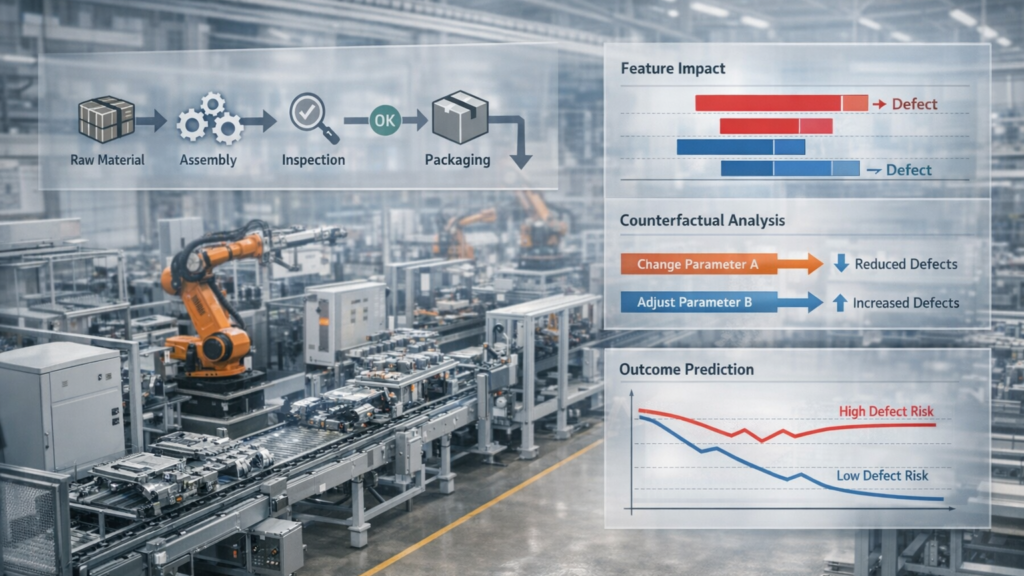

What this article covers: why explainable AI (XAI) matters for quality management, how it makes root-cause analysis transparent, practical methods for manufacturing and automotive settings, and concrete steps to integrate XAI with process mining and prescriptive remediation.
Why explainability matters in quality management
Quality teams need reliable, actionable explanations—not just predictions. Black-box models can flag anomalies or predict defect risk, but without clear reasons their outputs are hard to trust and act on. Explainable AI provides interpretable insights: which variables, process steps, or supplier batches drove a defect probability and how confident the model is in that conclusion.
How Explainable AI supports root-cause analysis
XAI helps in three ways:
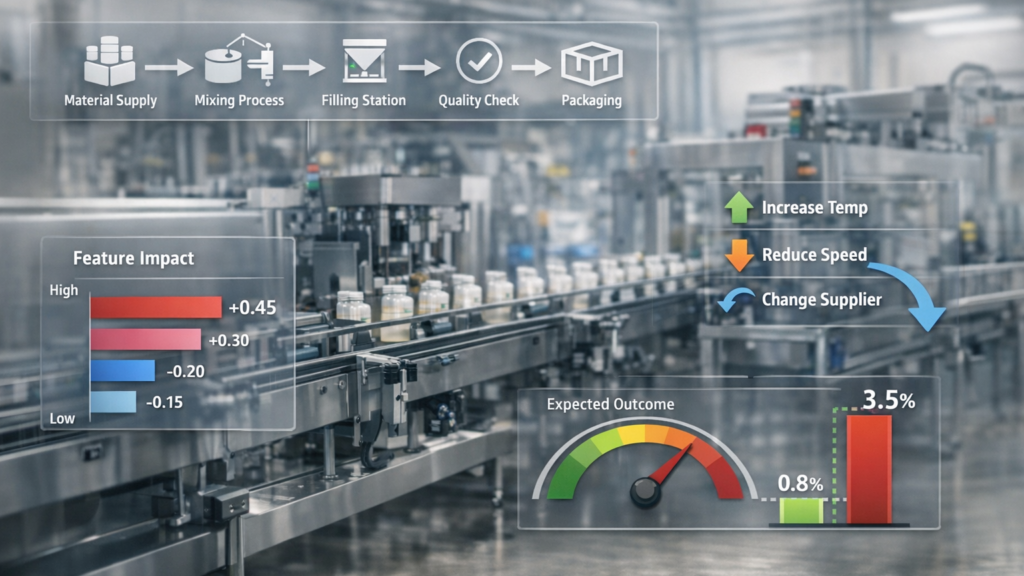
- Transparency: Shows contributing factors for each prediction (feature importance, counterfactuals).
- Traceability: Links model outputs to process data, timestamps and production records so findings can be validated against the shop floor.
- Actionability: Suggests targeted interventions (process adjustments, supplier checks, operator retraining) tied to identified causes.
Practical XAI methods for manufacturing and automotive
Choose methods that match your data volume and regulatory needs:
- Feature importance and SHAP values: Quantify each factor’s contribution to a specific defect prediction. Useful for sensor-rich manufacturing lines.
- Partial dependence and ICE plots: Show how changing one variable affects defect risk while holding others constant.
- Counterfactual explanations: Identify minimal changes needed to alter an outcome (e.g., adjust temperature by X to avoid a defect).
- Rule extraction and surrogate models: Generate simple decision rules approximating complex models for operator-level guidance.
Integrating XAI with process mining and prescriptive actions
Process mining maps the actual steps and variants of your production process. When you combine it with XAI, you get both a structural view (where in the process defects occur) and a causal view (why they occur).
For targeted remediation, pair XAI insights with prescriptive process mining workflows. Prescriptive tools prioritize the most impactful process changes and simulate effects before rollout. For dedicated solutions that combine process mining with prescriptive recommendations, review prescriptive process mining services that align analytics to concrete corrective actions: Prescriptive Process Mining — BeLean and an alternate service overview: Prescriptive Process Mining — BeLean (alternate).
Implementation checklist for industrial quality teams
- Data readiness: Ensure timestamped event logs, sensor data, batch and supplier metadata are linked and cleaned.
- Model selection: Balance performance and interpretability—consider ensembles with post-hoc explainability if needed.
- Explanation standards: Define which explanation types are acceptable for different stakeholders (operators, engineers, auditors).
- Validation loop: Establish on-floor validation of explanations: sample cases, run root-cause checks, adjust models.
- Governance: Document model versions, data sources and reporting lines for decisions informed by XAI.
- Prescriptive action pipeline: Connect XAI outputs to prioritized corrective workflows and measure impact.
Common pitfalls and how to avoid them
- Over-reliance on single explanations: Use multiple explanation methods and cross-validate with domain experts.
- Poor data lineage: Incomplete event logs undermine traceability—invest in data integration first.
- Lack of operator buy-in: Present explanations in operational terms and embed them into existing corrective procedures.
- Regulatory and safety oversight: For automotive and regulated industries, maintain auditable explanation records and conservative validation thresholds.
Case example: reducing defects with transparent root-cause insights
A manufacturing line experiences intermittent leakage in an assembly. A combined XAI and process-mining approach:
- Aligned event logs and test measurements to specific batches and shifts.
- Trained a model to predict leakage events and used SHAP to identify key contributors: clamp torque variation and a specific supplier valve serial range.
- Used process mining to locate the defect cluster in a particular assembly variant and shift pattern.
- Implemented a targeted prescriptive change—adjust clamp torque tolerance and quarantine valves from the suspect supplier range—then monitored defect rate decline.
This workflow reduced leakage incidents and created a documented, auditable trail linking root-cause explanation to corrective action.
Key takeaways
Explainable AI turns predictions into trustworthy, verifiable root-cause insights. For industry and automotive quality teams, the value is practical: faster investigations, targeted fixes, and auditable decisions. Pair XAI with process mining and prescriptive tooling to close the loop from detection to corrective action.
Weiterfuehrende Inhalte
- Prescriptive Process Mining Platforms: From Insights to Direct Improvements with BeLean
- Prescriptive Process Mining Platforms: From Insights to Direct Improvements with BeLean
FAQ
What is Explainable AI (XAI) and why is it important for quality management?
Explainable AI provides interpretable reasons behind model outputs—e.g., which variables influenced a defect prediction and how. For quality management, this transparency enables teams to validate findings, prioritize fixes, and maintain regulatory and safety compliance.
How does XAI differ from traditional root-cause analysis?
Traditional root-cause analysis relies on manual investigation and statistical tests. XAI augments that by surfacing data-driven contributors from complex models, linking them directly to process events and enabling faster, scalable investigations.
Can XAI be integrated with process mining tools?
Yes. XAI explains model predictions while process mining identifies where in the process issues occur. Combining both provides a structural and causal view that supports targeted, prescriptive interventions.
What are practical first steps for implementing XAI in manufacturing?
Start with data readiness (clean event logs and sensor data), pick interpretable methods (SHAP, counterfactuals), validate explanations on the floor, and connect findings to prescriptive remediation workflows.
Ready to make root-cause analysis transparent and actionable? Explore prescriptive process mining solutions that integrate analytics with corrective recommendations: Prescriptive Process Mining — BeLean or see the alternate overview: Prescriptive Process Mining — BeLean (alternate). Contact your analytics team to start a pilot that pairs XAI with process mining.