


Companies in manufacturing, automotive and enterprise operations face two recurring challenges: making Standard Operating Procedures (SOPs) easy to consume, and handling product/process variants consistently. Generative AI can help by producing concise SOP summaries, surfacing variant-specific instructions, and highlighting differences that matter to operators and engineers.
This article explains practical benefits, limits and implementation steps so production teams and managers can evaluate generative AI for SOP summarization and variant handling without overpromising results.
Why SOP summarization and variant handling matter
Long, inconsistently authored SOPs slow onboarding, increase dependency on subject-matter experts, and raise the risk of execution errors — especially when numerous product variants or process branches exist. Clear, variant-aware SOPs reduce cognitive load for operators, speed training and make deviations easier to detect.

What generative AI brings — and what it doesn’t
- What it brings: automated concise summaries, extraction of key steps, variant-aware instruction snippets, quick mapping between product configurations and required tasks.
- Limits to consider: models can hallucinate or omit critical constraints; output needs validation against source SOPs and domain rules; regulatory and traceability requirements often demand human sign-off.
Typical use cases
- Faster onboarding: new hires receive short, task-focused summaries and checklists before deep-dive training.
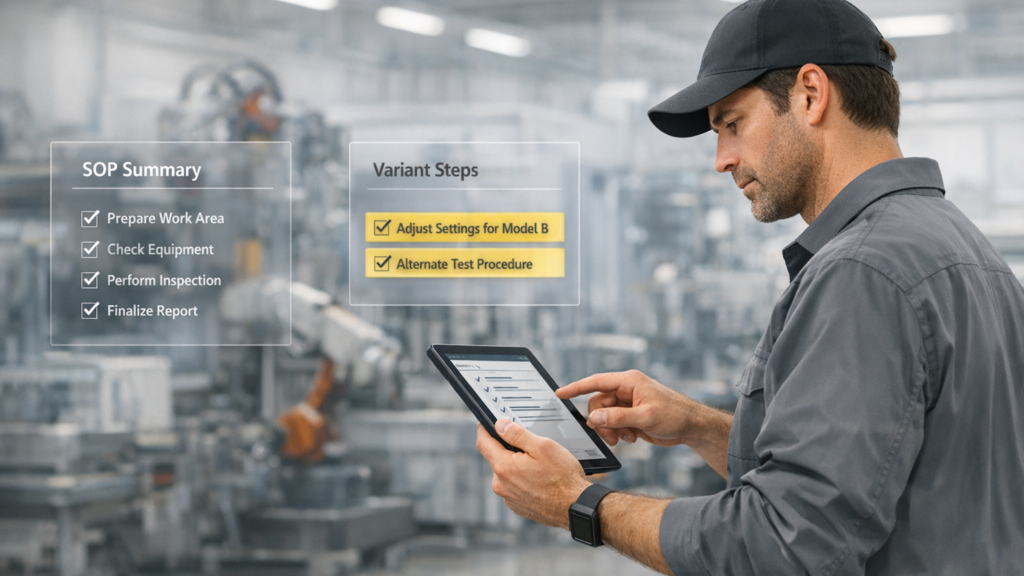
- Changeover and variant management: AI generates stepwise differences between variants so technicians see only the relevant deviations.
- Quality and compliance support: AI highlights mandatory steps and critical control points that require verification.
- Knowledge preservation: extract tacit expert notes from long SOPs into accessible guidance.
Implementation steps
- Inventory and classification: gather SOPs, associate them with product families and variant attributes.
- Data preparation: standardize headings, tag critical steps and safety elements, capture meta-data (revision, owner, machine).
- Model selection and prompt design: choose a model with enterprise-grade controls; design prompts to produce checklists, summaries and variant-specific instructions.
- Human validation loop: establish SME review, version control and sign-off processes before publishing AI-generated content.
- Integration: connect AI outputs to existing SOP repositories, work instruction systems or shop-floor tablets so summaries appear alongside canonical documents.
- Monitoring and feedback: log corrections and operator feedback to retrain or refine prompts and rules.
Integration and workflow patterns
Common approaches include: generating a short “operator checklist” alongside the full SOP, producing delta reports that list only changes for a variant, and embedding context-sensitive snippets into MES or digital work instruction systems. Keep the authoritative SOP as the source of truth and surface AI summaries as aids, not replacements.
Governance, traceability and error mitigation
To reduce risk:
- Keep a clear auditable link between AI outputs and source SOP revisions.
- Require SME approval for any AI-generated instruction used on the shop floor.
- Use rule-based guards to flag or block outputs that omit safety-critical steps or conflict with regulatory language.
Measuring impact
Track KPIs such as time-to-competency for new hires, first-time-right rates, changeover time and number of SOP-related deviations. Combine quantitative metrics with qualitative operator feedback to validate usefulness and safety.
Getting started checklist
- Map SOPs to product/process variants.
- Identify safety-critical steps and compliance requirements.
- Run a small pilot: generate summaries and deltas for a limited set of SOPs and collect SME and operator validation.
- Integrate accepted outputs into your SOP system and instrument user feedback.
For a concrete example of how generative AI can work with standardized work instructions and SOPs in manufacturing, see our implementation overview and service options at Generative AI for Standardized Work Instructions & SOPs.
When applied with appropriate governance and human-in-the-loop validation, generative AI shortens onboarding, reduces execution errors and makes variant handling more transparent — delivering practical value for mid-size manufacturers, large enterprises and automotive suppliers.
Weiterfuehrende Inhalte
FAQ
Can generative AI replace formal SOP documents?
No. AI-generated summaries and variant snippets are aids to improve usability. The formal SOP should remain the canonical, auditable source and any AI output must be validated and signed off by SMEs where required.
How do we prevent AI from hallucinating critical steps?
Use tightly constrained prompts, integrate rule-based checks that ensure presence of safety-critical steps, and enforce an SME review step before publishing outputs for shop-floor use.
What quick wins should we pilot first?
Start with SOP summarization for onboarding and delta reports for the most frequent variant changeovers. These pilots are low risk, fast to validate and show measurable improvements in training and changeover time.
Ready to pilot generative AI for SOP summarization and variant handling? Learn how our services bridge AI outputs with standardized work instructions: Explore service options.