


Modern production and industrial environments generate large volumes of sensor, log and telemetry data. Automated anomaly detection flags unusual patterns, but not every alert is actionable. Human-in-the-loop (HITL) anomaly triage pairs AI screening with targeted human review to route the right alerts to the right people and reduce time to resolution.
What is human-in-the-loop anomaly triage?
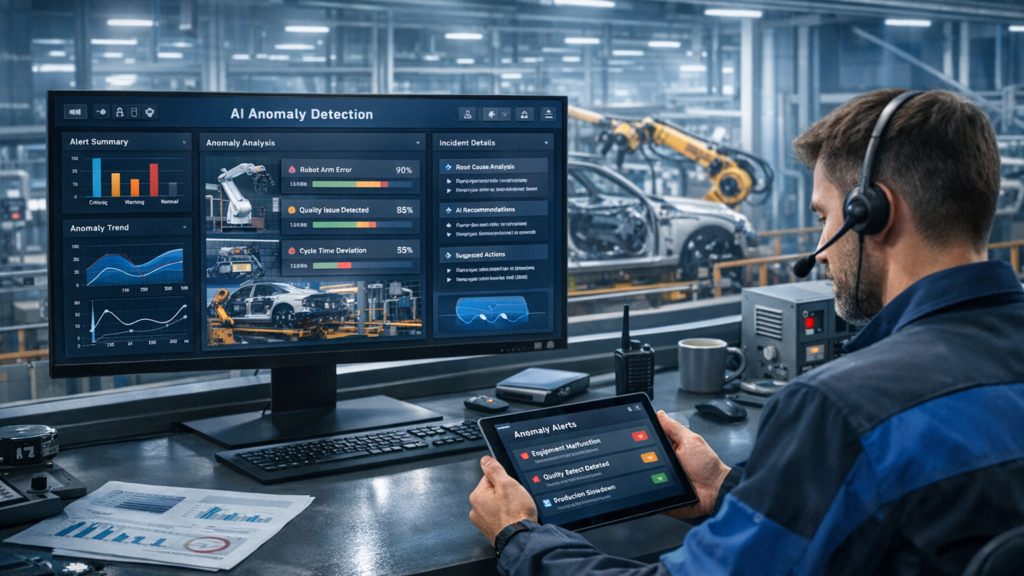
HITL anomaly triage is a hybrid process: machine learning models continuously scan operational data to surface potential issues, and humans validate, prioritize, and enrich alerts. The goal is to filter noise, improve decision quality, and accelerate remediation by leveraging both automated scale and human judgment.

How HITL combines AI and human expertise
- Automated detection: Models detect deviations from expected behavior and assign confidence scores.
- Smart routing: Alerts are routed to specialists based on severity, equipment, or domain context.
- Human triage: Engineers validate alerts, add context, and decide on actions or escalate further.
- Feedback loop: Human labels and decisions feed back into model training to improve precision over time.
Benefits for Mittelstand, industrial manufacturers, and automotive enterprises
- Less alert fatigue: Prioritized, higher-quality alerts let teams focus on real incidents.
- Faster resolution: Combining automation and expert judgment reduces time to identify root cause and remediate.
- Scalable expertise: Subject-matter experts can validate edge cases while routine triage stays automated.
- Better model accuracy: Continuous human feedback improves detection precision and lowers false positives.
- Operational resilience: Clear triage workflows and accountability reduce downtime risk in critical systems.
Typical workflow and architecture
A standard HITL triage system includes data ingestion, anomaly detection models, a prioritization and routing layer, a human review interface, and a feedback channel into model retraining. The human review interface should present context — recent trends, related alerts, relevant logs, and suggested next steps — so reviewers can decide quickly and consistently.
Implementation steps for operational teams
- Start with prioritized use cases: target high-impact assets or failure modes first.
- Instrument data sources and ensure consistent labeling and context capture.
- Deploy baseline anomaly detectors and define confidence thresholds for human review.
- Design routing rules so alerts reach the right role or team.
- Build a concise human review UI that captures decisions and reasons.
- Establish a feedback loop: use human labels to retrain and tune models.
- Measure outcomes and iterate: monitor resolution time, false positive rate, and reviewer workload.
Best practices and governance
- Define clear ownership and escalation paths for reviewed alerts.
- Use small, measured model updates informed by labeled data rather than frequent large changes.
- Document review guidance and maintain reviewer training to reduce variability.
- Protect data and implement role-based access for sensitive operational details.
Common challenges and how to address them
Challenges often include noisy alerts, inconsistent labels, and integration friction with existing workflows. Address these by tightening detection thresholds, standardizing labeling taxonomies, automating context aggregation, and integrating triage interfaces with the teams’ ticketing or incident management tools.
Measuring success and continuous improvement
Track metrics such as mean time to acknowledge, mean time to resolve, false positive rate, and reviewer throughput. Combine quantitative tracking with periodic qualitative reviews to refine routing rules and update model objectives.
Further resources
For a practical implementation guide and reference architecture, learn more about human-in-the-loop anomaly triage and how it fits into operational practices: Human-in-the-Loop Anomaly Triage.
Weiterfuehrende Inhalte
FAQ
What types of anomalies should be triaged with HITL systems?
Start with anomalies that are high-impact or have complex root causes, such as unusual vibration patterns on critical equipment, intermittent network degradations, or safety-related sensor deviations. Routine, low-risk alerts can remain fully automated.
Will human review slow down incident handling?
If designed correctly, HITL speeds overall resolution. Automation filters low-value alerts and presents prioritized, contextualized alerts to humans, so reviews are focused and faster than handling raw alert streams.
Is HITL suitable for small and mid-sized manufacturers?
Yes. HITL scales to the business case: begin with a small set of assets or lines, validate the process and ROI, then expand. The approach reduces wasted effort and helps teams manage limited expert capacity.
What skills are required to run a HITL triage program?
You need operational domain experts, data engineers to manage data pipelines, ML engineers to maintain models, and product or platform owners to design routing and reviewer workflows.
Interested in implementing HITL anomaly triage for your operations?