


Introduction

Lean Thinking is not a theoretical framework — it is a practical management approach that reduces waste, improves quality and shortens lead times. For German Mittelstand companies (small and medium-sized enterprises), applying Lean delivers measurable gains in productivity, customer satisfaction and competitiveness. This guide explains the seven core principles of Lean Thinking and shows how BeLean’s services can help you apply them in practice.
The 7 Principles of Lean Thinking — a quick overview
Lean Thinking centers on seven interdependent principles: specify value, map value streams, create flow, establish pull, pursue perfection, respect people and manage for the system. Applied together, they transform operations from firefighting to deliberate, continuous improvement.
1. Specify Value: Focus on the customer
Define value from the customer’s point of view — not from internal routines. For a Mittelstand manufacturer, value may be on-time delivery, consistent part quality and documentation. Techniques: voice-of-customer interviews, order analysis, and defining value-added vs non-value-added activities.
Practical step: run a short workshop with sales, production and service to list top 3 customer requirements and align processes to those needs.
2. Map Value Streams: Reveal waste
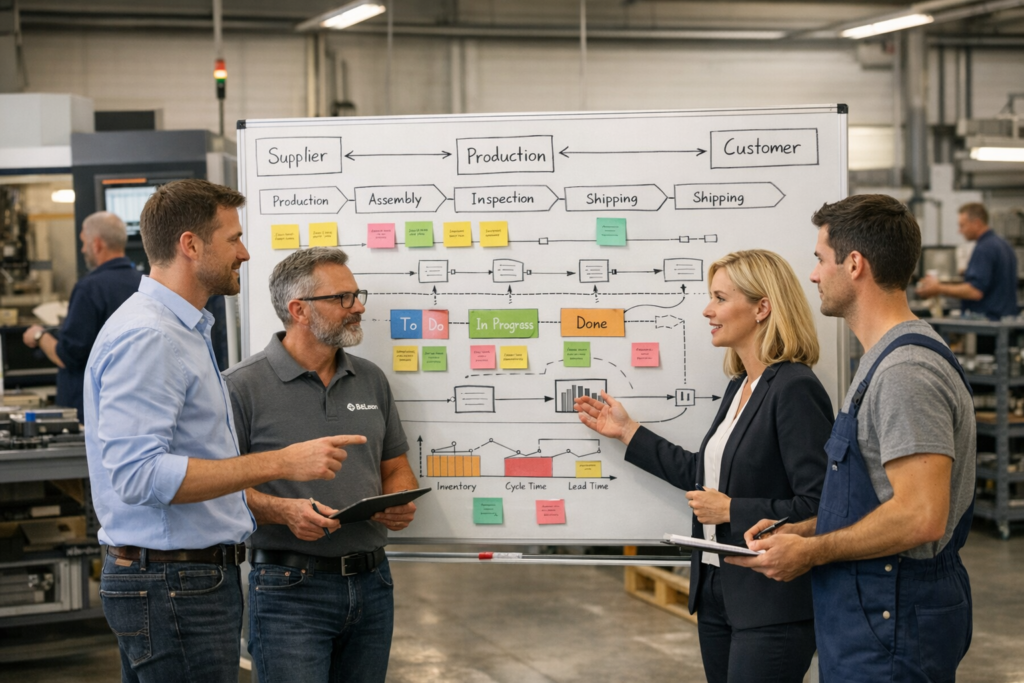
Value stream mapping (VSM) exposes the flow of materials, information and decisions. Map current-state first — identify wait times, rework loops and excess inventory. Then design a future-state map that eliminates the biggest wastes.
Practical step: use a one-day VSM event on a representative product line to create a baseline and a 30-60-90 day improvement backlog.
3. Create Flow: Reduce delays and handoffs
Flow means moving value through processes without interruption. Techniques include cell layouts, standardized work, takt time and quick changeovers (SMED).
Practical step: standardize the most common setup and document it on a single A3 sheet for every shift.
4. Establish Pull: Deliver what is needed, when needed
Pull systems (kanban, supermarket, order-based replenishment) prevent overproduction and free up cash. For SMEs, start with simple visual kanban rules and scale incrementally.
Practical step: pilot a two-bin kanban for one critical subassembly to stabilize inventory and reveal process variation.
5. Pursue Perfection: Continuous improvement loops
Lean is ongoing. Daily stand-ups, PDCA cycles, and small experiments compound into large gains. Build a routine for improvement suggestions and rapid experiments.
Practical step: set a daily 15-minute improvement huddle and require one small experiment per week per team.
6. Respect People: Empower frontline teams
Respecting people means training, involving and trusting employees to solve problems. Employee engagement unlocks contextual knowledge and sustainable improvements.
Practical step: create cross-functional problem-solving teams and release 1–2 hours per week for structured improvement work.
7. Manage for the System: Strategy, KPIs and governance
Lean succeeds when aligned with strategy and supported by governance. Use a small set of meaningful KPIs (lead time, first-time quality, inventory turns, on-time delivery) and review them in regular management cadences.
Practical step: establish a monthly Lean board review that connects shopfloor metrics to company targets.
How BeLean helps implement the 7 principles
BeLean provides services tailored to Mittelstand needs: value stream workshops, shopfloor coaching, continuous improvement training, digital kanban and performance dashboards. Our consultants focus on rapid, measurable results and transfer skills to your teams so improvements stick.
Learn more about our approach to continuous improvement on the BeLean Insights page: Continuous Improvement, and about our purpose and values on the BeLean About page: About BeLean.
Step-by-step implementation plan for a Mittelstand business (90-day starter)
- Week 1–2: Leadership alignment — clarify value and targets.
- Week 3–4: Value stream mapping and quick wins identification.
- Week 5–8: Pilot flow and pull solutions on one product family.
- Week 9–12: Rollout standardized work, start daily huddles and measure KPIs.
- Month 4+: Scale successful pilots and embed governance and training.
Common challenges and how to overcome them
- Resistance to change — mitigate with visible leadership support and small early wins.
- Capacity constraints — protect focused improvement time by adjusting short-term schedules.
- Data gaps — start with visual metrics and manual tracking before investing in integrations.
Measuring success: KPIs and examples
Track lead time reductions, first-pass yield improvements, inventory turns and on-time delivery. Example: a medium-sized component maker reduced lead time by 30% and inventory by 20% after a 12-week pilot by applying flow and kanban.
Next steps
If you want to pilot Lean Thinking quickly, start with a focused VSM event and a two-week coaching engagement. BeLean can run the workshop, coach your team and deliver a prioritized improvement roadmap tailored to Mittelstand constraints.
Internal resources
Read more about continuous improvement and BeLean’s purpose to understand how we partner with businesses: Continuous Improvement and About BeLean.
FAQ
What is the first step for a Mittelstand company starting Lean?
Start with leadership alignment on customer value and run a short value stream mapping workshop to identify the biggest wastes and quick wins.
How fast can Lean deliver measurable results?
You can expect measurable wins within 8–12 weeks from a focused pilot (lead time, quality, inventory). Sustained transformation takes longer as skills and governance embed.
Do I need expensive software to implement Lean?
No. Many Lean improvements begin with low-tech solutions (visual boards, kanban bins, standardized work). Digital tools can scale and automate metrics once processes are stable.