


Digital twins increasingly drive operational decisions across manufacturing, automotive, and enterprise settings. Lifecycle governance ensures those twins remain accurate, safe, and aligned with business outcomes as systems, environments, and data change. This article explains how to detect model drift, set retraining rules, and operationalize governance in industrial contexts.
Why lifecycle governance matters for digital twins
Digital twins combine models, data streams, and business logic to represent assets, processes, or systems. Over time, inputs and conditions shift: sensors age, production mixes change, software updates modify behavior. Without governance, model outputs diverge from reality, risking degraded performance, wrong actions, or regulatory issues. Governance provides the policies, metrics, and workflows to maintain trust and value throughout the twin’s life.
Types of model drift and their impact
Understand the common drift types so you can design targeted detection and response:
- Data drift: Input distributions change (e.g., new sensor calibration), which can bias predictions.
- Concept drift: The relationship between inputs and target changes (e.g., a new production process alters failure modes).
- Label drift: Ground-truth definitions evolve (e.g., a redefined defect classification).
- Performance degradation: Overall metrics (accuracy, error rates) decline even if input stats look stable.
Key metrics and monitoring to detect drift early
Monitoring must be continuous and actionable. Track at minimum:
- Input distribution stats: means, variances, histograms, and population stability indexes per feature.
- Model output distribution: prediction probabilities, class balance, and confidence shifts.
- Performance metrics: error rates, mean absolute error (MAE), precision/recall on recent labeled data.
- Business KPIs: downtime, throughput, scrap rate, energy use tied back to model outputs.
Combine statistical tests (KS test, PSI) with practical thresholds tied to operational impact. Alerting should prioritize KPIs and high-risk assets.
Data and feature governance that prevent spurious drift
Many false alarms stem from poor data hygiene. Implement:
- Source catalogs and lineage so you know where sensor values originate and how they transform.
- Schema checks and validation rules to catch unit changes or missing channels.
- Feature versioning to track how pipeline transforms evolve.
- Sampling strategies to ensure labeled evaluation sets reflect current operating regimes.
Decision rules for when to retrain
Retraining should be a controlled action, not an automatic reflex. Define rules that combine signals:
- Statistical thresholds (e.g., PSI > 0.2 on critical features).
- Sustained KPI degradation over a defined window (e.g., 7 production shifts).
- Availability of fresh, representative labeled data for validation.
- Risk classification of the model’s decisions — higher-risk models require stricter criteria and more human review.
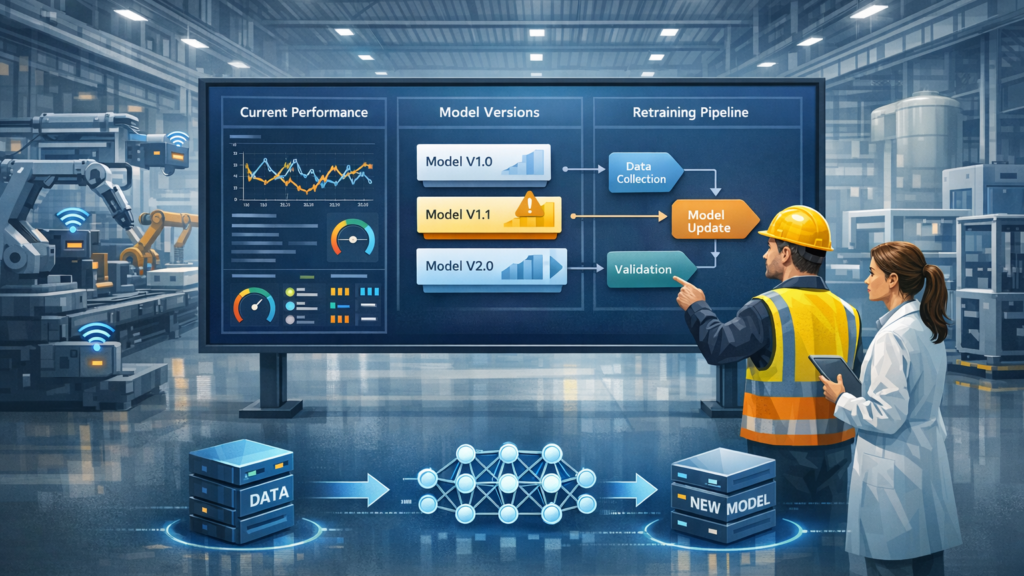
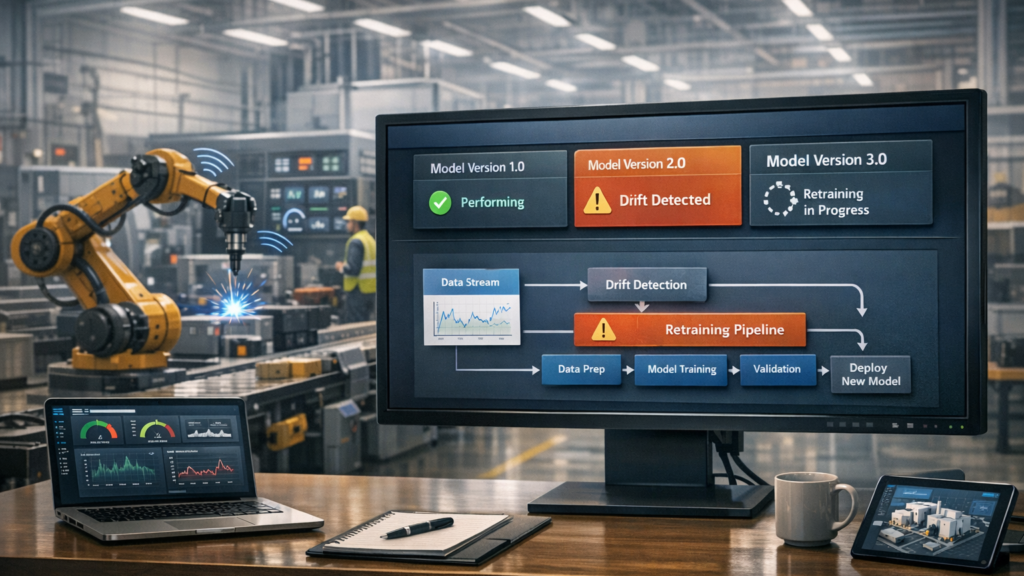
Use a tiered approach: monitoring → investigate → candidate retraining → validation → deploy. Reserve fully automated retraining for low-risk, well-instrumented models.
Retraining workflows: automation, validation, and deployment
Design retraining as repeatable pipelines with clear checkpoints:
- Data collection: collect and store labeled batches with provenance.
- Experimentation: run candidate models and compare against baseline on held-out, recent data.
- Validation gates: statistical tests, explainability checks, and domain expert review for edge cases.
- Canary deployment: roll out new models to a subset of assets and monitor key metrics before full swap.
- Rollback plan: automated fallback to the last validated model if regressions appear.
Automate routine steps with pipelines, but keep human-in-the-loop at validation, particularly for safety-critical systems.
Organizational roles and responsibilities
Clear roles reduce latency and risk:
- Model owner: responsible for performance, retraining decisions, and SLAs.
- Data steward: ensures data quality, lineage, and labeling standards.
- Operations/DevOps: manages deployment, monitoring infrastructure, and rollback mechanisms.
- Domain experts: validate behavior and approve changes affecting production processes.
Auditability, documentation, and compliance
Document every lifecycle step: versions, training data snapshots, hyperparameters, validation artifacts, and approval records. For regulated industries, retention of these artifacts supports traceability and post-incident analysis. Implement immutable logs for model actions and decisions when possible.
Implementation checklist for manufacturing and automotive teams
Practical starting checklist:
- Instrument telemetry and establish data lineage for critical assets.
- Define KPI maps linking model outputs to business impact.
- Set monitoring dashboards for input distributions, outputs, and KPIs.
- Create retraining criteria combining statistical and business thresholds.
- Build automated training pipelines with validation and canary deployment steps.
- Assign roles for model ownership, data stewardship, and validation.
- Document governance policies and retention rules for compliance.
Lifecycle governance transforms digital twins from one-off projects into resilient operational systems. Focus on measurable detection, transparent decision rules, and auditable retraining workflows to keep twins aligned with changing industrial realities.
FAQ
How can I detect model drift without large amounts of labeled data?
Use unsupervised signals: monitor input and output distributions, apply statistical tests (PSI, KS), and track prediction confidence shifts. Correlate these signals with downstream KPIs and prioritize assets where drift coincides with business impact. Where possible, deploy targeted labeling campaigns for affected periods to validate suspected drift.
When is automated retraining appropriate for industrial digital twins?
Automated retraining suits low-risk, high-volume models with strong monitoring, stable data pipelines, and rapid validation metrics. For safety-critical or high-cost decisions, require human validation and staged deployment (canary) before full automation. Always include rollback and audit trails.
What governance artifacts should we retain for audits?
Keep training data snapshots and lineage, model versions and hyperparameters, validation reports, deployment records, approval logs, and monitoring histories. Immutable timestamps and change logs help demonstrate traceability for compliance and post-incident reviews.
If you want a pragmatic governance checklist tailored to your production environment, request an internal review with your digital twin team to map KPIs, monitoring, and retraining rules.