



Predictive maintenance is no longer a niche capability: it’s a strategic imperative. A well-implemented digital thread connects sensors to decisions and turns raw signals into long-term asset value. This article explains how midmarket manufacturers, industrial operators, and automotive enterprises can build a predictable, scalable route from edge data to an enterprise asset strategy.
What is the Predictive Maintenance Digital Thread?
The digital thread is a continuous, traceable flow of digital information across an asset’s lifecycle. For predictive maintenance, it starts at the sensor and ends with actionable work orders, lifecycle planning, and investment decisions. Key properties: continuity, traceability, and context—so every prediction links back to the data, model, and business outcome.
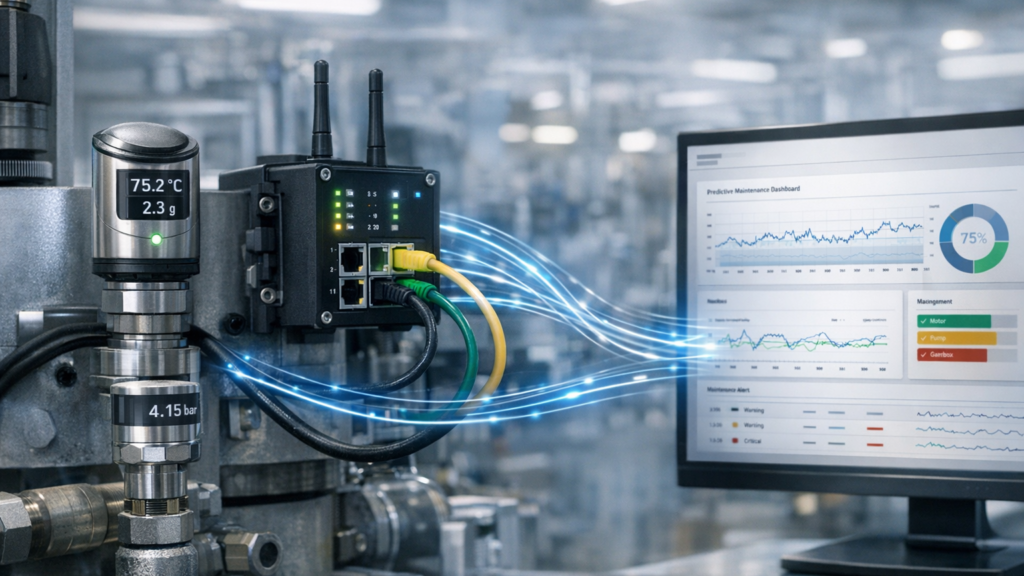
Key components
- Sensors and edge capture: Vibration, temperature, current, acoustic, and environmental sensors; edge preprocessing to reduce noise and bandwidth.
- Connectivity: Secure, reliable transport: wired (Ethernet/fieldbus), wireless (Wi‑Fi, LTE/5G), or hybrid. Use local gateways for protocol translation and buffering.
- Data platform: Time-series storage, metadata catalog, and a common asset model to link sensor streams to equipment hierarchies and BOMs.
- Analytics and models: Baseline models, anomaly detection, and physics-informed ML. Keep model lineage to track versions and performance.
- Operational workflows: Alerting, verification, work order creation, and feedback loops that update models with labeled outcomes.
- Governance and integration: Access controls, data quality rules, and API connections to ERP, EAM/CMMS, and MES.
Practical implementation steps
- Define outcomes: Prioritize failure modes and KPIs (downtime reduction, cost per work order, MTBF improvement).
- Start small with a pilot: Choose a representative asset class and limited geography. Focus on measurable outcomes and short feedback loops.
- Standardize the asset model: Create consistent identifiers and metadata so sensor data maps to asset records across systems.
- Deploy sensors and edge logic: Validate signal quality, implement local filtering, and ensure secure onboarding of devices.
- Ingest and normalize data: Use a time-series database and tagging to make streams queryable and comparable.
- Build and validate models: Combine statistical baselines with domain rules. Run models in parallel with existing maintenance processes to build trust.
- Integrate with operations: Automate prioritized alerts into CMMS/EAM for work planning, and ensure technicians can capture verification data back into the thread.
- Scale and govern: Automate device provisioning, CI/CD for models, and a governance process for data retention, quality, and access.
Sector-specific considerations
Manufacturing / Producing industry: Focus on line-level aggregation: correlate multiple machines to identify upstream causes and reduce bottlenecks.
Automotive: Prioritize drivetrain, battery, and ADAS sensors. For OEMs, combine field telemetry with service data to close the loop on warranty and design improvements.
Enterprise / Large industry: Standardize across sites with a global asset registry and local edge compute for latency-sensitive scenarios.
Data governance, security, and integration
- Implement role-based access and encryption in transit and at rest.
- Define data retention and anonymization rules to meet compliance and IP protection needs.
- Use middleware or API gateways to integrate analytics outputs with ERP, EAM, and planning systems—avoid point-to-point hardwiring.
Measuring ROI and scaling
Track short-term and strategic metrics: immediate reduction in unplanned downtime, changes to spare-parts inventory, labor hours for inspections, and long-term effects on asset replacement cycles and CAPEX planning. Use pilot results to build a business case for broader rollout, prioritizing assets with the highest combined failure cost and predictability.
Common pitfalls
- Overambitious scope: avoid trying to instrument every asset at once.
- Poor data quality: garbage in yields unreliable predictions—invest early in signal validation.
- Lack of operational buy-in: co-design alerts and workflows with maintenance teams.
- Model opacity: keep model explainability and versioning so technicians and managers trust recommendations.
Checklist: Launching your predictive maintenance digital thread
- Define target KPIs and pilot assets
- Establish an asset model and metadata standards
- Deploy sensors with edge preprocessing
- Provision secure connectivity and storage
- Develop models with clear validation metrics
- Integrate alerts with CMMS/EAM and technician workflows
- Set governance for data, security, and model lifecycle
When done right, a predictive maintenance digital thread reduces surprises, lowers maintenance costs, and informs long-term asset strategy. It turns episodic fixes into predictable, strategic decisions.
FAQ
What is the main difference between condition-based and predictive maintenance?
Condition-based maintenance reacts to current measured conditions (e.g., temperature thresholds). Predictive maintenance forecasts future failures using trends and models, enabling planned interventions before failures occur.
How quickly can a midmarket manufacturer expect results from a pilot?
A focused pilot with clear KPIs can produce measurable results in 3–6 months. Speed depends on signal quality, integration complexity, and stakeholder alignment.
Do I need cloud platforms or can everything run on-premises?
Both are possible. Edge and on-premises solutions reduce latency and data egress, while cloud platforms simplify scalable analytics and cross-site aggregation. Choose based on connectivity, compliance, and scale needs.
Ready to turn sensor data into strategic asset decisions? Contact our team to design a predictive maintenance pilot tailored to your operations.