

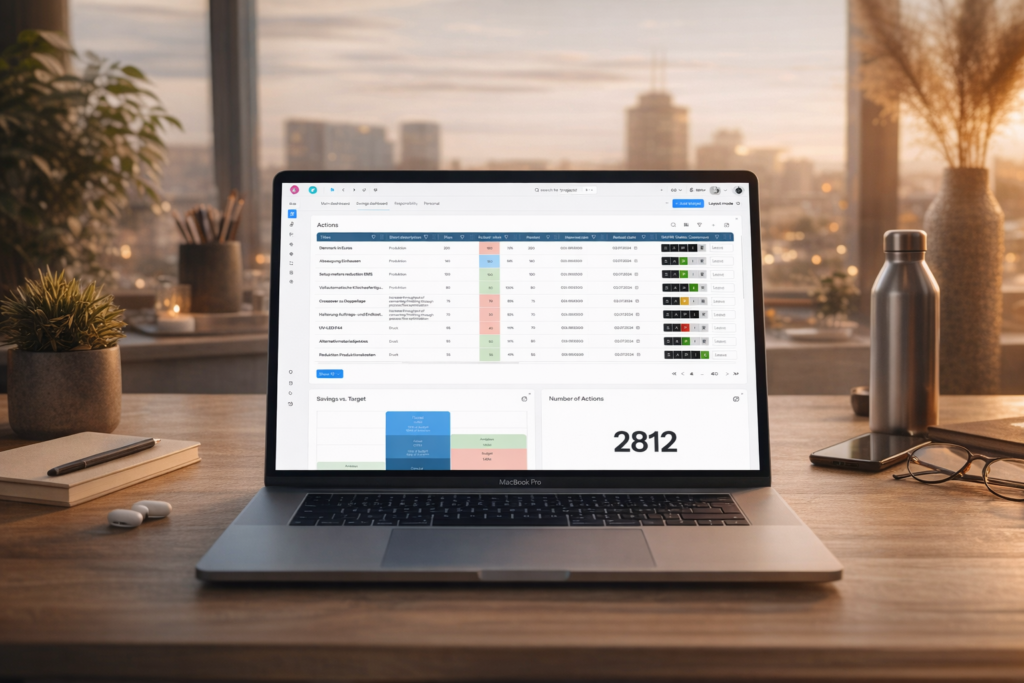


Skills‑aware production scheduling aligns available workforce capabilities with production needs. Instead of scheduling only machines and orders, it explicitly accounts for who can perform each operation and how quickly they can ramp up through targeted training. The result is better order fulfillment, fewer bottlenecks and greater operational agility across small and large manufacturing organizations.
What is skills‑aware production scheduling?
At its core, skills‑aware scheduling combines three elements:
- Skill maps: a structured inventory of worker qualifications, certifications and proficiency levels for specific tasks.
- Real‑time resource availability: shift patterns, absences and current assignments.
- Upskilling signals: indicators that suggest when and where short training or guidance would enable a worker to take on additional tasks.
When these elements feed into the scheduler, it can allocate work based on both machine availability and the right human capabilities, and it can flag opportunities to reskill resources to meet demand.
Why skill maps matter: visibility and matching
Skill maps make competencies explicit and comparable. They reduce dependency on tribal knowledge and allow automated systems to:

- Match operators to tasks by proficiency level.
- Identify multi‑skilled workers who can reduce changeover time or cover shortages.
- Prioritize assignments that make best use of scarce, high‑value skills.
For manufacturers, this visibility improves predictability and reduces the need for last‑minute manual interventions.
Upskilling signals: what they are and how to use them
Upskilling signals are triggers that indicate a worker could be trained quickly to perform an additional operation. Examples include:
- Consistently high performance on related tasks.
- Short completion times for adjacent operations.
- Digital trace evidence (e.g., logged steps completed correctly in guided workflows).
Schedulers that incorporate these signals can propose targeted micro‑training, visual work instructions or on‑the‑job guidance before reallocating tasks, enabling smoother transitions and higher first‑time quality.
Benefits by size and sector
Skills‑aware scheduling delivers measurable benefits, adapted to context:
- SMEs: Reduce reliance on a few specialists, raise floor productivity and avoid costly overtime by using multi‑skilled staff more effectively.
- Industrial & Manufacturing: Increase throughput and reduce lead times by minimizing skill‑related bottlenecks across lines and shifts.
- Enterprise: Standardize competence data across sites, improve workforce flexibility and support large‑scale capacity planning.
- Automotive: Manage complex assemblies and highly specialized operations by aligning certification levels with regulatory and quality requirements.
Implementing skills‑aware scheduling: practical steps
Adopt a phased approach:
- Build a skill map: collect job profiles, certification records and task proficiency levels. Start with high‑impact operations.
- Integrate data sources: link HR records, learning management systems and shop‑floor execution data.
- Define upskilling signals: choose simple, verifiable triggers you can measure from existing systems.
- Extend the scheduler: feed skill and upskilling data into planning tools so assignments respect both machine and human constraints.
- Run controlled pilots: test on a cell, line or product family, measure results and iterate.
Small, repeatable pilots reduce disruption and build stakeholder buy‑in faster than broad overnight rollouts.
Common challenges and how to mitigate them
- Data quality: Incomplete or inconsistent skill records reduce effectiveness. Mitigation: use short, standardized assessments and validated self‑reporting.
- Change resistance: Operators or planners may distrust automated assignment. Mitigation: involve shop‑floor staff in defining skill levels and show early wins.
- IT integration: Legacy systems can block seamless data flow. Mitigation: export minimal, high‑value datasets and use middleware or phased integrations.
Measuring impact and continuous improvement
Track a small set of KPIs to prove value and guide refinement:
- Order lead time and on‑time delivery rate.
- Operator utilization and multi‑skilling rate.
- First‑time quality and rework incidence on reassigned tasks.
- Time to competence after micro‑training interventions.
Use these metrics to expand the scope of skills included in the scheduler and to refine upskilling triggers over time.
For a practical reference on implementing skill maps and upskilling signals in production scheduling, see this detailed resource: Skills‑Aware Production Scheduling — Skill Maps & Upskilling Signals.
Weiterfuehrende Inhalte
FAQ
What is the difference between a skill map and a competency matrix?
A skill map is a structured inventory focused on the specific tasks and proficiency levels relevant to production scheduling. A competency matrix can be broader, covering behavioral or managerial competencies. For scheduling, the essential element is task‑level proficiency and certification status.
How quickly can an SME expect benefits from skills‑aware scheduling?
With a focused pilot on a single line or product family, SMEs can see improvements in assignment flexibility and reduced bottlenecks within weeks. Full implementation timing depends on data availability and integration scope.
Are upskilling signals automated or manual?
They can be both. Start with simple automated signals derived from production and learning data, and complement them with manager observations. Over time, automate more signals as data quality improves.
Does this approach require replacing existing ERP or MES systems?
No. Skills‑aware scheduling can be implemented by extending current planning tools or integrating a dedicated scheduling module that consumes skill and training data. Phased integration is a common approach to minimize disruption.
Ready to make your production scheduling skills‑aware? Learn practical steps and download implementation guidance: Explore the guide.