

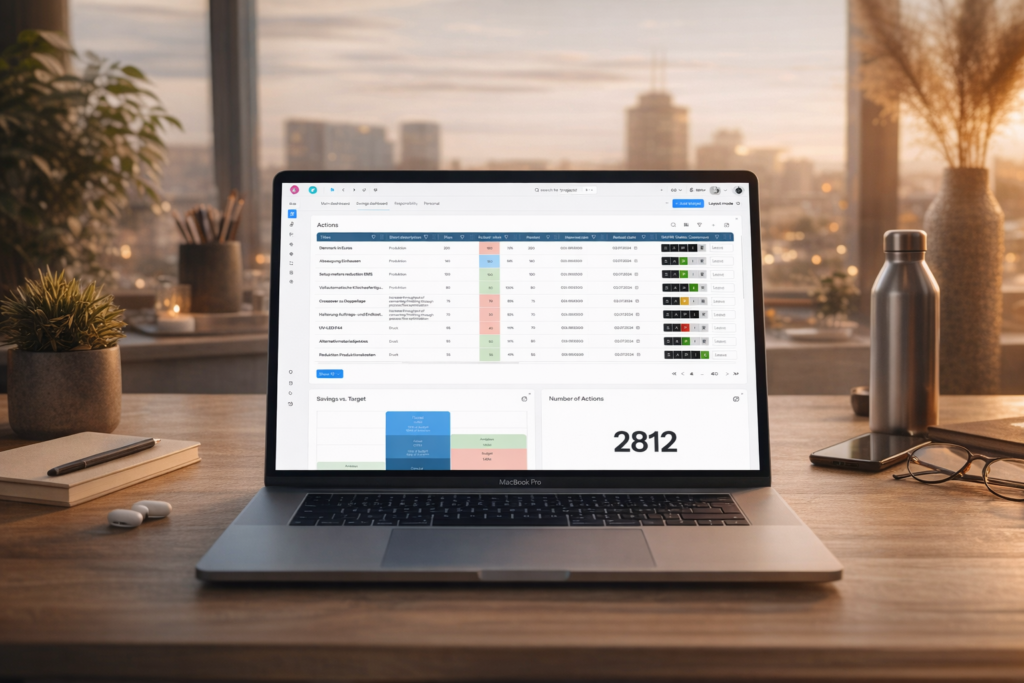


Manufacturers and industrial operators face pressure to improve both sustainability and operational performance. Traditionally, Environmental, Social and Governance (ESG) metrics sit in reporting and compliance, while Overall Equipment Effectiveness (OEE) lives in production and maintenance. Sustainability KPI fusion means deliberately aligning ESG and OEE so decisions improve both resource efficiency and sustainability outcomes — not one at the expense of the other.
Why fuse ESG and OEE?
Separating sustainability from operations creates sub-optimisations: energy-efficient product runs that increase scrap, or OEE gains achieved through practices that raise emissions or waste. Fusing the two delivers:
- Clearer decision-making across functions (operations, sustainability, finance)
- Improved traceability from line-level actions to ESG outcomes
- Stronger business cases for sustainability investments using productivity gains
Core metrics to align
Start by selecting a concise set of crosswalked KPIs from each domain. Examples:
- OEE components: availability, performance, quality
- Energy intensity: kWh per unit produced
- Material yield and scrap rate (links directly to OEE quality)
- Carbon intensity: CO2e per product or per ton-hour
- Water use per unit and hazardous waste generated
- Safety and labor indicators that affect uptime and quality
Combine these into composite indicators where useful — for example, an “Environmental Efficiency Index” that weights energy and carbon per effective production hour (OEE-adjusted).

Mapping methodology: convert and correlate KPIs
Use these steps to map ESG to OEE:
- Process mapping: identify where energy, materials and emissions occur in the value stream.
- Metric pairing: link each OEE sub-metric to one or more ESG measures (e.g., quality losses → scrap → material and carbon impact).
- Normalization: express indicators on a common denominator (per unit, per effective hour, per batch).
- Weighting and aggregation: agree how to weight environmental versus operational outcomes for composite KPIs.
Data and systems: where to integrate
Integration requires three elements:
- Reliable source data: PLC/SCADA for OEE inputs, utility meters and material tracking for ESG inputs.
- Data layer: a manufacturing data platform or IIoT middleware that can join time-series and event data.
- Analytics and reporting: dashboards that present combined KPIs at shop-floor, plant and enterprise levels.
Services that bridge IT and OT are often needed to normalize timestamps, reconcile production counts and apply conversion factors (e.g., energy-to-carbon).
Operational steps for pilots and roll-out
- Define scope: choose a pilot line or plant with measurable energy and quality issues.
- Select target KPIs: keep the initial set small (3–6 combined metrics).
- Instrument and validate: ensure meters and OEE inputs are calibrated and accurate.
- Run baseline for a fixed period, then test interventions that aim to improve both OEE and sustainability.
- Measure, iterate, scale: document results, refine weighting and expand successful patterns to other lines.
Change management and governance
Success depends on cross-functional governance. Recommended practices:
- Create a KPI steering group with operations, sustainability, maintenance and finance representation.
- Embed shared incentives: link parts of performance pay or capital allocation to fused KPIs.
- Standardize measurement and audit trails to avoid greenwashing and ensure regulatory alignment.
Sector-focused scenarios
Practical examples by sector:
- Mid-market manufacturers: use fused KPIs to prioritize retrofit projects with short payback and measurable carbon reduction per effective hour.
- Industrial/producing enterprises: scale pilots across plants using a central analytics platform and consistent conversion factors.
- Automotive suppliers: align paintshop and stamping OEE with solvent and energy intensity to reduce both costs and Scope 1 emissions.
- Large enterprise: roll up plant-level fused KPIs into a corporate dashboard for capital planning and ESG reporting.
Risks, pitfalls and measurement integrity
Watch for these common issues:
- Poor data quality: bad inputs produce misleading composite KPIs.
- Perverse incentives: over-optimising a composite KPI may hide deterioration in an unweighted area.
- Lack of traceability: without event-level links you cannot explain why a fused KPI moved.
Mitigate by keeping transparency in weighting, preserving drill-down ability and routinely auditing data sources.
Next steps
Start small, measure rigorously, and align incentives. A practical path: run a 3-month pilot on a single line, validate fused KPIs, then scale to complementary lines while documenting energy, material and OEE gains.
Services to support this work typically include data integration (IT/OT), analytics setup, KPI design workshops and change management coaching. Engage multidisciplinary teams early to ensure the pilot translates into scalable operational practice.
FAQ
What is the main benefit of combining ESG and OEE?
Combining ESG and OEE aligns operational decisions with sustainability outcomes, revealing opportunities to reduce energy, materials and emissions while improving productivity and quality.
Which KPIs should I start with for a pilot?
Begin with a small set: OEE (and its three components), energy intensity (kWh per unit or per effective hour), and material yield/scrap rate. Add carbon intensity once energy baselines are established.
How do I avoid creating misleading composite KPIs?
Keep weighting transparent, preserve drilldowns to underlying metrics, audit data sources, and ensure KPIs are validated against physical measurements and financial impacts.
What systems are required to fuse these KPIs?
You need reliable OT and utility data, a data layer or IIoT platform to join time-series and event data, and analytics/dashboarding to present fused metrics across shop-floor and plant levels.
Ready to pilot fused ESG–OEE KPIs in your operations? Contact your cross-functional team to set scope, select metrics and plan a 3-month pilot. Consider engaging data integration and analytics services to accelerate implementation.