


Introduction: Why fuse ESG and OEE?
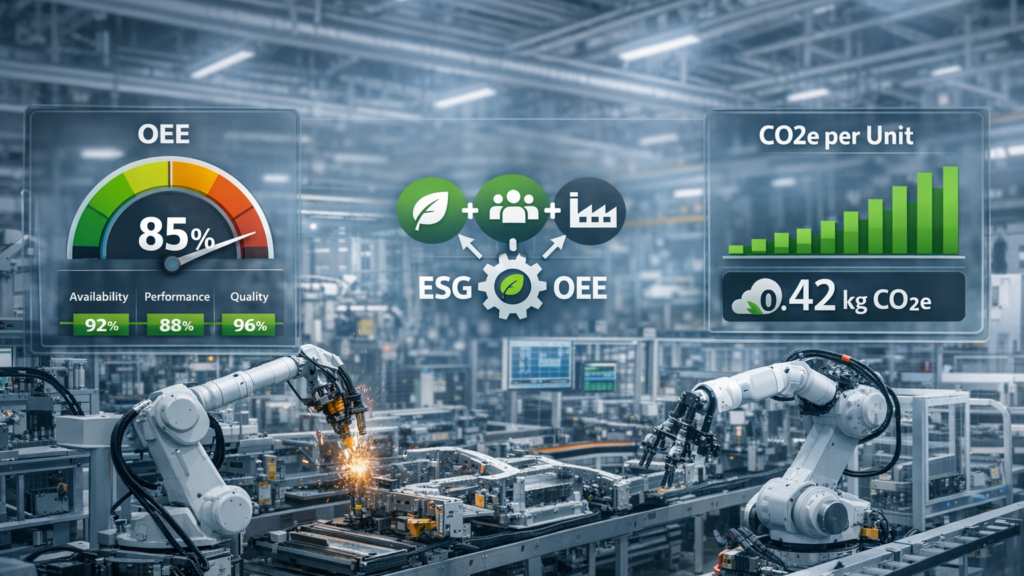
Industrial companies face two parallel pressures: improve operational productivity and meet rising sustainability expectations. Environmental, Social, Governance (ESG) metrics capture long-term resilience and regulatory compliance; Overall Equipment Effectiveness (OEE) measures day-to-day production efficiency. Treating them separately risks sub-optimizing outcomes. KPI fusion aligns sustainability and productivity so decision-makers see trade-offs and synergies in one view.
Core concepts: What ESG and OEE measure
- ESG: emissions (Scope 1–3), energy intensity, waste, water use, worker safety, supply chain risks, governance indicators.
- OEE: availability, performance (speed), and quality — combined into a single percentage that shows asset productivity.
Business case: Benefits of combining sustainability and operational KPIs
- Reveal interventions that improve both sustainability and throughput (e.g., process optimization that reduces scrap and energy per part).
- Make trade-offs explicit (e.g., higher throughput vs. energy spikes) to inform CAPEX and scheduling decisions.
- Support reporting and compliance with operational proof points tied to ESG claims.
- Enable cross-functional alignment across operations, procurement, and sustainability teams.
Data foundations: Sources, normalization, and master metrics
Start by identifying authoritative data sources: PLC/SCADA for machine-level OEE, MES for production context, energy meters and utility invoices for consumption, and ERP/purchasing for material flows and Scope 3 estimates. Key steps:
- Timestamp alignment: ensure consistent time bases between production cycles and energy readings.
- Unit harmonization: convert energy, emissions, and throughput to common denominators (e.g., kWh/part, CO2e/ton).
- Data quality checks: missing values, sensor drift, and rounding must be flagged and corrected.
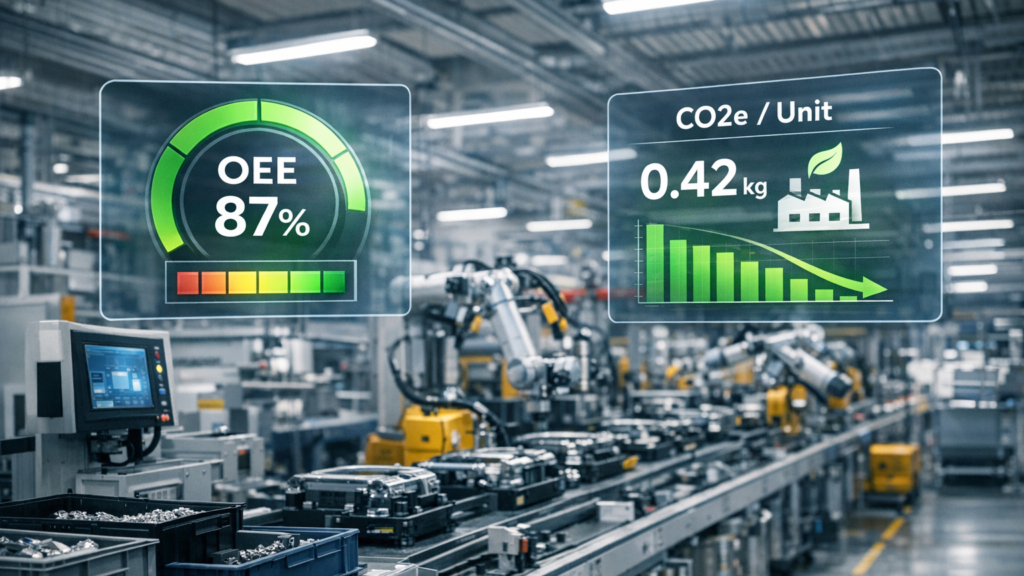
- Define master metrics: e.g., energy intensity per good unit, CO2e per good unit, and OEE per shift or line.
Practical KPI fusion framework: Four layers
Implement fusion across these layers to keep work practical and scalable:
- Measurement — instrument key assets and collect high-frequency OEE and energy/consumption data.
- Enrichment — join production context: product mix, cycle times, downtime reasons, and material yields.
- Normalization — compute intensity metrics (e.g., kWh/part, CO2e/part) and normalize OEE across products or lines.
- Decisioning — create composite views and dashboards where users can see sustainability per produced unit, cost of emissions per uptime hour, or sustainability-adjusted OEE.
Implementation steps for mid-market and enterprise
- Assess readiness: map data sources, ownership, and IT constraints. Small factories may need edge collectors; enterprises require integration planning.
- Define core fused KPIs: agree on a minimal set (e.g., OEE, energy/part, CO2e/part, scrap rate) and how they’re calculated.
- Build MVP dashboards: start with one line or plant; focus on clarity and actionability rather than exhaustive metrics.
- Iterate with stakeholders: incorporate feedback from operations, sustainability, finance, and procurement.
- Scale: standardize measurement templates and roll out to additional sites with training and governance.
Use cases: Automotive, manufacturing, and producing industries
- Automotive: correlate paint shop energy profiles with quality rejects to schedule lower-emission shifts without raising defect rates.
- Discrete manufacturing: reduce changeover times to lower energy per unit and improve OEE simultaneously.
- Process/continuous production: tune run speeds to balance throughput and thermal efficiency, measured as CO2e/ton and OEE-adjusted throughput.
Common pitfalls and how to avoid them
- Relying on coarse data: avoid monthly utility bills as the only energy source; use submetering for meaningful per-shift metrics.
- Mixing incompatible units: always normalize to per-unit or per-time metrics before combining.
- Ignoring governance: set clear owners for fused KPIs and a cadence for review to prevent metric drift.
- Overcomplicating dashboards: prioritize actionable signals and root-cause links (e.g., downtime reason → emissions spike).
Measuring success and continuous improvement
Track outcomes that matter: reduced energy intensity, lower CO2e per unit, improved OEE, fewer quality defects, and financial impact (cost per unit). Use A/B style pilots (two lines or shifts) to test changes and quantify dual benefits. Set targets that combine operational and sustainability goals, such as percentage reduction in CO2e per good unit while holding OEE steady or improving it by X%.
Services to support KPI fusion
Typical services that accelerate fusion projects include:
- Data discovery and readiness assessment — inventory sources, sensors, and data quality.
- Edge data collection and ingestion — integrate PLC/MES/energy meters into a central model.
- Metric design and normalization — define master metrics, units, and calculation rules.
- Dashboarding and alerts — create fused KPI views, threshold alerts, and role-based access.
- Pilot implementation and scaling — run pilots, capture ROI, and roll out site-by-site with governance.
Conclusion and next steps
Fusing ESG and OEE converts two important but separate conversations into one operationally useful lens. Start small: align stakeholders, pick a pilot line, instrument data properly, and build normalized, per-unit metrics. Use those insights to prioritize investments that deliver both sustainability and productivity gains. Over time, this integrated approach reduces risk, supports reporting, and uncovers continuous-improvement opportunities that single-focus KPIs miss.
FAQ
What is KPI fusion between ESG and OEE?
KPI fusion means combining sustainability indicators (like energy intensity and CO2e per unit) with operational metrics (OEE) so decision-makers can evaluate productivity and environmental impact together.
Which KPIs should I prioritize first?
Start with a minimal set: OEE, energy per good unit (kWh/part), CO2e per good unit, scrap rate, and downtime reasons. These give immediate insight into both productivity and sustainability.
How do I handle data differences (e.g., frequency, units)?
Align timestamps, harmonize units to per-unit or per-time measures, and apply data-quality checks. Submetering and MES/PLC integration are often required for meaningful, high-frequency fusion.
Can KPI fusion work for small factories and large enterprises?
Yes. Small sites often need edge collectors and simplified dashboards; enterprises require governance, standards, and scalable integration. Start with pilots tailored to site complexity.
What outcomes can companies expect?
Typical outcomes include reduced energy intensity and CO2e per unit, improved OEE, fewer rejects, and clearer ROI for sustainability investments thanks to quantified operational impacts.
Ready to align sustainability and productivity? Contact our team to assess your data readiness, design fused KPIs, and run a pilot tailored to your plant. Tell us about your most important production line and we’ll outline next steps.