

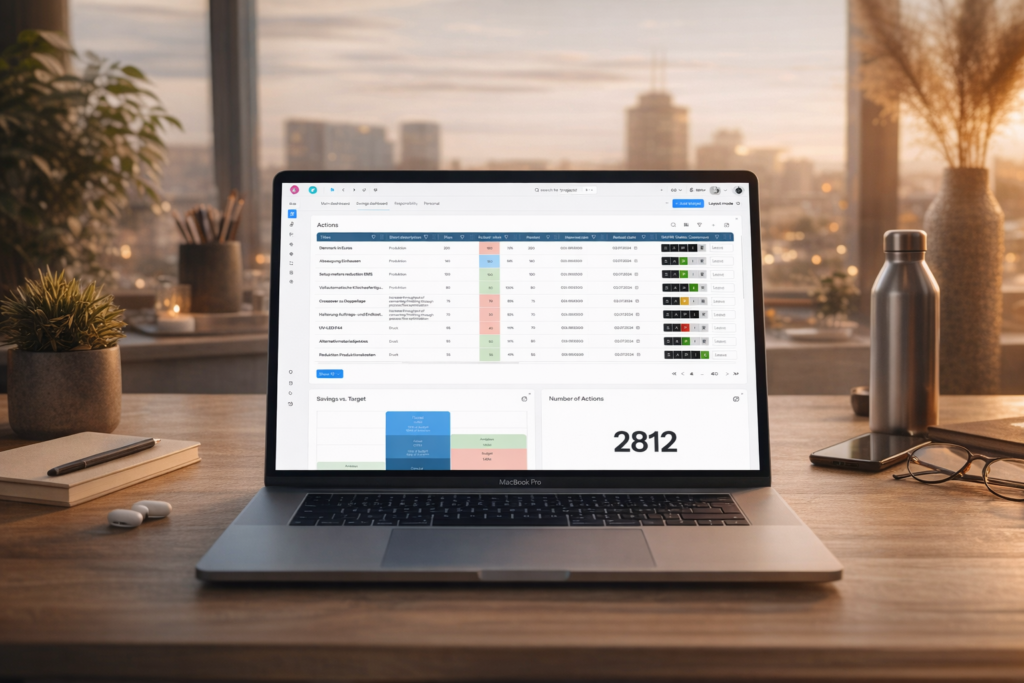


Companies in the mid-market, industrial and automotive sectors are under pressure to deliver both operational excellence and verifiable sustainability. ESG (Environmental, Social, Governance) metrics and OEE (Overall Equipment Effectiveness) have traditionally lived in separate reporting streams. When fused, they create a single view of performance that connects resource productivity, operational losses and sustainability outcomes—enabling better decisions, clearer targets and more credible external reporting.
Why fuse ESG and OEE? The business case for integrated performance
OEE quantifies manufacturing efficiency by combining availability, performance and quality. ESG captures environmental impact, social risks and governance factors. Separately they offer value; together they show whether efficiency gains reduce environmental impact or merely shift emissions or waste elsewhere. Fusion delivers:
- Aligned incentives across operations, sustainability and finance.
- Clearer attribution of emissions and resource use to operational drivers.
- Faster identification of improvement opportunities with dual benefits (cost and CO2/waste reduction).
- Stronger internal and external narratives for compliance, customers and investors.
Core KPIs to track: ESG metrics + OEE components
Start with a short list of high-impact metrics. Keep them measurable, auditable and tied to operational processes.
- OEE and its components: Availability (%), Performance (%), Quality (%), OEE (%)
- Energy intensity (kWh per unit produced)
- Scope 1 & 2 emissions per unit (kg CO2e/unit)
- Material yield and scrap rate (% of input)
- Water use per unit (m3/unit) where relevant
- Safety incident rate (incidents per 200,000 hours)
- Supplier sustainability score for critical vendors
Combine these into composite indicators where useful—for example, an Operational Sustainability Index that weights OEE, energy intensity and scrap rate.
How to fuse metrics: mapping, weighting, and composite indicators
Fusion requires a mapping from operational drivers to sustainability outcomes:

- Map causal links: e.g., unplanned downtime increases scrap and energy per unit.
- Standardize units: normalize energy, emissions and scrap to a per-unit basis.
- Define weights: assign business-driven weights to reflect strategic priorities (e.g., CO2 reduction vs. cost savings).
- Create composites: aggregate normalized, weighted metrics into a single score for dashboards and targets.
Keep the methodology transparent and documented so results are auditable and defensible.
Data strategy and systems: where the numbers come from
Reliable fusion depends on data quality and integration:
- Connect shop-floor systems (PLC/SCADA, MES) to capture OEE components automatically.
- Integrate energy meters and utility data with production volumes for intensity metrics.
- Use a single data model or a data warehouse to normalize timestamps, units and identifiers.
- Implement data governance: owners, validation rules, and a cadence for reconciliation.
Start small: pick a production line or plant for a pilot, then scale once data flows are proven.
Operational changes and governance: roles, cadence, and audits
Successful KPI fusion relies on organizational alignment:
- Define clear ownership: operations for OEE, sustainability for ESG, finance for validation.
- Form a cross-functional steering team to set weights, targets and escalation rules.
- Adopt a regular cadence: weekly operational reviews, monthly sustainability scorecards, quarterly governance reviews.
- Audit and assurance: embed internal checks and prepare for third-party validation when needed.
Industry examples: mid-market, manufacturing, automotive, enterprise
Examples of fused KPIs in practice:
- Automotive: tie paint-shop OEE to solvent emissions per vehicle; improvements in changeover reduce both downtime and VOC emissions.
- Discrete manufacturing: link quality rejects to raw material waste and lifecycle emissions, prioritizing process fixes with the highest sustainability ROI.
- Industrial plants (mid-market): combine energy intensity and OEE to justify investments in motor drives and process heating upgrades.
Implementation roadmap: quick wins and long-term steps
Practical rollout sequence:
- Pilot: choose one line/plant, define 3–6 core KPIs, and establish data feeds.
- Operationalize: run the pilot for 3 months, refine calculations and dashboards.
- Scale: apply the model to other sites, harmonizing units and governance.
- Optimize: use fused KPIs in continuous improvement cycles and capital planning.
Quick wins often include targeting high-waste processes, improving changeover routines, and reducing idle running time—actions that improve both OEE and environmental metrics fast.
Measuring success and communicating results
Track outcomes on three horizons: short-term operational gains, medium-term sustainability improvements, and long-term strategic benefits (reduced regulatory risk, better market positioning). Communicate using simple, comparable dashboards that show the fused score plus the underlying drivers.
Services to support KPI fusion
Typical services to accelerate fusion projects include:
- Baseline assessment and KPI selection
- Data integration and MES/IT implementation support
- Methodology design for composite indicators and weighting
- Change management, training and governance setup
- Analytics and dashboard development for operations and sustainability teams
Call to action and next steps
If you operate in manufacturing or automotive and want to measure sustainability through the lens of operations, start with a focused pilot: pick a line, define a fused KPI set, and run a three-month validation. Use the results to build a scalable, auditable framework that supports both operational improvements and credible ESG reporting.
FAQ
What is the main benefit of combining ESG and OEE?
Combining ESG and OEE reveals whether operational improvements reduce environmental impact or simply shift it. It aligns incentives across operations, sustainability and finance, enabling decisions that deliver both cost and sustainability gains.
Which KPIs should we start with for a pilot?
Start with OEE and its components (availability, performance, quality), energy intensity per unit, emissions per unit (Scope 1 & 2), and scrap/yield rates. These are measurable, auditable and closely linked to operational drivers.
How do we ensure data quality for fused KPIs?
Integrate automatic shop-floor feeds (MES/SCADA), align timestamps and units in a data warehouse, implement validation rules, and assign data owners responsible for regular reconciliation and audits.
Can small and mid-market manufacturers implement KPI fusion?
Yes. Start with a single production line pilot, use simple normalized metrics, and scale gradually. Many quick wins—like reducing idle time or scrap—deliver measurable benefits fast without large upfront investment.
Contact your internal sustainability or operations lead to define a 3-month pilot: select a line, set 4–6 core KPIs and validate data feeds.