

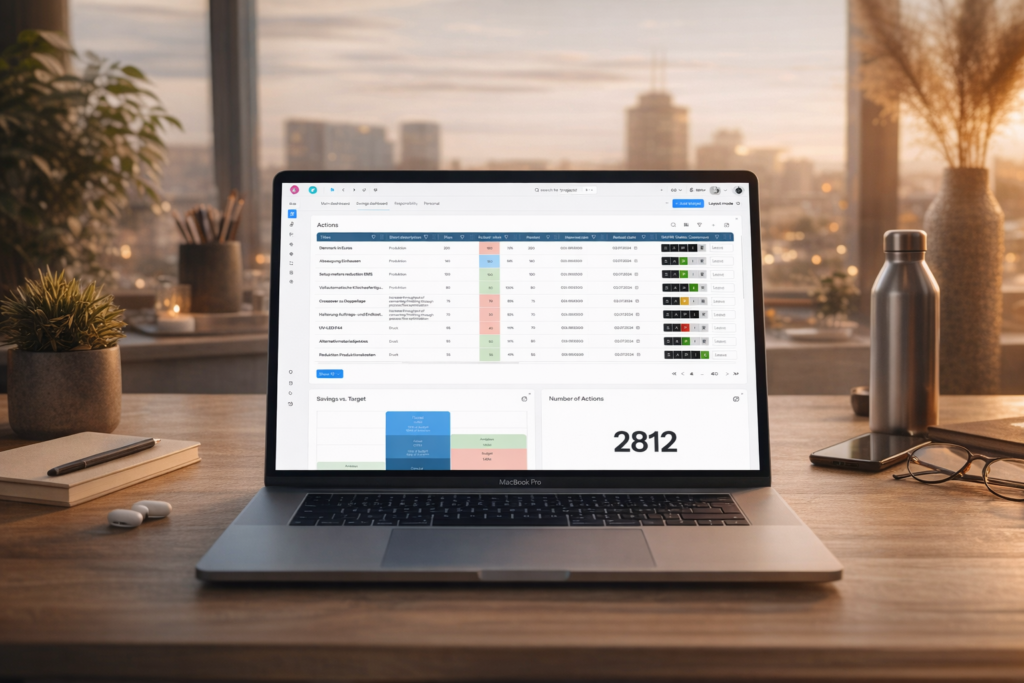


Companies in manufacturing, automotive and the wider industrial sector increasingly face two parallel pressures: meet strict sustainability expectations and sustain—or improve—operational performance. Sustainability KPI Fusion means deliberately connecting environmental, social and governance (ESG) metrics with operational KPIs such as Overall Equipment Effectiveness (OEE). The goal is one unified view that supports decisions which are both green and productive.
Core concepts: ESG and OEE explained
ESG describes non-financial performance across environmental (emissions, energy, water), social (health & safety, labor) and governance (compliance, risk) dimensions. OEE measures production efficiency via availability, performance and quality. Each lens is useful alone; fused, they reveal trade-offs and synergies—e.g., how energy optimization affects throughput or how maintenance strategies affect emissions.
Why fuse ESG and OEE? The business case
- Aligned decision-making: Operators and sustainability teams use the same metrics to evaluate actions.
- Reduced trade-off surprises: Avoid solutions that improve one goal but harm the other (e.g., increasing speed that raises scrap and emissions).
- Regulatory and investor readiness: Provide integrated reports that show production and sustainability performance together.
- Cost and resource efficiency: Identify investments (like predictive maintenance) that improve uptime and reduce energy use.
Which KPIs to align
Start with a compact set spanning both domains. Examples:

- OEE and its components: Availability, Performance, Quality
- Energy intensity: kWh per unit produced
- CO2 intensity: kg CO2e per unit
- Material yield and scrap rate
- Unplanned downtime hours (linked to maintenance emissions)
- Workplace incidents per 100,000 hours (safety)
Data architecture: sources and integration
Key sources: shop-floor PLC/SCADA, MES, energy meters, ERP, EHS systems and external emissions factors. Recommended approach:
- Inventory sources and owners.
- Define canonical KPIs with clear formulas and timestamps.
- Implement time-series storage for high-frequency signals and a relational layer for master data.
- Apply ETL/ELT with validation rules: missing timestamps, unit mismatches, and negative values flagged.
Step-by-step implementation roadmap
- Governance: form a cross-functional steering group (operations, sustainability, IT, finance).
- Pilot: choose one product line or site, define fused KPIs and run 3–6 months.
- Data model: standardize units, frequencies and calculation windows (shift, day, month).
- Integrate: connect MES/SCADA and energy meters into the analytics layer.
- Visualization: build dashboards that show production and sustainability impacts side-by-side.
- Scale: roll out to other lines/sites with a library of KPI definitions and templates.
Analytics and visualization
Design dashboards for three audiences:
- Operators: real-time alerts where a change in process increases emissions or scrap.
- Plant managers: shift/day KPIs showing OEE vs. energy and CO2 intensity.
- Executives: aggregated, normalized KPIs, trendlines and scenario analyses for investments.
Use composite indicators (e.g., normalized sustainability score per OEE point) only when formulas and weights are transparent.
Governance, targets and incentives
Align targets so teams aren’t penalized for improving sustainability at the cost of production (or vice versa). Examples:
- Set dual targets: minimum OEE with improving energy intensity milestones.
- Incentivize cross-functional KPIs: bonuses tied to both throughput and emissions reduction.
- Include data stewardship in role descriptions to maintain KPI integrity.
Use cases
- Mid-market manufacturer: Pilot reduced idle time that cut energy per unit while improving availability.
- Automotive supplier: Integrated dashboards helped prioritize tooling maintenance that reduced scrap and CO2 from rework.
- Enterprise plant network: Normalized CO2 intensity across sites to prioritize capex for energy-efficient equipment.
Common pitfalls and how to avoid them
- Too many KPIs: keep the initial set small and outcome-focused.
- Data silos: assign owners and automate data flows to avoid manual reconciliation.
- Opaque composite scores: document weights and allow users to view component KPIs.
- Ignoring frequency mismatch: align calculations across comparable time windows (shift/day/month).
Next steps and services to consider
Start with a scoping workshop to identify high-impact KPIs and a 90-day pilot. Typical services to engage include data integration for shop-floor sources, KPI modeling and dashboard build-out, plus governance and change management services to embed new workflows.
Connecting ESG and OEE is not a theoretical exercise: it creates operational clarity that supports sustainable growth. Begin small, prove value, then scale.
FAQ
What is the first KPI I should fuse for a pilot?
Start with OEE plus energy intensity (kWh per unit). This pair highlights both production efficiency and the primary environmental input, giving immediate, actionable insight.
How long should a pilot run before scaling?
Run a pilot for 3–6 months to collect enough operational cycles, validate data quality and observe seasonal variation if relevant.
Do I need new sensors to integrate ESG and OEE?
Not always. Many sites already have energy meters and MES data. Prioritize integrating existing sources; add sensors where gaps prevent reliable calculation of core KPIs.
Ready to start a KPI fusion pilot? Book a scoping workshop to define your high-impact metrics, data sources and a 90-day pilot plan. Contact our team to begin.