

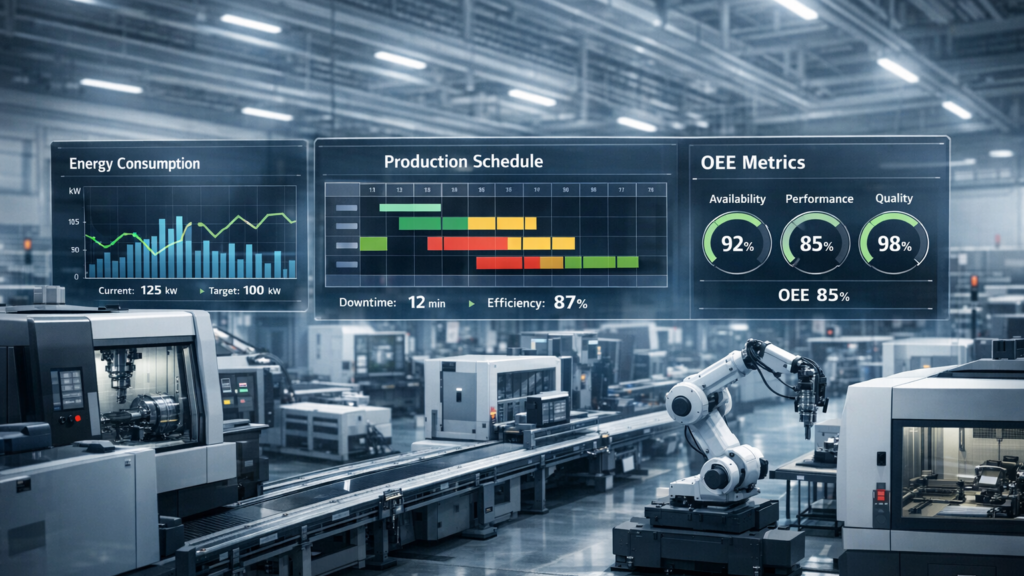

Energy-aware production planning aligns manufacturing schedules, equipment usage and digital controls to reduce electricity consumption and lower operating costs without sacrificing throughput or quality. For mid-market manufacturers, industrial sites, automotive suppliers and large enterprises, targeted planning reduces peak demand charges, avoids costly load spikes and improves overall equipment effectiveness (OEE).
Why energy-aware production planning matters
Electricity can be a significant portion of variable production costs. Energy-aware planning helps companies:
- Reduce consumption during peak-tariff periods and lower demand charges
- Shift flexible processes to off-peak hours
- Increase equipment utilization with lower energy intensity per unit
- Support sustainability goals and regulatory requirements
Key objectives and KPIs for energy-aware planning
Define measurable goals before implementing changes. Common KPIs include:
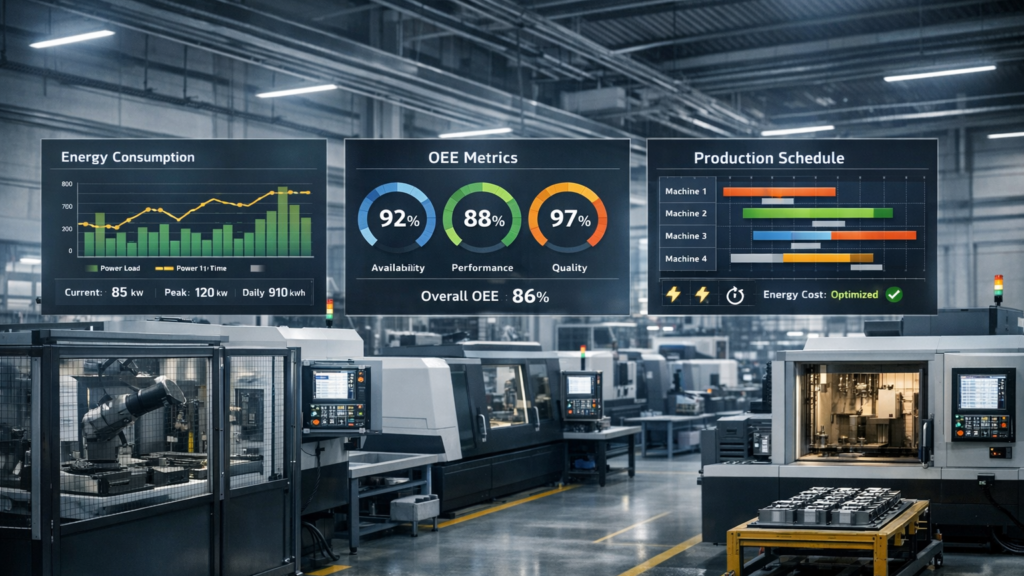
- kWh per finished unit (energy intensity)
- Peak demand (kW) and demand charge reductions
- Cost per unit produced (including energy)
- Energy cost as % of variable costs
- OEE adjusted for energy consumption
Operational methods to reduce electricity use
These methods are actionable and can be combined:
- Load shifting: Move energy-intensive tasks (heat treatment, compression, baking, plating) to off-peak hours or weekends where feasible.
- Batch sequencing: Sequence similar processes or materials to minimize start-up/shutdown losses and reduce transient energy spikes.
- Demand management: Temporarily reduce noncritical loads during grid peaks (lighting dimming, nonessential HVAC, auxiliary systems).
- Peak shaving and energy storage: Use onsite storage or buffered systems to limit grid peak draws where capex allows.
- Process optimization: Tune process parameters (temperature profiles, cycle times, motor speeds) to reduce energy per cycle while maintaining quality.
- Preventive and predictive maintenance: Minimize energy-wasting faults (unbalanced motors, worn bearings) that increase consumption.
Digital tools and integrations (MES, ERP, EMS, OEE)
Software and data integrations turn the above methods into repeatable workflows:
- Energy Management Systems (EMS): Monitor real-time consumption, tariffs and site-level KPIs. EMS platforms enable alerts for demand thresholds and visualize consumption by line or cell.
- Manufacturing Execution Systems (MES): Use MES to enforce energy-aware schedules, implement batch sequencing rules and capture production context for energy consumption analysis.
- OEE and production optimization: Combine OEE with energy metrics to prioritize improvements that deliver the best energy-to-output gains. Solutions that link OEE and energy enable decision-making that considers both uptime and power use. See an example of energy-aware OEE optimization at /energy-aware-oee-optimization-2/.
- ERP integration: Feed long-term production plans and demand forecasts into EMS/MES so energy optimization is part of capacity planning and procurement decisions.
- Advanced analytics and AI: Use forecasting to anticipate demand charges, predict energy consumption per order, and schedule production to minimize costs while meeting delivery windows.
Practical implementation steps for manufacturers
- Assess and baseline: Measure current energy use by line, shift and process for several months. Identify major energy consumers and load profiles.
- Set targets and KPIs: Define realistic savings goals (kWh/unit, peak kW reduction) and link them to financial targets.
- Pilot interventions: Start with a single line or shift. Test load shifting, sequencing and control changes with clear measurement plans.
- Integrate tools: Connect meters and EMS to MES and ERP for automated scheduling and reporting. Ensure data flows are verified and reliable.
- Scale and standardize: Roll out successful pilots, codify scheduling rules, and train planners and operators on energy-aware practices.
- Monitor and iterate: Continuously track KPIs, refine models, and incorporate maintenance and process improvements to sustain savings.
Sector considerations
Different sectors have varying flexibility and constraints:
- Mid-market manufacturers: Focus on low-cost, high-impact actions (sequencing, scheduling, basic EMS) before major capital investments.
- Industrial and process plants: Look for continuous-process optimizations and opportunities to shift ancillary loads; coordinate with process engineers to avoid quality issues.
- Automotive suppliers: Emphasize takt-time aware scheduling and buffer management so energy shifts don’t create supply risks to assembly lines.
- Large enterprises: Centralize energy policies across sites, leverage analytics at scale and use demand aggregation to negotiate better tariffs.
Measurement, verification and continuous improvement
Verification ensures claimed savings are real:
- Use calibrated meters and submetering for lines and major equipment.
- Apply normalization for production volume, ambient conditions and product mix when reporting kWh/unit.
- Run A/B tests or before/after comparisons with statistical controls to isolate impacts of schedule or control changes.
- Include energy KPIs in regular performance reviews and operator scorecards.
Common challenges and how to overcome them
- Operational resistance: Engage planners and operators early; demonstrate that changes preserve quality and delivery performance.
- Data gaps: Start with targeted submetering where uncertainty is highest; expand instrumentation iteratively.
- Conflicting KPIs: Align incentives so production, quality and energy goals are part of the same performance framework.
- Investment constraints: Prioritize low-cost process and scheduling changes before capex-heavy solutions like storage.
Recommended next steps
Begin with a short assessment: baseline energy by line, identify 2–4 quick wins for scheduling or sequencing, and pilot them on one shift. For a data-driven approach that connects OEE and energy metrics, consider exploring energy-aware OEE optimization solutions and integrations to gain clear visibility and automated decision support. A concrete starting resource is available here: Energy-aware OEE optimization.
Weiterfuehrende Inhalte
FAQ
What is energy-aware production planning?
Energy-aware production planning incorporates electricity consumption and tariff signals into production scheduling and process decisions to reduce energy costs while maintaining output and quality.
Which tools are most useful for implementing energy-aware planning?
Key tools are Energy Management Systems (EMS) for monitoring, MES for execution and scheduling, OEE platforms that include energy metrics, and analytics that forecast demand and consumption.
How do I measure success?
Measure kWh per unit, peak demand reductions, energy cost per unit and the impact on overall production cost. Normalize results for production volume and operating conditions.
Ready to reduce electricity costs with energy-aware production planning? Learn how energy-aware OEE optimization ties energy metrics to production performance: Explore the solution.